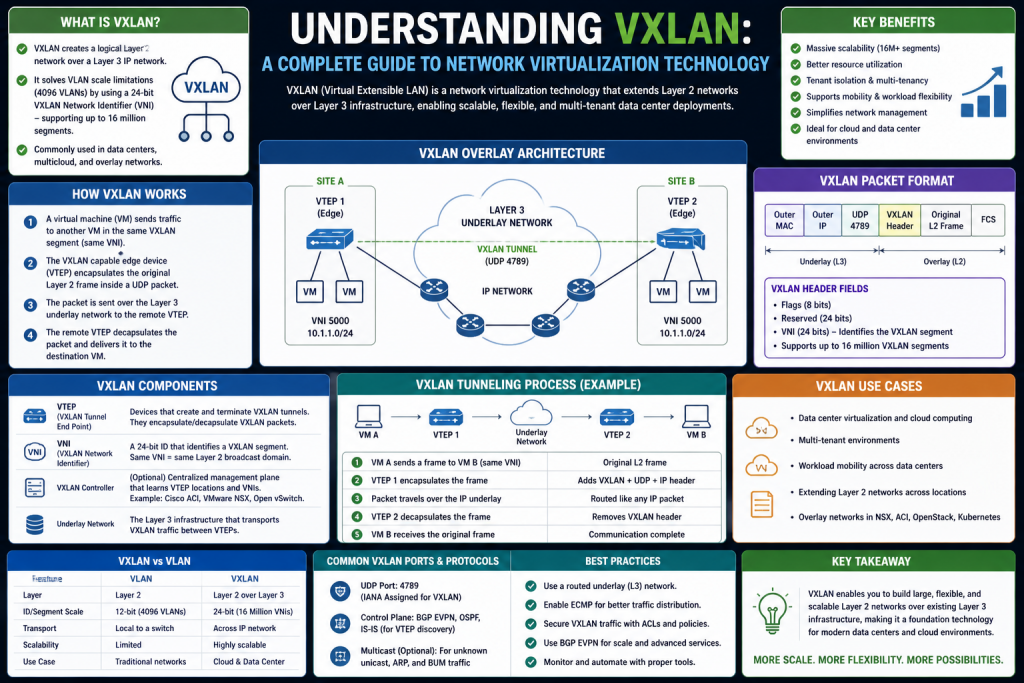
VXLAN, short for Virtual eXtensible Local-Area Network, is a modern network virtualization technology designed to overcome the limitations of traditional Layer 2 networking. It is widely used in data centers, cloud computing environments, and enterprise networks where scalability, flexibility, and multi-tenancy are essential requirements.
In simple terms, VXLAN allows multiple virtual networks to exist on top of the same physical infrastructure without interfering with each other. It creates a virtual overlay network that behaves like a traditional local network but is capable of operating across large, distributed environments.
As organizations continue to adopt virtualization and cloud-based systems, VXLAN has become an important part of modern networking architecture. It enables efficient resource utilization, seamless workload mobility, and large-scale network segmentation.
Why VXLAN Was Introduced
Before understanding VXLAN deeply, it is important to understand why it was created in the first place. Traditional networking relies heavily on VLANs (Virtual Local Area Networks) to segment traffic. VLANs allow administrators to divide a physical network into multiple logical networks. However, VLAN technology has a major limitation: it only supports a small number of network segments.
This limitation becomes a serious problem in modern data centers and cloud environments where thousands of applications, virtual machines, and tenants must be isolated from each other. The limited number of VLAN IDs is not enough to support large-scale environments.
Additionally, traditional Layer 2 networks are restricted in terms of scalability and flexibility. They rely on protocols like Spanning Tree, which can block network paths and reduce efficiency. They also make it difficult to move workloads freely across different physical locations without reconfiguring the network.
VXLAN was introduced to solve these challenges. It provides a scalable way to create virtual networks that are not restricted by physical topology or VLAN limitations. It allows organizations to build large-scale cloud networks while maintaining isolation, performance, and flexibility.
Basic Concept of VXLAN
At its core, VXLAN is a tunneling protocol. It works by encapsulating Layer 2 Ethernet frames inside Layer 4 UDP packets. These packets are then transported across a Layer 3 IP network.
This encapsulation allows Ethernet traffic to travel across networks that would normally not support Layer 2 communication. Once the packet reaches its destination, it is decapsulated and delivered to the correct virtual machine or endpoint.
The key idea behind VXLAN is abstraction. Instead of relying on physical network boundaries, VXLAN creates a virtual network layer that operates independently of the underlying infrastructure. This allows network administrators to design flexible and scalable architectures without being limited by physical constraints.
How VXLAN Works
The working mechanism of VXLAN can be understood in a step-by-step process. When a device sends data within a VXLAN network, the following actions take place:
First, the original Ethernet frame is generated by the source device. This frame contains the data that needs to be transmitted along with source and destination MAC addresses.
Next, this Ethernet frame is identified by a VXLAN Tunnel Endpoint. The VXLAN Tunnel Endpoint is responsible for handling VXLAN traffic and acts as a bridge between the virtual network and the physical network.
Once the frame is identified, it is encapsulated inside a UDP packet. During this process, additional VXLAN headers are added to the packet. One of the most important fields in this header is the VXLAN Network Identifier, which determines the virtual network to which the packet belongs.
After encapsulation, the packet is sent over the underlying IP network. At this stage, it behaves like any other IP packet and can be routed across routers and switches.
When the packet reaches the destination VXLAN Tunnel Endpoint, the encapsulation is removed. The original Ethernet frame is extracted and delivered to the target device within the correct virtual network.
This entire process happens transparently, meaning the end devices are unaware of the encapsulation and decapsulation process.
VXLAN Network Identifier (VNI)
One of the most important components of VXLAN is the VXLAN Network Identifier, commonly known as VNI. The VNI is a unique 24-bit value assigned to each virtual network segment.
This identifier allows VXLAN to support a very large number of isolated networks. While VLANs are limited to a few thousand segments, VXLAN can support millions of unique virtual networks.
Each VNI ensures that traffic remains isolated within its assigned virtual network. This means that devices belonging to one VXLAN segment cannot directly communicate with devices in another segment unless explicitly allowed through routing or gateway configurations.
The large address space provided by VNI is one of the key reasons VXLAN is widely used in cloud environments and large-scale data centers.
VXLAN Overlay Networks
VXLAN operates using the concept of overlay networks. An overlay network is a virtual network built on top of an existing physical network.
In this model, the physical network is responsible for transporting packets, while the overlay network defines how virtual machines and devices communicate with each other.
VXLAN creates tunnels between different endpoints in the network. These tunnels carry encapsulated traffic across the underlying infrastructure. As a result, the physical network only sees standard IP traffic, while the virtual network maintains its own structure and segmentation.
This separation between physical and virtual layers is one of the key strengths of VXLAN. It allows organizations to scale their networks without making major changes to physical infrastructure.
VXLAN Tunnel Endpoints
VXLAN Tunnel Endpoints, commonly referred to as VTEPs, play a critical role in VXLAN communication. These endpoints are responsible for encapsulating and decapsulating VXLAN traffic.
A VTEP can exist in different forms. It can be a physical switch, a virtual switch inside a hypervisor, or a software-based network component running on a server.
When a device sends data within a VXLAN network, the VTEP identifies the VXLAN segment and encapsulates the data into a UDP packet. When the packet reaches its destination, another VTEP removes the encapsulation and delivers the original data to the destination device.
VTEPs also maintain mapping information that associates MAC addresses with VXLAN Network Identifiers and IP addresses. This mapping is essential for forwarding traffic correctly within the VXLAN environment.
Role of VXLAN in Modern Networking
VXLAN plays a crucial role in modern network architecture, especially in environments that rely heavily on virtualization and cloud computing.
In traditional networks, physical limitations often restrict how networks are designed and managed. VXLAN removes many of these limitations by introducing a virtual layer that operates independently of physical infrastructure.
This makes it possible to build large-scale multi-tenant environments where multiple organizations or applications can share the same physical resources without interfering with each other.
VXLAN also supports workload mobility, which is essential in virtualized environments. Virtual machines can be moved between physical servers without changing their network configuration. This ensures continuous service availability and simplifies resource management.
Security and Isolation in VXLAN
One of the key benefits of VXLAN is improved network isolation. Since each VXLAN segment operates independently, traffic from one segment is isolated from others.
This isolation is essential in multi-tenant environments where security and privacy are important. Each tenant can operate within its own virtual network without accessing or being affected by other tenants.
While VXLAN itself does not provide encryption, it can be combined with other security mechanisms to enhance data protection. This allows organizations to build secure and scalable network architectures.
VXLAN and Network Flexibility
VXLAN provides a high level of flexibility compared to traditional networking approaches. Because it is independent of physical topology, network administrators can design virtual networks based on application needs rather than hardware limitations.
This flexibility also makes it easier to scale networks. New virtual networks can be created without requiring changes to physical infrastructure. Similarly, existing networks can be modified or expanded with minimal disruption.
VXLAN also supports integration with existing network technologies, allowing it to coexist with VLAN-based systems. This makes it easier for organizations to gradually adopt VXLAN without replacing their entire infrastructure.
VXLAN Architecture, Comparison with VLAN, Advantages and Limitations
VXLAN is widely used in modern cloud computing and data center environments, but to truly understand its importance, it is necessary to explore its internal structure, how it compares with traditional VLAN technology, and what strengths and weaknesses it brings to large-scale networks.
In this section, the focus is on how VXLAN is architected, how it differs from VLANs in real-world scenarios, and what benefits and challenges it introduces when deployed in enterprise networks. Understanding these aspects is essential for network engineers, IT professionals, and anyone working with virtualized infrastructure.
VXLAN Architecture Overview
VXLAN architecture is designed around the concept of virtualization and overlay networking. Instead of relying on physical network boundaries, VXLAN introduces a logical structure that operates independently of underlying hardware.
The architecture consists of several key components working together to create a scalable virtual network environment. These include VXLAN Tunnel Endpoints, VXLAN identifiers, overlay and underlay networks, and the encapsulation mechanism.
At a high level, VXLAN separates the physical network from the virtual network. The physical network, known as the underlay, is responsible for transporting packets. The virtual network, known as the overlay, defines how devices communicate with each other logically.
This separation is what allows VXLAN to scale efficiently. Network administrators can design virtual networks without worrying about physical topology constraints such as switch locations, cable layouts, or Layer 2 boundaries.
Underlay Network in VXLAN
The underlay network is the physical infrastructure that carries VXLAN traffic. It consists of routers, switches, and physical links that transport IP packets between different endpoints.
In VXLAN architecture, the underlay network is unaware of the virtual networks running on top of it. It simply forwards IP packets based on routing information.
This means that the complexity of virtual network segmentation is hidden from the physical network. The underlay only sees standard IP traffic, which makes VXLAN easier to deploy on existing infrastructure without major changes.
A well-designed underlay network is critical for VXLAN performance. Since all encapsulated traffic relies on it, any bottlenecks or misconfigurations in the underlay can affect the entire virtual network.
Overlay Network in VXLAN
The overlay network is the virtual network created by VXLAN on top of the physical infrastructure. It defines how virtual machines and devices communicate with each other.
The overlay network uses VXLAN identifiers to segment traffic. Each segment behaves like an independent Layer 2 network, even though it is built over a Layer 3 infrastructure.
This abstraction allows multiple virtual networks to coexist on the same physical hardware. Each overlay network is isolated from others, ensuring that traffic does not leak between segments.
The overlay network is where most of the intelligence of VXLAN resides. It handles encapsulation, decapsulation, segmentation, and communication between virtual devices.
VXLAN Tunnel Endpoints in Detail
VXLAN Tunnel Endpoints play a central role in VXLAN architecture. They are responsible for connecting the overlay network to the underlay network.
A VXLAN Tunnel Endpoint performs two main functions. First, it encapsulates outgoing traffic by wrapping Ethernet frames inside UDP packets. Second, it decapsulates incoming VXLAN traffic and delivers it to the correct virtual machine or device.
VXLAN Tunnel Endpoints can be implemented in hardware or software. In hardware implementations, they are often part of network switches or routers. In software implementations, they exist inside hypervisors or virtual switches.
Each VXLAN Tunnel Endpoint maintains mapping tables that associate virtual network identifiers with physical IP addresses. These mappings are essential for forwarding traffic correctly across the network.
VXLAN Tunnel Endpoints also communicate with each other to learn network paths and update forwarding information dynamically. This allows VXLAN networks to scale without requiring manual configuration for every connection.
Encapsulation and Decapsulation Process
Encapsulation is a key process in VXLAN communication. When a device sends data, the original Ethernet frame is wrapped inside a VXLAN header and then inside a UDP packet.
This process adds additional information such as the VXLAN Network Identifier, source and destination IP addresses, and UDP ports. The result is a packet that can be transmitted over any IP-based network.
Decapsulation is the reverse process. When the packet reaches its destination VXLAN Tunnel Endpoint, the outer UDP and VXLAN headers are removed. The original Ethernet frame is then extracted and forwarded to the target device.
This process is completely transparent to the end devices. They continue to operate as if they are on the same local network, even though their communication is being routed through a virtualized overlay.
VXLAN vs VLAN
One of the most important comparisons in networking is between VXLAN and VLAN. Both technologies are used for network segmentation, but they differ significantly in design and scalability.
VLANs operate at Layer 2 and are used to divide a physical network into smaller broadcast domains. Each VLAN is identified by a 12-bit identifier, which limits the number of possible VLANs to a few thousand.
VXLAN, on the other hand, operates over Layer 3 and uses a 24-bit identifier. This allows for millions of unique virtual networks, making it far more scalable than VLANs.
Another major difference is how traffic is handled. VLANs rely on spanning tree protocols to prevent loops, which can block network paths and reduce efficiency. VXLAN eliminates this limitation by using IP routing in the underlay network.
VXLAN also supports better workload mobility. Virtual machines can move between physical hosts without requiring changes to their network configuration. In contrast, VLANs often require reconfiguration when workloads are moved.
In terms of infrastructure, VLANs are tightly coupled with physical switches. VXLAN, however, is decoupled from physical hardware, making it more flexible in cloud environments.
Despite these differences, VXLAN and VLAN can coexist. Many modern networks use both technologies together to support different requirements.
Advantages of VXLAN
VXLAN offers several important advantages that make it suitable for modern networking environments.
One of the primary advantages is scalability. VXLAN supports millions of virtual network segments, which is essential for large data centers and cloud platforms.
Another advantage is network isolation. Each VXLAN segment operates independently, ensuring that traffic remains separated between different tenants or applications.
This isolation is achieved through the use of VXLAN Network Identifiers, which act as unique labels for each virtual network. Because each segment is logically separated, devices in one VXLAN network cannot directly communicate with devices in another unless explicitly allowed through routing or gateway configurations. This creates a strong boundary between workloads, which is especially important in shared environments such as cloud platforms and large enterprise infrastructures.
In practical terms, this isolation improves both security and stability. From a security perspective, it reduces the risk of unauthorized access between different applications or tenants. Even if multiple organizations share the same physical hardware, their traffic remains completely segregated at the virtual layer. From a stability standpoint, isolation ensures that network issues such as broadcast storms or configuration errors in one segment do not affect other segments.
Network isolation in VXLAN also simplifies resource management. Administrators can design and deploy networks for different departments, applications, or customers without worrying about overlapping IP spaces or physical constraints. This makes it easier to scale infrastructure while maintaining clear separation of responsibilities.
Additionally, isolation supports compliance requirements in industries where data separation is mandatory. VXLAN helps organizations meet these requirements by ensuring that sensitive workloads remain logically separated even when running on shared infrastructure.
VXLAN also improves flexibility. Since it is not tied to physical topology, network administrators can design and modify virtual networks without changing physical infrastructure.
Workload mobility is another key benefit. Virtual machines can be moved across different physical servers without losing network connectivity, which improves resource utilization and system availability.
VXLAN also enhances efficiency by allowing better use of Layer 3 routing. Unlike traditional Layer 2 networks that rely on spanning tree protocols, VXLAN can utilize multiple paths simultaneously.
In addition, VXLAN supports multi-tenancy. Multiple organizations or applications can share the same physical infrastructure while maintaining complete isolation.
Limitations of VXLAN
Despite its advantages, VXLAN also has certain limitations that must be considered.
One of the main challenges is complexity. VXLAN networks are more complex to design and manage compared to traditional VLAN-based networks. They require careful configuration of Tunnel Endpoints and routing paths.
Another limitation is increased overhead. Since VXLAN encapsulates Ethernet frames inside UDP packets, it adds extra headers to each packet. This increases bandwidth usage and processing requirements.
Performance can also be affected in some cases. Encapsulation and decapsulation processes require additional computing resources, which may impact network performance if not properly optimized.
VXLAN also depends heavily on the underlying IP network. If the underlay network is poorly designed or congested, it can negatively affect the performance of the overlay network.
In some environments, troubleshooting VXLAN issues can be more difficult compared to traditional networks due to its multi-layer architecture.
VXLAN and Network Efficiency
VXLAN improves network efficiency in several ways. One of the most important improvements is its ability to use all available network paths. Unlike traditional Layer 2 networks that rely on spanning tree protocols, VXLAN uses Layer 3 routing, which allows better load distribution.
This reduces network congestion and improves overall performance. It also eliminates the problem of blocked links, which is common in traditional Layer 2 designs.
VXLAN also reduces the need for large broadcast domains. Since each virtual network is isolated, broadcast traffic is limited to specific segments, improving network efficiency.
VXLAN in Modern Data Centers
VXLAN is widely used in modern data centers where virtualization and cloud computing are essential. It enables data centers to support large numbers of virtual machines and tenants without running into scalability issues.
It also allows data centers to implement flexible network designs that can adapt to changing workloads. This is especially important in environments where applications are frequently deployed, scaled, or migrated.
VXLAN supports automation and orchestration tools, making it easier to manage large-scale infrastructures.
Security Considerations in VXLAN
VXLAN provides isolation between virtual networks, but it does not provide encryption by default. This means that additional security measures are often required to protect data.
In real-world deployments, this limitation is addressed by combining VXLAN with other security technologies such as IPsec or MACsec to ensure that traffic is encrypted while it travels across the underlying network. Without encryption, VXLAN traffic is still visible at the transport layer, which means that anyone with access to the physical network infrastructure could potentially inspect or intercept packets. For this reason, security planning is an essential part of any VXLAN implementation.
Organizations also rely heavily on access control mechanisms and segmentation policies to strengthen security in VXLAN environments. Firewalls, distributed security policies, and micro-segmentation techniques are often used to ensure that even within a virtual network, only authorized devices can communicate with each other. This reduces the attack surface and limits the impact of potential breaches.
Another important consideration is securing VXLAN Tunnel Endpoints, since they are responsible for encapsulating and decapsulating traffic. If a VTEP is compromised, it could expose multiple virtual networks to risk. Therefore, strong authentication, monitoring, and logging practices are typically implemented to protect these critical components.
In addition, modern software-defined networking solutions often integrate security directly into VXLAN overlays, allowing policies to be enforced dynamically based on workload identity rather than just IP addresses. This makes VXLAN environments more adaptable and secure in highly dynamic cloud infrastructures.
Organizations typically combine VXLAN with encryption technologies or secure tunneling protocols to ensure data confidentiality.
Proper configuration of VXLAN Tunnel Endpoints and access controls is also important to prevent unauthorized access.
VXLAN Implementation, Deployment Models, Use Cases, and Conclusion
VXLAN is not just a theoretical networking concept; it is widely implemented in real-world environments, especially in cloud platforms, enterprise data centers, and large-scale virtualization infrastructures. Understanding how VXLAN is implemented, deployed, and used in practical scenarios is essential for anyone working in modern networking.
In real deployments, VXLAN becomes the backbone of network virtualization, allowing organizations to run thousands of isolated workloads on shared physical infrastructure. This is particularly important in environments where resources must be allocated dynamically, such as cloud computing platforms that continuously scale applications up and down based on demand. VXLAN makes this possible by decoupling the logical network from the underlying physical topology, enabling seamless communication even when workloads are moved across different servers or data centers.
Another important aspect of VXLAN in real-world use is its role in multi-tenant environments. Service providers often host multiple customers on the same infrastructure, and each customer requires complete isolation of their traffic and resources. VXLAN ensures that each tenant operates within its own virtual network segment, preventing interference and maintaining security boundaries without requiring separate physical hardware.
VXLAN also plays a significant role in disaster recovery and high availability architectures. Workloads can be migrated or replicated across geographically distributed sites without requiring major network reconfiguration. This reduces downtime and improves resilience. Additionally, VXLAN integrates with modern automation and orchestration tools, allowing networks to be provisioned and managed programmatically, which significantly reduces operational complexity in large-scale environments.
In this final section, the focus is on how VXLAN is configured and deployed, the different deployment models used in real environments, real-world applications of VXLAN, and a detailed conclusion that brings together the overall concept.
VXLAN Implementation Overview
Implementing VXLAN involves configuring both the physical and virtual components of a network so that they can support overlay communication. The implementation process is centered around enabling VXLAN functionality on network devices and defining how virtual networks will operate.
In practical environments, this also includes ensuring that routing is properly established between VXLAN Tunnel Endpoints so that encapsulated traffic can move efficiently across the underlay network. Administrators must carefully plan IP addressing, assign VXLAN Network Identifiers, and configure forwarding tables to ensure correct traffic separation. In addition, performance tuning is often required to optimize encapsulation overhead and maintain low latency communication between distributed workloads. Proper validation and testing are also essential to confirm that virtual machines can communicate seamlessly across different hosts without network disruption or packet loss in production environments.
At a basic level, VXLAN implementation requires three key elements. These include VXLAN Tunnel Endpoints, VXLAN Network Identifiers, and proper configuration of the underlying IP network.
Before VXLAN can function properly, the physical network must be prepared to support IP-based communication between endpoints. This means that the underlay network must be fully routed and capable of handling traffic efficiently between all participating devices.
Once the underlay network is ready, VXLAN can be enabled on virtual switches or physical devices. These devices are then configured to act as VXLAN Tunnel Endpoints.
Each virtual network is assigned a VXLAN Network Identifier, which ensures proper segmentation and isolation of traffic. This identifier is crucial because it determines which virtual machines or workloads belong to the same network segment.
After configuration, VXLAN Tunnel Endpoints exchange information and establish communication paths. This allows encapsulated traffic to flow between different hosts seamlessly.
Key Steps in VXLAN Deployment
The deployment of VXLAN typically follows a structured process that ensures proper setup and connectivity.
The first step is identifying the network requirements. This includes determining how many virtual networks are needed, how workloads will be distributed, and what level of isolation is required.
The second step is preparing the underlay network. The physical infrastructure must be configured to support IP routing between all VXLAN Tunnel Endpoints. This includes ensuring proper routing protocols, connectivity, and performance optimization.
The third step is enabling VXLAN functionality on network devices. This involves configuring virtual switches or hardware switches to support VXLAN encapsulation and decapsulation.
The fourth step is assigning VXLAN Network Identifiers. Each virtual network is given a unique identifier that distinguishes it from other networks in the environment.
The fifth step is configuring VXLAN Tunnel Endpoints. These endpoints are responsible for handling traffic between virtual and physical networks. They must be configured with correct IP addresses and mapping information.
The final step is testing and validation. Network administrators verify that virtual machines can communicate across VXLAN segments and that traffic is properly encapsulated and decapsulated.
VXLAN Deployment Models
VXLAN can be deployed in different ways depending on the architecture and requirements of the network. The three most common deployment models are host-based VXLAN, gateway-based VXLAN, and hybrid VXLAN.
Host-Based VXLAN Deployment
In host-based VXLAN deployment, the VXLAN functionality is implemented directly on the host machines. This means that virtual switches running inside hypervisors handle VXLAN encapsulation and decapsulation.
Each host acts as a VXLAN Tunnel Endpoint, managing traffic for the virtual machines running on it. When a virtual machine sends data, the host encapsulates the traffic and forwards it through the physical network.
This approach provides high flexibility because it does not rely heavily on physical network devices. It is commonly used in virtualized environments where control is primarily managed at the software level.
Host-based deployment is especially useful in cloud environments where virtual machines are frequently created, deleted, or migrated.
Gateway-Based VXLAN Deployment
In gateway-based VXLAN deployment, physical network devices such as routers or Layer 3 switches are responsible for handling VXLAN traffic.
These devices act as VXLAN Tunnel Endpoints and manage encapsulation and decapsulation of packets at the hardware level.
Gateway-based deployment is often used when there is a need to connect VXLAN networks with traditional non-VXLAN networks. It allows communication between virtualized environments and legacy infrastructure.
This model is commonly used in enterprise data centers where both modern and traditional systems coexist.
Gateway-based VXLAN provides better performance in some cases because hardware devices can handle packet processing more efficiently than software-based solutions.
Hybrid VXLAN Deployment
Hybrid VXLAN deployment combines both host-based and gateway-based approaches. In this model, some VXLAN Tunnel Endpoints are implemented in software on hosts, while others are implemented in physical network devices.
This approach provides the benefits of both flexibility and performance. Host-based endpoints offer agility and ease of management, while gateway-based endpoints provide hardware-level efficiency and connectivity to external networks.
Hybrid deployment is commonly used in large-scale cloud environments where different types of workloads and infrastructure coexist.
VXLAN in Cloud Computing
VXLAN plays a critical role in cloud computing environments. Cloud platforms require highly scalable and flexible networking solutions to support large numbers of virtual machines and applications.
VXLAN enables cloud providers to create isolated virtual networks for different customers while using the same physical infrastructure. This is essential for multi-tenancy, where multiple organizations share computing resources securely.
It also supports dynamic workload management. Virtual machines can be moved between physical servers without changing their network configuration. This ensures continuous availability and efficient resource utilization.
Cloud environments rely heavily on automation, and VXLAN integrates well with orchestration tools. This allows networks to be created, modified, and managed automatically based on application needs.
VXLAN in Data Centers
Modern data centers are one of the primary use cases for VXLAN. Traditional data center networks are limited by VLAN scalability and physical network constraints.
VXLAN solves these issues by allowing data centers to support millions of isolated network segments. This is especially important in environments that host large numbers of applications and services.
VXLAN also improves traffic management within data centers. It enables better utilization of network paths by using Layer 3 routing instead of relying on spanning tree protocols.
This reduces congestion and improves overall performance.
Data centers also benefit from VXLAN’s ability to support workload mobility. Virtual machines can be moved between servers without disrupting network connectivity, making maintenance and scaling much easier.
VXLAN in Enterprise Networks
Enterprise networks also benefit from VXLAN, especially large organizations with complex IT infrastructures.
VXLAN allows enterprises to segment their networks more effectively. Different departments, applications, or business units can operate within isolated virtual networks.
This improves security and reduces the risk of unauthorized access between different parts of the organization.
VXLAN also simplifies network management in enterprise environments. Instead of managing complex physical network configurations, administrators can focus on virtual network design.
VXLAN and Network Automation
One of the key advantages of VXLAN is its compatibility with network automation tools. Modern IT environments rely heavily on automation to manage large-scale infrastructures.
VXLAN integrates well with software-defined networking systems, allowing networks to be configured and managed programmatically.
This reduces manual configuration tasks and improves efficiency. It also reduces the risk of human error in complex network setups.
Automation allows VXLAN networks to adapt dynamically to changing workloads and traffic patterns.
Challenges in VXLAN Deployment
While VXLAN offers many advantages, its deployment also comes with challenges.
One of the main challenges is complexity. VXLAN networks involve multiple layers, including underlay and overlay networks, which can make configuration and troubleshooting difficult.
Another challenge is performance overhead. Encapsulation and decapsulation processes require additional processing power, which can impact performance if not properly optimized.
Network troubleshooting is also more complex in VXLAN environments. Because traffic is encapsulated, identifying issues requires deeper analysis of both physical and virtual layers.
Proper design and planning are essential to avoid these challenges.
Best Practices for VXLAN Deployment
To ensure successful VXLAN implementation, several best practices should be followed.
The underlay network should be properly designed with high availability and sufficient bandwidth.
VXLAN Tunnel Endpoints should be carefully configured to ensure accurate mapping of virtual networks.
Monitoring and management tools should be used to track network performance and detect issues early.
Automation should be implemented where possible to reduce manual configuration errors.
Security measures should be applied alongside VXLAN to protect data traffic.
Future of VXLAN
VXLAN continues to evolve as networking technology advances. It is expected to remain a key component of cloud and data center networking for the foreseeable future.
As networks become more complex and distributed, the need for scalable and flexible solutions like VXLAN will continue to grow.
Integration with advanced technologies such as software-defined networking and network function virtualization will further enhance its capabilities.
VXLAN is also expected to play a major role in hybrid and multi-cloud environments, where workloads are distributed across different platforms.
Conclusion
VXLAN is a powerful network virtualization technology that has transformed modern networking. It enables scalable, flexible, and efficient network segmentation across large and distributed environments.
Through its use of encapsulation, VXLAN Network Identifiers, and Tunnel Endpoints, it allows Layer 2 communication over Layer 3 infrastructure.
VXLAN supports multiple deployment models, including host-based, gateway-based, and hybrid approaches, making it suitable for a wide range of environments.
It is widely used in cloud computing, data centers, and enterprise networks due to its ability to support multi-tenancy, workload mobility, and large-scale virtualization.
Although it introduces some complexity and overhead, its benefits far outweigh its limitations in modern IT infrastructures.
VXLAN represents a foundational technology for building scalable and future-ready network architectures in an increasingly digital world.
Continue exploring the technologies and certification concepts that matter most to you.