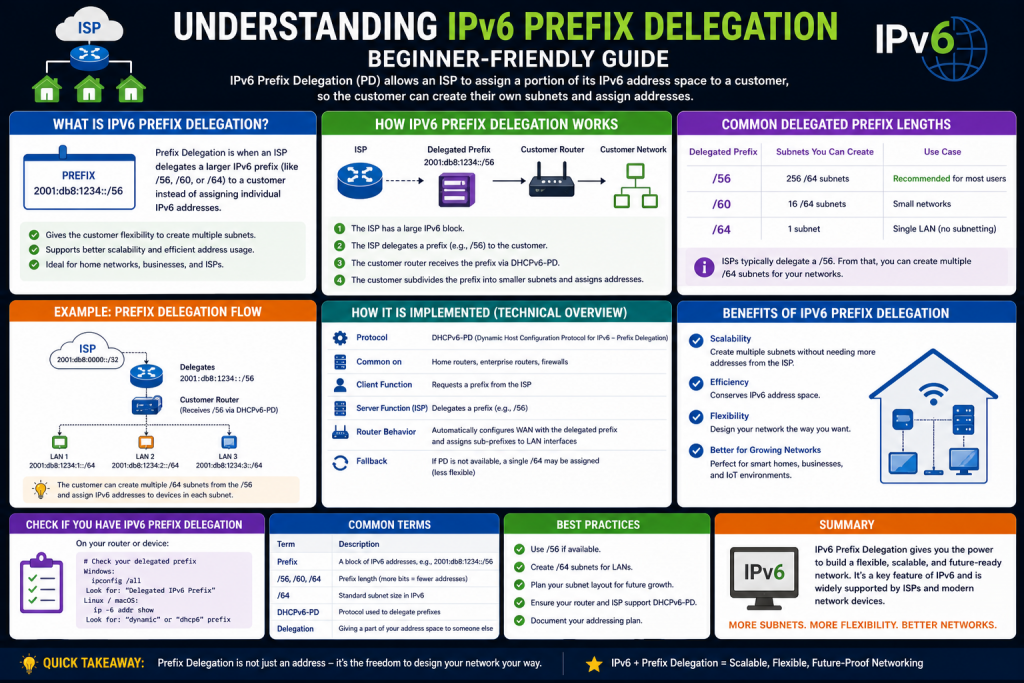
IPv6 Prefix Delegation is a key mechanism in modern networking that allows service providers to assign entire blocks of IP addresses to customers instead of giving them a single address. To understand why this is important, it is necessary to first understand how IPv6 itself changes the way networks are built and managed compared to older IPv4 systems.
IPv6 was introduced to solve a major limitation in IPv4, which was the exhaustion of available IP addresses. IPv4 uses a 32-bit addressing system, which provides around 4.3 billion unique addresses. While this seemed large in the early days of the internet, the rapid growth of devices, servers, mobile phones, and IoT systems quickly consumed this space. This shortage became especially critical as more organizations connected their infrastructure to the internet and as personal devices became permanently online.
The rise of cloud computing and virtualization further accelerated address consumption because multiple virtual machines often required their own IP addresses. Network Address Translation helped delay the exhaustion, but it was only a temporary solution and introduced additional complexity in communication and troubleshooting. IPv6 was designed to permanently resolve these limitations by using a 128-bit addressing system, which provides an almost unlimited number of unique addresses.
This massive expansion not only eliminates address scarcity but also enables more efficient hierarchical network design. It allows service providers to allocate large blocks of addresses to customers without worrying about depletion. As a result, IPv6 also supports advanced features like automatic configuration and prefix delegation, making modern networks more scalable, flexible, and easier to manage in the long term.
IPv6 expands the address size to 128 bits, creating an extremely large pool of possible addresses. This expansion does not just solve the shortage problem, it also allows for a more structured and hierarchical approach to network design. Instead of carefully conserving addresses, IPv6 enables networks to be designed with simplicity, scalability, and automation in mind.
Within this system, prefix delegation plays a critical role by allowing entire networks to be assigned dynamically and efficiently.
Understanding the Concept of Network Prefixes in IPv6
In IPv6, an IP address is divided into two main parts. The first part is the network prefix, and the second part is the interface identifier. The network prefix defines the overall network or subnet, while the interface identifier identifies a specific device within that network.
For example, in a typical IPv6 address structure, a /64 prefix is commonly used for individual local networks. This means that the first 64 bits represent the network portion, while the remaining 64 bits represent individual devices.
The concept of a prefix is essential because it allows large blocks of addresses to be grouped together logically. Instead of assigning each device a completely unique address from scratch, administrators assign a prefix that defines the network boundary, and devices automatically configure themselves within that space.
Prefix delegation builds on this idea by allowing an Internet Service Provider to assign not just a single prefix for a single network, but a larger prefix that can be further divided by the customer.
Why Internet Service Providers Use Prefix Delegation
Internet Service Providers operate large-scale networks that connect thousands or even millions of customers to the internet. Managing IP addresses at this scale requires efficiency, automation, and careful planning.
In many cases, customers do not need just one IP address. Instead, they may need multiple subnets for different purposes such as internal users, servers, guest networks, or management systems. Assigning each of these manually would be complex and inefficient. As networks grow in size and complexity, the number of devices and services increases significantly, making manual configuration both time-consuming and error-prone.
Each subnet often requires careful planning to avoid address conflicts, ensure proper routing, and maintain security boundaries between different parts of the network. For example, a server network may need restricted access, while a guest network must be isolated from internal resources, and a management network may require controlled administrative access. Handling all of this with individual IP assignments would place a heavy burden on network administrators and increase the risk of misconfiguration. Prefix delegation solves this challenge by providing a structured block of addresses that can be divided automatically into multiple subnets.
This allows routers to generate and manage internal networks dynamically based on predefined rules. It also improves scalability because new subnets can be created instantly without requesting additional addresses from the provider. As a result, organizations can focus more on network design and policy enforcement rather than manual IP management tasks.
Prefix delegation solves this problem by allowing providers to assign a block of IPv6 addresses to a customer router. The customer router then becomes responsible for dividing that block internally as needed.
This approach benefits both sides. The provider reduces administrative overhead because they only manage large blocks rather than individual devices. The customer gains flexibility because they can design their internal network without constantly requesting new address allocations.
Another important reason for using prefix delegation is scalability. As networks grow, it becomes impractical to manually configure every subnet. With prefix delegation, expansion is automatic and structured.
The Role of Hierarchical Addressing in IPv6 Networks
IPv6 is designed with hierarchical addressing in mind. This means that address space is divided into increasingly smaller blocks as it moves from the provider to the customer and then to internal networks.
At the top level, global internet registries allocate large blocks of IPv6 space to Internet Service Providers. These blocks are often extremely large, such as /32 or /29 allocations. The ISP then subdivides this space into smaller prefixes for customers.
Customers may receive a /48, /56, or /60 prefix depending on their needs. This prefix represents a significant amount of address space that can be further divided internally.
For example, a /56 prefix contains enough space to create many /64 subnets. Each of these subnets can support a separate local network. This hierarchical structure ensures that IPv6 remains organized even at a massive scale.
Prefix delegation fits into this hierarchy by automating the assignment of these mid-level prefixes between providers and customers.
How Prefix Delegation Fits Into the IPv6 Ecosystem
Prefix delegation is not a standalone concept. It is part of a larger ecosystem of IPv6 technologies that work together to enable automatic network configuration.
At the core of this system is DHCPv6, which is the IPv6 version of the Dynamic Host Configuration Protocol. While DHCP in IPv4 typically assigns individual IP addresses, DHCPv6 can also assign entire network prefixes.
When prefix delegation is used, the customer router acts as a DHCPv6 client. Instead of requesting a single IP address, it requests a prefix. The provider’s DHCPv6 server responds by assigning a block of addresses from its available pool.
This exchange allows networks to be configured automatically without manual intervention. Once the prefix is received, the customer router can begin using it immediately for internal network configuration.
This system is particularly useful in environments where devices frequently connect and disconnect, or where network structures change over time.
Basic Flow of a Prefix Delegation Request
The process of prefix delegation follows a simple but structured sequence.
First, the customer router connects to the service provider network. At this stage, it does not yet have information about which prefix it will receive.
Next, the router sends a request asking for a delegated prefix. This request is sent using DHCPv6 messages and indicates that the router is capable of managing its own internal addressing.
The provider receives this request and checks its pool of available IPv6 prefixes. It then selects an appropriate block based on availability and configuration policies.
Once a suitable prefix is selected, the provider assigns it to the customer router. This assignment includes details such as the prefix length and lease duration.
The customer router then stores this prefix and uses it to configure its internal interfaces.
This entire process is automated and typically completes within seconds, making it highly efficient for large-scale networks.
Importance of Prefix Size in Delegation
One of the most important aspects of prefix delegation is the size of the prefix being assigned. The prefix size determines how much address space the customer will receive.
A smaller prefix, such as /64, provides enough addresses for a single local network. However, in prefix delegation scenarios, customers usually receive larger blocks such as /56 or /48.
A /56 prefix is particularly common because it allows for a large number of /64 subnets. This gives customers the flexibility to create multiple internal networks without running out of address space.
For example, a /56 prefix allows for 256 different /64 networks. This is more than enough for most small to medium-sized organizations.
A /48 prefix provides even more flexibility, allowing for thousands of subnets. This is often used by larger enterprises or institutions.
The choice of prefix size depends on the customer’s needs and the provider’s allocation policies.
Customer Router Behavior in Prefix Delegation
When a customer router receives a delegated prefix, it becomes responsible for managing that prefix internally. This means it must track which subnets are in use and assign them appropriately to different interfaces.
The router uses the delegated prefix as a base and then creates subnets by extending it. Each internal interface can be assigned its own subnet derived from the main prefix.
For example, if a router receives a /56 prefix, it can create multiple /64 subnets from it. Each subnet can then be assigned to a different network segment inside the organization.
This behavior makes the customer router a central point of network management. It acts as both a client to the provider and a controller for internal addressing.
This dual role is what makes prefix delegation so powerful in IPv6 environments.
Advantages of Using Prefix Delegation in IPv6 Networks
Prefix delegation provides several important advantages that make it a preferred method for IPv6 network configuration.
First, it reduces manual configuration. Network administrators do not need to assign individual IP addresses or subnets manually.
Second, it improves scalability. Networks can grow without requiring major reconfiguration.
Third, it supports automation. Devices can automatically configure themselves based on delegated prefixes.
Fourth, it improves organization. Hierarchical address structure ensures that networks remain structured and easy to manage.
Finally, it reduces administrative overhead for service providers, allowing them to manage large customer bases efficiently.
These benefits make prefix delegation a fundamental part of modern IPv6 deployment strategies.
Introduction to Practical Prefix Delegation Behavior
IPv6 Prefix Delegation becomes far more meaningful when viewed from a practical networking perspective rather than just a theoretical concept. In real environments, it is used to automatically distribute network prefixes between service providers and customer routers, allowing both sides to avoid manual IP assignment and complex subnet planning.
This part focuses on how prefix delegation actually operates in real networks, how routers behave during the process, and how service provider systems are configured to support dynamic prefix assignment. Understanding this operational side is essential for anyone working with modern IPv6 networks, especially in enterprise or ISP environments.
At this stage, the concept shifts from “what it is” to “how it works in practice,” including communication between routers, DHCPv6 interactions, and internal subnet creation.
The Role of DHCPv6 in Prefix Delegation
At the core of prefix delegation is DHCPv6, which is the protocol responsible for managing IPv6 address assignments. While DHCP in IPv4 is commonly used to assign individual addresses to devices, DHCPv6 extends this capability to include entire network prefixes.
This enhancement is a major shift in how network configuration is handled, because it allows routers, rather than just individual hosts, to participate in the address assignment process. In prefix delegation, the requesting device is usually a router that needs a block of addresses to distribute within its own network. DHCPv6 handles this by supporting specialized messages that allow a client to request a prefix instead of a single IP address. Once the request is received, the server responds with a delegated prefix that the client can use internally.
This makes DHCPv6 far more powerful in hierarchical network environments where multiple layers of routing exist. It also reduces administrative complexity because the service provider does not need to manually assign each subnet. Instead, the system automatically allocates structured address blocks based on predefined pools and policies. Another important aspect is that DHCPv6 supports long-term leases and stable assignments, which are essential for enterprise networks that require consistent addressing over time.
In a prefix delegation scenario, the customer router acts as a DHCPv6 client. Instead of requesting a single IP address, it specifically requests a delegated prefix. This request is sent to the service provider’s DHCPv6 server.
The provider’s system, acting as a DHCPv6 server, maintains a pool of available IPv6 prefixes. These prefixes represent portions of a larger global IPv6 allocation. When a request is received, the server selects an appropriate prefix from this pool and assigns it to the requesting router.
This process is fully automated and does not require human intervention once properly configured. It allows large-scale networks to function efficiently with minimal administrative effort.
Customer Router as a Dual Role Device
In prefix delegation, the customer router performs two important roles at the same time. First, it acts as a DHCPv6 client when communicating with the service provider. Second, it acts as a DHCPv6 server or internal address manager for devices within its own network.
This dual role is what makes prefix delegation powerful. The router is not just receiving an address; it is receiving a whole network structure that it can further divide and distribute internally.
When the router receives a delegated prefix, it stores it locally and uses it as a base for internal subnet creation. Each internal interface can then be assigned a portion of this prefix.
For example, if the router receives a /56 prefix, it can generate multiple /64 subnets from it. These subnets are then assigned to internal interfaces such as LAN segments, server networks, or guest networks.
This behavior transforms the router into a local network controller that dynamically builds internal addressing based on provider allocation.
Step-by-Step Flow of Prefix Delegation Communication
The process of prefix delegation follows a structured communication flow between the customer router and the service provider.
Initially, the customer router connects to the provider’s network through a physical or virtual interface. At this point, the router does not yet have a delegated prefix.
The router then sends a DHCPv6 solicitation message. This message indicates that the router is requesting configuration information, specifically a delegated prefix.
The provider receives this request and checks its available prefix pool. This pool contains pre-defined IPv6 address blocks that can be assigned to customers.
Once an appropriate prefix is found, the provider responds with a DHCPv6 advertisement and assignment message. This message includes the delegated prefix and associated parameters such as lease duration.
The customer router receives this information and stores the prefix under a local identifier. This identifier is used internally to reference the assigned block.
After this exchange, the router acknowledges the assignment, completing the DHCPv6 negotiation process.
From this point onward, the router is ready to use the delegated prefix for internal network configuration.
Provider-Side Configuration and Address Pool Management
On the service provider side, prefix delegation requires careful configuration of address pools and DHCPv6 policies. The provider must first define a large block of IPv6 addresses that will be used for customer assignments.
This block is typically a subset of a larger allocation received from a regional internet registry. The provider divides this block into smaller segments that can be assigned to individual customers.
For example, a provider might have a large /49 or /48 block. From this block, it can create multiple /56 prefixes for customers. Each of these prefixes is stored in a pool that the DHCPv6 server manages.
The provider then configures DHCPv6 services to handle prefix delegation requests. This includes defining which pools are available, how large each delegated prefix should be, and how long assignments should remain valid.
In many real-world networks, lease times are set to very long durations or even infinite values for stable customer connections. This ensures that customers maintain consistent network addressing over time.
The provider router also maintains routing information for all delegated prefixes. This ensures that traffic destined for customer networks is correctly forwarded.
Customer-Side Configuration and Router Setup
On the customer side, configuration begins with enabling IPv6 on the interface that connects to the service provider. This interface is responsible for sending and receiving DHCPv6 messages.
Once IPv6 is enabled, the interface is configured to act as a DHCPv6 client specifically for prefix delegation. This tells the router that it should request a network prefix instead of a single address.
After this configuration, the router automatically sends a request when the interface becomes active. If the provider is properly configured, a delegated prefix is received.
The router then stores this prefix under a local reference name. This name is important because it allows internal interfaces to reference the delegated block without needing to know the exact numeric value of the prefix.
Inside the router, additional interfaces are then configured to use this delegated prefix. Each interface uses a portion of the prefix to create a valid IPv6 subnet.
This process allows the router to build an internal network structure dynamically without manual IP assignment.
Internal Subnet Creation Using Delegated Prefixes
Once a prefix is received, the customer router can begin dividing it into smaller subnets. This is one of the most powerful features of prefix delegation.
IPv6 networks typically use /64 subnets for individual networks. This means that regardless of the size of the delegated prefix, internal networks are usually standardized to /64.
The router takes the delegated prefix and extends it to create multiple /64 subnets. Each subnet can then be assigned to a different internal interface.
For example, one interface might represent a user network, another might represent a server network, and another might represent a guest network. All of these networks are derived from the same delegated prefix.
This structure allows for clear separation of network segments, improving both organization and security.
Each subnet operates independently while still being part of the larger delegated address space.
Verification and Troubleshooting of Prefix Delegation
After configuration, it is important to verify that prefix delegation is functioning correctly. This is typically done using router diagnostic commands that display DHCPv6 status and interface assignments.
On the customer router, administrators can check whether a prefix has been successfully received. This includes viewing the delegated prefix, lease status, and associated interface mappings.
If the prefix is not received, common issues include misconfigured DHCPv6 settings, incorrect provider pool configuration, or interface connectivity problems.
On the provider side, administrators can verify that the DHCPv6 server is receiving requests and assigning prefixes correctly. They can also check logs to confirm successful delegation events.
Routing tables can also be examined to ensure that traffic for delegated prefixes is being properly directed toward customer routers.
Routing Behavior with Delegated Prefixes
Once a prefix is delegated, routing becomes an important part of the system. The provider must ensure that traffic destined for the delegated prefix is forwarded to the correct customer router.
This is typically done through static or dynamic routing entries that map delegated prefixes to specific customer connections.
From the provider’s perspective, each delegated prefix represents a reachable network behind a customer router. This means the provider must maintain accurate routing information for all active delegations.
On the customer side, routing is simpler because the router already understands that the delegated prefix belongs to its internal network.
This separation of routing responsibilities allows both provider and customer networks to operate efficiently without overlap or conflict.
Behavior During Network Changes and Reassignment
One of the advantages of prefix delegation is its ability to handle network changes dynamically. If a customer disconnects and reconnects, the same prefix may be reassigned.
If a prefix is no longer valid, the router can request a new one automatically. This ensures continuity without manual intervention.
In some cases, providers may reassign prefixes based on network optimization or policy changes. When this happens, the customer router updates its internal configuration accordingly.
This dynamic behavior makes IPv6 prefix delegation highly adaptable in modern network environments where changes are frequent.
Introduction to Advanced Prefix Delegation Concepts
After understanding how IPv6 Prefix Delegation works and how it is configured in real environments, the next step is to explore how it behaves in larger, more complex networks. In real-world deployments, prefix delegation is not just a simple mechanism for assigning addresses. It becomes part of a broader architectural strategy that supports scalability, segmentation, automation, and efficient routing.
In enterprise networks and service provider infrastructures, prefix delegation is used in combination with routing policies, subnet design strategies, security segmentation, and multi-layer network planning. This makes it a critical building block for modern IPv6 adoption.
At an advanced level, prefix delegation is not just about receiving a network block. It is about how that block is structured, divided, distributed, and maintained across dynamic and evolving network environments.
Hierarchical Network Design Using Delegated Prefixes
One of the most important advantages of IPv6 prefix delegation is that it naturally supports hierarchical network design. This means networks can be structured in layers, with each layer receiving a portion of a larger address space.
At the top level, a service provider holds a large IPv6 allocation. This is divided into smaller blocks, which are then delegated to customers. Each customer receives a prefix that represents their own independent address space.
Inside the customer network, that delegated prefix is further divided into subnets. Each subnet can represent a different functional area such as internal users, servers, management systems, or guest access networks.
This hierarchical structure ensures that network design remains organized even as it grows. Instead of flat address assignments, IPv6 allows a tree-like structure where each level of the network has its own defined portion of address space.
This approach also simplifies troubleshooting and management because each segment of the network can be identified by its prefix structure.
Subnet Planning and Address Efficiency in Large Networks
In large-scale deployments, subnet planning becomes a critical part of network design. With IPv6 prefix delegation, subnet planning is significantly simplified due to the abundance of available address space.
A typical delegated prefix, such as a /56, provides enough room to create many /64 subnets. Each of these subnets can serve a different purpose within an organization.
For example, a company might allocate one subnet for employees, another for servers, another for IoT devices, and another for guest access. All of these subnets are derived from the same delegated prefix.
Because IPv6 does not suffer from address scarcity, there is no need to conserve subnets. This allows administrators to design networks based on logical structure rather than address limitations.
Each subnet remains independent, which improves security and performance isolation. At the same time, all subnets remain part of the same larger delegated block, maintaining consistency in routing.
Dynamic Network Growth and Scalability
One of the strongest advantages of prefix delegation is its ability to support dynamic network growth. As organizations expand, their network requirements change. New departments, devices, and services may require additional subnets.
With IPv4, this often leads to complex renumbering or address reallocation. However, with IPv6 prefix delegation, expansion is much simpler.
If a delegated prefix is large enough, new subnets can be created instantly without requesting additional address space. The customer router can simply assign unused portions of the prefix to new interfaces.
This makes IPv6 networks highly scalable. Growth does not require restructuring existing networks, which reduces operational complexity.
In cases where additional space is needed beyond the original delegation, the service provider can assign a larger prefix. This process is also automated in many modern systems.
Routing Architecture and Delegated Prefix Integration
Routing plays a central role in how delegated prefixes function in real networks. Once a prefix is assigned to a customer, it must be properly integrated into routing tables so that traffic can reach it.
At the service provider level, routing entries are created to direct traffic for the delegated prefix toward the correct customer connection. This ensures that external devices can communicate with the internal customer network.
These routing entries may be static or dynamically generated depending on the provider’s infrastructure. In large-scale environments, dynamic routing protocols are often used to manage this process automatically.
On the customer side, routing is typically simpler. The customer router already knows that the delegated prefix belongs to its internal network. It therefore routes traffic internally without requiring complex configuration.
This separation of routing responsibilities allows the provider to manage global connectivity while the customer manages internal traffic flow.
Multi-Site and Branch Network Design Using Prefix Delegation
In enterprise environments, prefix delegation is often used to support multi-site or branch network architectures. Each branch office can receive its own delegated prefix from the central provider.
This allows each location to operate independently while still being part of the same overall network structure.
For example, a company with multiple offices can assign each branch a unique IPv6 prefix. Each branch router then divides its prefix into internal subnets based on local needs.
This model simplifies centralized management while allowing local flexibility. Each site can operate its own internal network without conflicting with others.
Additionally, this structure supports easier troubleshooting. If a network issue occurs at a specific branch, the prefix helps quickly identify the affected location.
Security Segmentation Through Delegated Subnets
Security is another important aspect of advanced prefix delegation usage. By dividing a delegated prefix into multiple subnets, organizations can create strong network segmentation.
Each subnet can be isolated from others using firewall rules or routing policies. This prevents unauthorized access between different parts of the network.
For example, a guest network can be placed in a separate subnet from internal systems. Even though both subnets originate from the same delegated prefix, they can be fully isolated at the network policy level.
This improves overall security posture and reduces the risk of lateral movement in case of a breach.
Prefix delegation makes this segmentation easier because all subnets are derived from a structured address block, allowing consistent policy enforcement.
Automation and Network Orchestration
Modern networks increasingly rely on automation, and prefix delegation plays a key role in this transformation. Because prefixes are assigned dynamically, they can be integrated into automated network orchestration systems.
When a new device or site connects to the network, it can automatically receive a delegated prefix without manual intervention. This allows networks to scale rapidly without requiring additional configuration work.
Automation systems can also monitor prefix usage and adjust allocations based on demand. If a subnet becomes full, new subnets can be created automatically from the delegated block.
This level of automation is especially useful in cloud environments and large enterprise networks where manual configuration would be inefficient.
Challenges and Considerations in Prefix Delegation
Although prefix delegation is powerful, it also introduces certain challenges that must be considered in real deployments.
One challenge is ensuring proper prefix sizing. If a delegated prefix is too small, it may not provide enough subnets for future growth. If it is too large, it may waste address space, although this is less of an issue in IPv6.
Another consideration is routing complexity in large networks. As the number of delegated prefixes increases, maintaining accurate routing tables becomes more important.
Security policies must also be carefully designed to ensure that subnet segmentation is properly enforced. Without proper controls, internal networks could become overly connected.
Finally, monitoring and troubleshooting require a good understanding of prefix structure. Network administrators must be able to interpret prefix assignments and trace traffic across subnets.
Real-World Deployment Scenarios
In real-world environments, prefix delegation is used in a variety of scenarios. Internet service providers use it to assign address blocks to residential and business customers.
Enterprises use it to manage internal networks across multiple locations. Data centers use it to allocate structured address spaces to different services or tenants.
Even home networks can benefit from prefix delegation when using advanced routers that support multiple internal subnets.
In each case, the core principle remains the same: a large IPv6 block is delegated to a router, which then divides it into usable internal networks.
Future of IPv6 Prefix Delegation
As IPv6 adoption continues to grow, prefix delegation will become even more important. It is already a standard mechanism in modern networks, and its role will expand as more devices and services come online. This growth is driven by the increasing demand for scalable addressing in environments where traditional manual configuration methods are no longer practical. As organizations deploy more cloud services, virtual machines, IoT devices, and distributed applications, the need for automated and flexible network assignment becomes essential.
Prefix delegation supports this by allowing entire network blocks to be dynamically assigned without human intervention, which reduces configuration errors and improves operational efficiency. It also enables networks to adapt in real time, meaning new subnets can be created instantly as requirements change. In large enterprise environments, this flexibility helps maintain consistent network architecture across multiple locations while still allowing local autonomy. Service providers also benefit because they can manage address space more efficiently and support a larger number of customers without increasing administrative overhead. Over time, prefix delegation is expected to integrate even more deeply with automated network orchestration systems, making it a foundational element in fully self-configuring IPv6 infrastructures.
Future networks are expected to rely heavily on automation, and prefix delegation fits naturally into this model. It provides a flexible and scalable way to manage addressing without manual intervention.
With the growth of cloud computing, IoT systems, and distributed architectures, the need for efficient address management will continue to increase.
Prefix delegation provides a foundation for this future by enabling structured, automated, and scalable network design.
Conclusion
IPv6 Prefix Delegation is a fundamental technology that supports modern network architecture by enabling automatic distribution of large address blocks. It allows service providers to efficiently manage global IPv6 space while giving customers full control over internal subnet design.
In advanced environments, prefix delegation supports hierarchical network structures, dynamic growth, routing integration, and strong security segmentation. It simplifies subnet planning, reduces administrative overhead, and enables automation at scale.
From small home networks to large enterprise infrastructures, prefix delegation plays a key role in ensuring that IPv6 networks remain flexible, scalable, and efficient.
As networks continue to evolve, prefix delegation will remain one of the core mechanisms that makes IPv6 practical for real-world deployment, supporting the transition toward fully automated and highly scalable networking systems.
Continue exploring the technologies and certification concepts that matter most to you.