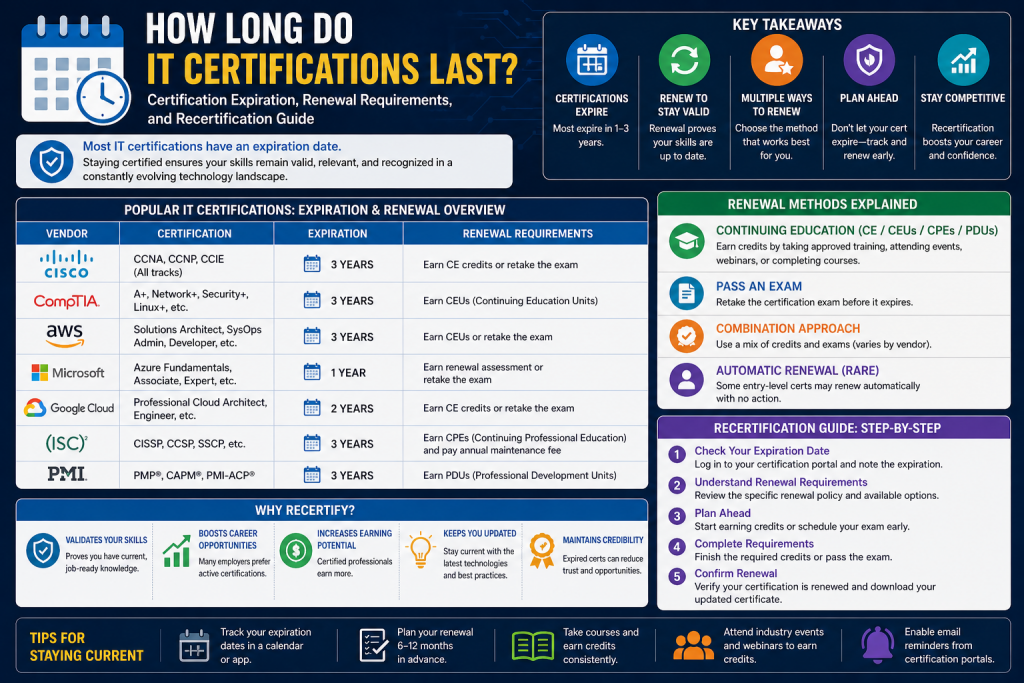
Earning an IT certification is often seen as a major milestone in a technology professional’s journey. It represents proof of knowledge, dedication, and the ability to meet industry standards. However, one important aspect that many learners overlook is that most certifications are not permanent. After the excitement of passing an exam fades, professionals are faced with the reality that certifications often come with an expiration date.
This concept can feel discouraging at first. After all, significant time, effort, and sometimes money are invested in preparing for these certifications. The idea of having to renew them might seem like an unnecessary burden. However, when viewed from a broader perspective, certification expiration serves a valuable purpose. The technology industry evolves at a rapid pace, and certifications must reflect current knowledge rather than outdated skills.
Understanding how long certifications last and why they expire is essential for anyone pursuing a career in IT. It helps professionals plan their learning journey, stay competitive in the job market, and make informed decisions about which certifications to pursue. Rather than being a setback, certification renewal can be seen as an opportunity to grow and stay aligned with industry trends.
The Reality Behind Expiring Certifications
The expiration of IT certifications is not arbitrary. It is closely tied to the nature of the technology industry itself. Unlike some professions where core knowledge remains stable for decades, IT is constantly changing. New programming languages emerge, cloud platforms evolve, cybersecurity threats become more sophisticated, and tools are continuously updated.
Because of this rapid evolution, a certification earned today may not accurately represent a professional’s knowledge a few years down the line. For example, a cloud certification obtained several years ago might not include knowledge of the latest services or best practices. Similarly, security certifications must adapt to new threats and vulnerabilities that were not relevant in the past.
Certification providers recognize this challenge and design their programs accordingly. By setting expiration dates, they ensure that certified professionals periodically update their skills. This approach maintains the credibility of certifications and ensures that they remain meaningful indicators of current expertise.
From an employer’s perspective, this system is highly beneficial. When hiring or promoting employees, organizations rely on certifications as proof of competency. Knowing that a certification has been recently renewed provides confidence that the individual is familiar with modern technologies and practices.
Common Certification Lifespans
Although certification policies vary across providers, there are some common patterns. Many certifications are valid for a period of three years. This timeframe strikes a balance between stability and relevance. It allows professionals enough time to benefit from their certification while ensuring that their knowledge does not become outdated.
Some certifications have shorter lifespans. For instance, certain cloud-based certifications may require renewal after just one year. This is because cloud technologies evolve particularly quickly, with frequent updates and new features being introduced.
On the other hand, some certifications are designed to last indefinitely. These are typically foundational certifications that focus on basic concepts rather than specific technologies. Since foundational knowledge changes less frequently, there is less need for regular updates.
Understanding these differences is important when planning a certification path. Professionals should consider not only the value of a certification but also the effort required to maintain it over time.
Why Certification Renewal Is Important
Renewing a certification is not just about keeping a credential active. It is also about maintaining professional relevance. In a competitive job market, having up-to-date certifications can set candidates apart from others with outdated or inactive credentials.
Certification renewal also encourages continuous learning. Instead of viewing education as a one-time event, professionals are motivated to keep expanding their knowledge. This mindset is essential in IT, where staying stagnant can quickly lead to obsolescence.
Another benefit of renewal is the opportunity to explore new developments in a field. For example, a professional renewing a cloud certification may learn about new services, improved security measures, or more efficient deployment strategies. This knowledge can be directly applied in the workplace, leading to better performance and innovation.
In many cases, renewal processes are designed to be less demanding than initial certification exams. Providers often offer shorter assessments, continuing education options, or alternative pathways that recognize real-world experience. This makes it easier for professionals to stay certified without repeating the entire certification process.
Overview of Major Certification Providers
Different certification providers have adopted varying approaches to validity and renewal. Understanding these approaches can help professionals choose certifications that align with their goals and preferences.
Some providers focus on role-based certifications that reflect specific job functions. These certifications are often updated frequently to keep pace with industry changes. Others emphasize foundational knowledge, offering certifications that remain valid for life.
There are also providers that balance both approaches, offering a mix of lifetime and expiring certifications. This allows professionals to build a strong foundation while also demonstrating current expertise in specialized areas.
By exploring the policies of different providers, individuals can create a certification strategy that suits their career path and learning style.
Microsoft Certification Model
Microsoft has significantly transformed its certification program in recent years. The company has shifted away from older certification structures and introduced a role-based model that aligns more closely with real-world job roles.
In this model, certifications are divided into two main categories. The first category includes fundamental certifications. These are designed for beginners and cover basic concepts related to cloud computing, artificial intelligence, and data. Fundamental certifications do not expire, making them an excellent starting point for newcomers.
The second category includes role-based certifications, such as those for administrators, developers, and security engineers. These certifications are more specialized and reflect specific job roles. Because they are closely tied to evolving technologies, they typically require renewal every year.
Microsoft has made the renewal process relatively simple. Instead of requiring candidates to retake full exams, the company offers online assessments that focus on recent updates. These assessments are shorter, open-book, and can be taken multiple times within a specified period.
This approach reduces the burden of recertification while still ensuring that professionals stay current. It also encourages continuous learning by highlighting new features and best practices.
VMware Certification Approach
VMware has taken a different path compared to many other certification providers. In the past, VMware required regular recertification, often every two years. However, the company has since changed its policy.
Most VMware certifications no longer expire. Once earned, they remain valid indefinitely. This approach reflects VMware’s focus on product-based certifications rather than skills-based ones.
However, this does not mean that professionals can ignore updates. VMware frequently releases new versions of its products, and certifications are often associated with specific versions or years. As a result, many professionals choose to pursue updated certifications to stay relevant.
VMware has also simplified its certification naming conventions. Instead of tying certifications to specific product versions, they are now labeled by year. This makes it easier to understand how current a certification is.
While recertification is not mandatory, staying updated is still important for career growth. Employers often value recent certifications that reflect knowledge of the latest technologies.
Cisco Certification Lifecycle
Cisco certifications are widely recognized in the networking industry and are known for their structured renewal requirements. Most Cisco certifications are valid for three years, after which they must be renewed.
Cisco offers multiple pathways for recertification. One option is to pass a qualifying exam. Interestingly, candidates do not need to retake the same exam they originally passed. Instead, they can choose from a range of exams at the same or higher level.
Another option is to earn continuing education credits. These credits can be obtained through various activities, such as attending training sessions, completing courses, or participating in professional development activities.
Cisco also recognizes contributions to the community, such as teaching, mentoring, or publishing technical content. This flexible approach allows professionals to choose a renewal method that suits their preferences and career goals.
It is important to keep track of certification expiration dates. If a certification expires, candidates may need to retake exams to regain their credentials. Staying proactive can help avoid unnecessary setbacks.
The Role of Continuous Learning in IT Careers
One of the most important lessons from certification expiration is the value of continuous learning. In IT, learning does not stop after earning a certification. Instead, it becomes an ongoing process that spans an entire career.
Continuous learning helps professionals adapt to changes, improve their skills, and remain competitive. It also opens up new opportunities, such as transitioning to different roles or specializing in emerging technologies.
Certifications play a key role in this process by providing structure and motivation. They encourage professionals to set goals, track their progress, and validate their knowledge.
In addition to formal certifications, learning can take many forms. Professionals can attend workshops, participate in online courses, read industry publications, or gain hands-on experience through projects. All of these activities contribute to skill development and career growth.
Building a Sustainable Certification Strategy
Managing certifications effectively requires careful planning. With different expiration timelines and renewal requirements, it can be challenging to keep track of everything.
One useful approach is to create a certification roadmap. This involves identifying your career goals and selecting certifications that align with them. By focusing on relevant certifications, you can avoid unnecessary effort and maximize the value of your learning.
It is also important to keep track of expiration dates and renewal requirements. Setting reminders or using digital tools can help you stay organized and avoid last-minute stress.
Another key consideration is balancing effort and reward. Some certifications require significant time and resources to maintain. It is important to evaluate whether the benefits justify the investment.
Finally, take advantage of flexible renewal options. Many providers offer alternatives to retaking exams, such as continuing education credits or online assessments. These options can make the renewal process more manageable.
Looking Ahead in the Certification Journey
As the technology landscape continues to evolve, certification programs will likely continue to adapt. Providers may introduce new models, update existing requirements, or explore innovative approaches to learning and validation.
For professionals, this means staying informed and being prepared to adapt. Keeping up with certification changes can help you make better decisions and stay ahead in your career.
Rather than viewing certification expiration as a challenge, it can be seen as an opportunity. It encourages growth, keeps skills relevant, and ensures that professionals remain valuable in a competitive industry.
By understanding how certifications work and planning accordingly, you can turn this ongoing process into a powerful tool for career advancement.
Understanding Recertification Methods Across the Industry
Once a certification is earned, the next important step is understanding how to maintain it. Recertification is not a one-size-fits-all process. Different certification providers offer different renewal paths, each designed to balance convenience with the need to keep professionals up to date.
In general, there are three primary methods for recertification. The first is retaking or passing an exam. This is the most direct approach and is often required when major updates occur in a technology. The second method involves earning continuing education credits through training, courses, or professional activities. The third method is completing shorter renewal assessments that focus on recent changes rather than the entire exam syllabus.
Each method has its advantages. Exams provide a comprehensive validation of knowledge, continuing education credits reward ongoing learning, and assessments offer a quick and efficient way to stay certified. Understanding these options helps professionals choose the path that best fits their schedule and career goals.
The Continuing Education Model
Continuing education plays a central role in many certification programs. Instead of requiring professionals to retake exams every few years, providers allow them to earn credits by engaging in learning activities. These credits are often referred to as CEUs (Continuing Education Units) or CPEs (Continuing Professional Education).
The idea behind this model is that learning does not only happen in exam environments. Real-world experience, training sessions, and knowledge sharing all contribute to professional growth. By recognizing these activities, certification providers create a more flexible and realistic renewal process.
Professionals can earn credits in a variety of ways. Attending webinars, completing online courses, participating in conferences, and even teaching or mentoring others can count toward recertification. Some programs also allow individuals to earn credits by writing articles, publishing research, or contributing to open-source projects.
This approach encourages a broader view of learning. It motivates professionals to stay engaged with their field, explore new ideas, and share their knowledge with others. Over time, this leads to deeper expertise and stronger professional networks.
CompTIA Certification Renewal Process
CompTIA certifications are widely recognized and follow a structured renewal process based on continuing education. Most CompTIA certifications are valid for three years, after which they must be renewed.
To maintain a CompTIA certification, professionals need to earn a specific number of CEUs within the three-year period. The number of required units varies depending on the certification level. Entry-level certifications require fewer units, while advanced certifications require more.
There are several ways to earn these units. Completing training programs is one of the most common methods. Many online courses and learning platforms offer pre-approved CEUs, making it easy to accumulate credits while improving skills.
Another option is earning a higher-level certification. In many cases, obtaining an advanced CompTIA certification automatically renews lower-level certifications. This creates a natural progression path and rewards professionals for advancing their knowledge.
Professionals can also earn credits through academic courses, industry events, and professional contributions. Activities such as writing blog posts, attending conferences, or participating in webinars all contribute to the required total.
CompTIA also offers a streamlined renewal option through its CertMaster CE program. This program allows professionals to complete an online course that covers updated exam objectives. Once completed, it automatically renews the certification without requiring additional documentation.
This combination of flexibility and structure makes the CompTIA renewal process one of the most accessible in the industry. It allows professionals to choose the method that best fits their learning style and career goals.
ISC2 Certification Maintenance Requirements
ISC2 certifications are highly regarded in the cybersecurity field and follow a renewal model similar to continuing education programs. However, ISC2 uses specific terminology and requirements that distinguish it from other providers.
To maintain an ISC2 certification, professionals must remain active members of the organization. This involves paying annual membership fees and earning continuing professional education credits over a three-year cycle.
The number of required credits depends on the certification level. Advanced certifications require more credits, reflecting the higher level of expertise expected. These credits must be earned through activities that contribute to professional development.
ISC2 recognizes a wide range of activities for earning credits. These include attending conferences, completing training courses, participating in webinars, and contributing to the cybersecurity community. Volunteering, mentoring, and publishing content are also valid ways to earn credits.
One key aspect of the ISC2 model is its emphasis on professionalism and community involvement. By encouraging members to engage with the industry, it promotes a culture of continuous improvement and collaboration.
Failure to meet the requirements can result in certification suspension or revocation. This makes it important for professionals to track their credits and ensure they meet all deadlines. While the process requires effort, it reinforces the value of ISC2 certifications as indicators of current and active expertise.
AWS Certification Renewal Options
Cloud computing certifications require frequent updates due to the rapid pace of innovation in the field. AWS certifications follow a three-year validity period and offer several renewal options.
The most straightforward method is retaking the certification exam. This ensures that professionals are tested on the latest services and best practices. However, AWS also provides alternative pathways that make renewal more flexible.
One option is earning a higher-level certification. For example, a professional with an associate-level certification can renew it by obtaining a professional-level certification. This approach encourages career progression while maintaining certification status.
AWS has also introduced interactive learning experiences as part of its recertification strategy. These experiences provide hands-on opportunities to build skills while earning renewal credits. By combining learning with practical application, AWS ensures that professionals stay prepared for real-world challenges.
Another advantage of AWS certification renewal is the availability of discounts and incentives. Certified professionals often receive vouchers or reduced exam fees, making it more affordable to maintain their credentials.
Overall, AWS strikes a balance between maintaining high standards and offering flexibility. Its renewal options cater to both exam-focused learners and those who prefer hands-on, experience-based learning.
The Role of Higher-Level Certifications in Renewal
Many certification programs allow higher-level certifications to renew lower-level ones. This creates a natural progression path and reduces the need for repeated renewals.
For example, earning an advanced certification can automatically extend the validity of foundational certifications. This approach recognizes that advanced knowledge builds upon basic concepts, making separate renewals unnecessary.
This system benefits professionals by simplifying certification management. Instead of tracking multiple expiration dates, they can focus on advancing their skills and achieving higher-level credentials.
It also encourages continuous growth. By rewarding progression, certification providers motivate professionals to expand their expertise and pursue more challenging goals.
However, it is important to understand the specific rules for each provider. Not all certifications follow the same hierarchy, and some may have unique requirements. Taking the time to review these details can help avoid confusion and ensure that certifications remain active.
Balancing Work and Recertification
One of the biggest challenges professionals face is balancing work responsibilities with certification maintenance. Preparing for exams or earning credits requires time and effort, which can be difficult to manage alongside a full-time job.
Fortunately, many certification providers recognize this challenge and offer flexible options. Online courses, self-paced learning modules, and virtual events make it easier to earn credits without disrupting work schedules.
Employers also play an important role in this process. Many organizations support certification maintenance by providing training resources, funding exam fees, or offering time for professional development. Taking advantage of these opportunities can make recertification more manageable.
Time management is another key factor. Setting aside regular time for learning, even in small increments, can help professionals stay on track. Instead of cramming for renewal deadlines, a consistent approach to learning leads to better results and less stress.
The Cost of Maintaining Certifications
Maintaining certifications often involves financial considerations. Exam fees, training courses, and membership dues can add up over time. Understanding these costs is important for planning and budgeting.
Some providers charge renewal fees or require membership payments as part of the recertification process. Others offer free or low-cost renewal options, such as online assessments or continuing education programs.
Employers may cover some or all of these costs, especially if certifications are relevant to job roles. Professionals should explore available support options and take advantage of any benefits offered by their organizations.
While there are costs involved, it is important to view them as an investment. Certifications can lead to career advancement, higher salaries, and increased job opportunities. The long-term benefits often outweigh the initial expenses.
Tracking and Managing Certification Status
Keeping track of multiple certifications can be challenging, especially when they have different renewal requirements and timelines. Effective management is essential to avoid missed deadlines and expired credentials.
One practical approach is to maintain a centralized record of certifications. This can include details such as expiration dates, renewal requirements, and progress toward earning credits. Digital tools, spreadsheets, or certification management platforms can help organize this information.
Setting reminders is another useful strategy. Notifications can be scheduled months in advance to ensure that there is enough time to complete renewal requirements. This proactive approach reduces the risk of last-minute stress.
Regularly reviewing certification status is also important. By staying informed about upcoming deadlines and changes in requirements, professionals can plan their activities more effectively.
Adapting to Changes in Certification Programs
Certification programs are not static. Providers frequently update their policies, introduce new certifications, and retire outdated ones. Staying informed about these changes is essential for maintaining relevant credentials.
Changes may include new renewal requirements, updated exam objectives, or shifts in certification focus. For example, a provider may introduce new certifications to reflect emerging technologies or retire older ones that are no longer relevant.
Professionals should regularly check official resources and announcements to stay updated. Subscribing to newsletters, following industry blogs, and participating in professional communities can provide valuable insights.
Adapting to these changes requires flexibility and a willingness to learn. By staying proactive, professionals can ensure that their certifications remain aligned with industry trends and career goals.
Building Long-Term Value Through Certification Maintenance
Maintaining certifications is not just about meeting requirements. It is about building long-term value in a career. Each renewal cycle provides an opportunity to deepen knowledge, explore new technologies, and strengthen professional skills.
Over time, this continuous learning process leads to greater expertise and confidence. It also enhances credibility, making professionals more attractive to employers and clients.
Certification maintenance can also open doors to new opportunities. Advanced certifications, specialized skills, and active participation in the industry can lead to leadership roles, consulting opportunities, and career advancement.
By approaching recertification as a strategic investment rather than an obligation, professionals can maximize the benefits of their certifications and achieve sustained success in the IT field.
Why Some Certifications Never Expire
While many IT certifications require periodic renewal, there are still some that remain valid for life. These certifications are typically designed to validate foundational knowledge rather than skills tied to rapidly changing technologies. Because of this, their relevance does not diminish as quickly over time.
Foundational certifications usually focus on core principles such as basic networking concepts, general IT literacy, or introductory cloud knowledge. These topics do not change dramatically, even as tools and platforms evolve. As a result, there is less need to reassess knowledge through frequent renewal.
Another reason some certifications do not expire is that they are tied to specific products or versions that remain stable for extended periods. In these cases, the certification reflects knowledge of a particular system rather than a continuously evolving skill set. While the product itself may eventually become outdated, the certification still serves as proof of experience with that technology.
However, having a lifetime certification does not mean that ongoing learning is unnecessary. Employers often value recent experience and current knowledge more than older credentials. Even if a certification does not expire, professionals should continue updating their skills to remain competitive.
Skills-Based Versus Product-Based Certifications
A key distinction in the world of IT certifications is the difference between skills-based and product-based certifications. This distinction largely determines whether a certification will expire and how it is maintained.
Skills-based certifications focus on abilities that apply across multiple technologies or platforms. Examples include cybersecurity practices, networking fundamentals, and general IT troubleshooting. Because these skills evolve over time, certifications that validate them typically require regular renewal.
Product-based certifications, on the other hand, are tied to specific technologies, tools, or platforms. These certifications demonstrate expertise in a particular system or solution. While the underlying product may receive updates, the certification often reflects a snapshot of knowledge at a specific point in time.
This difference explains why some certification providers emphasize recertification while others do not. Skills-based certifications require continuous updates to remain relevant, while product-based certifications may remain valid as long as the product itself is in use.
Understanding this distinction helps professionals make better decisions about which certifications to pursue. Those looking for long-term stability may prefer foundational or product-based certifications, while those seeking to stay at the cutting edge may focus on skills-based credentials.
The Impact of Certification Expiration on Careers
Certification expiration can have a significant impact on career progression. In many cases, certifications are used as benchmarks for hiring, promotions, and project assignments. An active certification signals that a professional is up to date and engaged in continuous learning.
Allowing a certification to expire can create challenges. Some employers may require active certifications for certain roles, particularly in areas such as cybersecurity, cloud computing, or networking. In these situations, an expired certification may limit job opportunities or delay career advancement.
Additionally, renewing a certification after it has expired can be more difficult. Professionals may need to retake exams or complete additional requirements to regain their credentials. This can require more time and effort than maintaining certification continuously.
On the positive side, the need for renewal can motivate professionals to stay engaged with their field. Instead of becoming complacent, they are encouraged to keep learning and improving. This mindset is essential for long-term success in IT.
Strategies for Staying Current in a Rapidly Changing Industry
Staying current in the IT industry requires more than just renewing certifications. It involves adopting a proactive approach to learning and professional development.
One effective strategy is to set clear learning goals. These goals should align with career objectives and focus on developing relevant skills. For example, a professional interested in cloud computing might prioritize learning about new services, security practices, and deployment methods.
Another important strategy is to engage with the community. Participating in forums, attending events, and networking with other professionals can provide valuable insights and opportunities. These interactions often expose individuals to new ideas and perspectives that enhance their understanding.
Hands-on experience is also critical. Working on real-world projects, experimenting with new tools, and applying knowledge in practical situations helps reinforce learning. This approach ensures that skills are not only theoretical but also applicable in real scenarios.
Continuous learning can also be supported through online resources. Courses, tutorials, and training programs offer convenient ways to stay updated. Many of these resources are flexible, allowing professionals to learn at their own pace.
The Role of Employers in Certification Maintenance
Employers play a significant role in supporting certification maintenance and professional development. Organizations that invest in their employees’ growth benefit from a more skilled and capable workforce.
Many companies provide resources such as training programs, access to learning platforms, and financial support for certification exams. These benefits reduce the burden on employees and make it easier to maintain certifications.
Some organizations also integrate certifications into their performance management systems. Employees may be encouraged or required to maintain certain certifications as part of their roles. This creates a structured approach to professional development and ensures that skills remain aligned with business needs.
In addition to financial support, employers can foster a culture of learning. Encouraging knowledge sharing, providing mentorship opportunities, and recognizing achievements all contribute to a positive learning environment.
For professionals, taking advantage of these opportunities is essential. Engaging with employer-supported programs can accelerate learning and enhance career growth.
Challenges Associated with Certification Renewal
While certification renewal offers many benefits, it also comes with challenges. One of the most common challenges is time management. Balancing work responsibilities, personal commitments, and study time can be difficult.
Another challenge is staying motivated. After earning a certification, it can be tempting to take a break from studying. However, maintaining certifications requires ongoing effort and commitment.
Financial considerations can also be a barrier. Exam fees, training costs, and membership dues can add up over time. For some professionals, these expenses may be difficult to manage without employer support.
Keeping track of multiple certifications is another challenge. Different certifications may have different renewal requirements and timelines, making it easy to lose track of deadlines.
Despite these challenges, effective planning and organization can help overcome them. Setting goals, creating schedules, and using tracking tools can make the process more manageable.
The Future of IT Certifications
The landscape of IT certifications is constantly evolving. As technology continues to advance, certification programs must adapt to reflect new trends and requirements.
One notable trend is the shift toward more flexible and accessible renewal options. Many providers are moving away from traditional exam-only models and offering alternatives such as online assessments and continuing education programs.
Another trend is the integration of practical, hands-on learning experiences. Certifications are increasingly focusing on real-world skills rather than theoretical knowledge. This approach ensures that certified professionals are prepared to handle actual challenges.
The rise of emerging technologies such as artificial intelligence, cloud computing, and cybersecurity is also influencing certification programs. New certifications are being developed to address these areas, while existing ones are being updated to include relevant content.
Digital credentials and badges are becoming more common as well. These credentials provide a convenient way to showcase skills and achievements, making it easier for employers to verify qualifications.
As these trends continue, professionals must remain adaptable and open to change. Staying informed about new developments and embracing innovative learning methods will be key to success.
Creating a Personal Certification Roadmap
A well-planned certification roadmap can help professionals navigate the complexities of certification maintenance. This roadmap should outline goals, timelines, and strategies for achieving and maintaining certifications.
The first step is identifying career objectives. Understanding where you want to go in your career helps determine which certifications are most relevant. For example, someone interested in cybersecurity may focus on security-related certifications, while someone in cloud computing may prioritize cloud certifications.
Next, prioritize certifications based on their importance and relevance. Not all certifications carry the same weight, so it is important to focus on those that provide the most value.
Setting realistic timelines is also crucial. Planning when to earn and renew certifications helps avoid last-minute stress and ensures consistent progress.
Tracking progress is another important aspect. Keeping a record of completed certifications, renewal requirements, and deadlines helps maintain organization and accountability.
Finally, remain flexible. Career goals and industry trends may change over time, so it is important to adjust the roadmap as needed.
Leveraging Certifications for Career Growth
Certifications are powerful tools for career advancement when used strategically. They can open doors to new opportunities, increase earning potential, and enhance professional credibility.
One way to leverage certifications is by aligning them with in-demand skills. Certifications in areas such as cloud computing, cybersecurity, and data analytics are highly valued in the job market.
Another approach is combining certifications with practical experience. Employers often look for candidates who can apply their knowledge in real-world situations. Gaining hands-on experience alongside certifications strengthens your profile.
Networking is also important. Sharing your achievements with peers, mentors, and employers can create opportunities for collaboration and career growth.
Certifications can also support career transitions. For example, professionals looking to move into a new field can use certifications to demonstrate their readiness and commitment.
By strategically selecting and maintaining certifications, professionals can maximize their impact and achieve long-term success.
Conclusion
IT certifications are not just one-time achievements but part of an ongoing journey of learning and growth. While many certifications expire, this process exists to ensure that professionals remain up to date in a rapidly changing industry. Rather than viewing expiration as a disadvantage, it should be seen as an opportunity to refresh knowledge, develop new skills, and stay competitive.
Different certification providers follow different approaches. Some require regular renewal through exams or continuing education, while others offer lifetime certifications for foundational knowledge. Understanding these differences allows professionals to make informed decisions and plan their certification paths effectively.
Maintaining certifications requires effort, including time, commitment, and sometimes financial investment. However, the benefits far outweigh the challenges. Active certifications enhance credibility, improve job prospects, and support career advancement.
The key to success lies in adopting a proactive approach. Setting clear goals, staying organized, engaging in continuous learning, and leveraging available resources can make certification maintenance more manageable and rewarding.
As the technology landscape continues to evolve, certifications will remain an essential part of professional development. By embracing the need for ongoing learning and staying adaptable, IT professionals can build successful and resilient careers that stand the test of
Continue exploring the technologies and certification concepts that matter most to you.