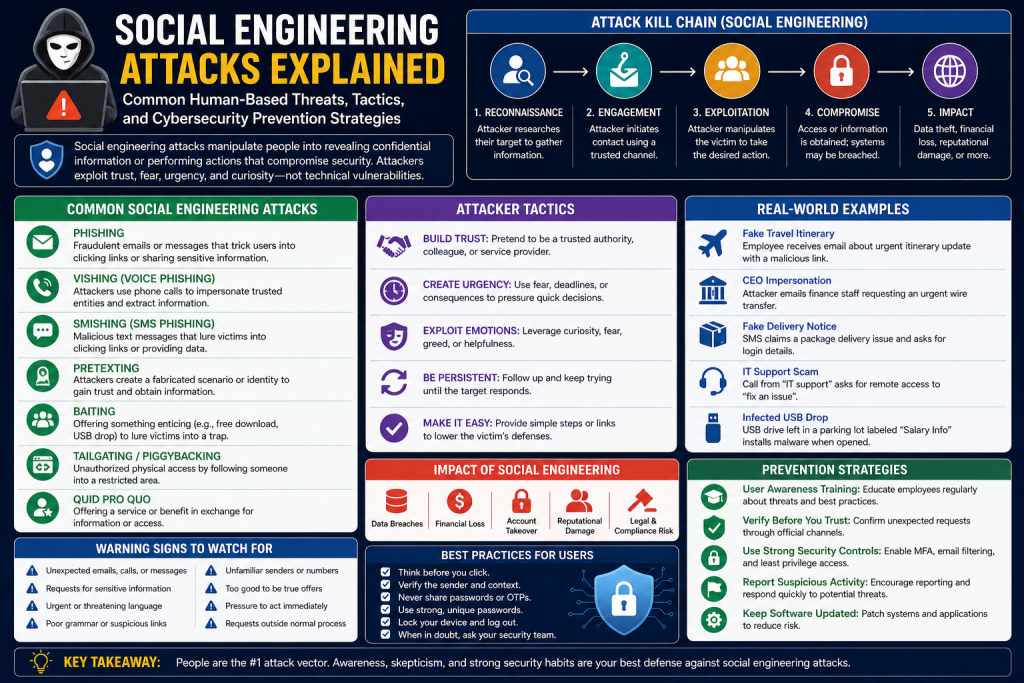
Social engineering represents one of the most persistent and dangerous threats in modern security environments. Unlike traditional cyberattacks that exploit vulnerabilities in software, hardware, or networks, social engineering targets people. It relies on manipulating human behavior to gain access to systems, data, or physical spaces. Because it focuses on psychology rather than technology, it often bypasses even the most advanced technical defenses.
In today’s interconnected world, organizations invest heavily in firewalls, encryption, and intrusion detection systems. However, attackers increasingly recognize that the human element is often the easiest point of entry. A single moment of trust, distraction, or confusion can open the door to a major security breach. This is what makes social engineering both simple and highly effective.
At its core, social engineering is about deception. Attackers create believable scenarios designed to influence decisions. They may impersonate trusted individuals, fabricate urgent situations, or exploit social norms. The goal is to convince someone to take an action that compromises security, such as revealing credentials, granting access, or ignoring established procedures.
As workplaces become more collaborative and fast-paced, the opportunities for social engineering continue to grow. Employees are expected to communicate quickly, assist others, and adapt to changing situations. While these traits are essential for productivity, they also create vulnerabilities that attackers can exploit.
The Psychology Behind Social Engineering
Understanding why social engineering works requires an examination of human psychology. Attackers do not rely on random tactics; they carefully study behavior and use predictable patterns to their advantage.
One of the most powerful psychological triggers is trust. People are naturally inclined to trust others, especially in professional environments where cooperation is encouraged. Attackers exploit this by presenting themselves as colleagues, managers, vendors, or service providers. When someone appears legitimate, individuals are less likely to question their intentions.
Another important factor is authority. Individuals tend to comply with requests from perceived authority figures. An attacker who claims to be from IT support or senior management may be able to persuade employees to share sensitive information or grant access without hesitation.
Urgency is another commonly used tactic. By creating a sense of immediate need, attackers pressure individuals into acting quickly. For example, a message that claims a system will be locked unless action is taken immediately can cause panic. In such situations, people often bypass normal verification processes.
Fear and curiosity also play significant roles. Fear can lead individuals to act defensively without thinking critically, while curiosity can drive them to explore unfamiliar or suspicious content. Both emotions can be manipulated to achieve the attacker’s goals.
Social norms further contribute to vulnerability. People generally want to be polite, helpful, and cooperative. They may hesitate to question someone or refuse a request, even if something feels unusual. Attackers rely on this reluctance to challenge others.
How Social Engineering Differs from Traditional Cyberattacks
Traditional cyberattacks focus on exploiting technical weaknesses. These may include software bugs, misconfigurations, or outdated systems. Security teams can often address these issues through patches, updates, and monitoring tools.
Social engineering, on the other hand, bypasses these defenses entirely. Instead of attacking systems directly, it targets the individuals who use them. This makes it more difficult to detect and prevent, as human behavior is less predictable than software vulnerabilities.
Another key difference is the level of interaction involved. Social engineering often requires direct or indirect communication between the attacker and the target. This interaction can take many forms, including emails, phone calls, text messages, or face-to-face encounters.
Because social engineering relies on human interaction, it can adapt quickly. Attackers can adjust their approach based on the target’s responses, making the attack more convincing. This flexibility gives social engineering a significant advantage over automated attacks.
Additionally, social engineering attacks often serve as a gateway to larger threats. For example, stolen credentials obtained through deception can be used to access systems, deploy malware, or conduct further attacks. This layered approach increases the overall impact.
Common Forms of Social Engineering
Social engineering encompasses a wide range of techniques, each designed to exploit different aspects of human behavior. Some of the most common forms include phishing, pretexting, baiting, and physical intrusion methods.
Phishing involves sending deceptive messages that appear to come from legitimate sources. These messages often contain links or attachments that lead to malicious websites or software. The goal is to trick individuals into revealing sensitive information such as passwords or financial details.
Pretexting involves creating a fabricated scenario to gain trust. For example, an attacker may pretend to be a support technician who needs access to a system. By establishing a believable story, they can persuade individuals to cooperate.
Baiting relies on curiosity or temptation. Attackers may leave infected devices, such as USB drives, in public places. When someone picks up the device and connects it to their computer, malware is introduced.
Physical social engineering attacks involve direct interaction with environments and people. These include methods like tailgating, piggybacking, and shoulder surfing. While they may seem simple, they can be highly effective in bypassing security measures.
Each of these techniques highlights a different aspect of human vulnerability. When combined, they create a comprehensive threat that is difficult to defend against using technology alone.
The Growing Threat Landscape
The prevalence of social engineering attacks has increased significantly in recent years. As organizations strengthen their technical defenses, attackers have shifted their focus toward human vulnerabilities.
One reason for this trend is the increasing value of data. Sensitive information, such as personal details, financial records, and intellectual property, has become a primary target. Social engineering provides a direct path to accessing this information.
The rise of remote work has also expanded the attack surface. Employees often work from various locations, using different devices and networks. This creates more opportunities for attackers to exploit weaknesses.
In addition, digital communication has become a central part of daily operations. Emails, messaging platforms, and video calls are widely used, making it easier for attackers to impersonate others and initiate contact.
Social engineering attacks are not limited to large organizations. Small businesses and individuals are also at risk. In many cases, they may lack the resources or awareness needed to defend against such threats.
The financial impact of these attacks can be substantial. Organizations may face direct losses, legal penalties, and reputational damage. Recovery efforts can be time-consuming and costly, further emphasizing the need for prevention.
Introduction to Physical Social Engineering
While many people associate social engineering with digital attacks, physical methods are equally important. These involve direct interaction with people and environments to gain unauthorized access.
Physical social engineering attacks often target entry points, workspaces, and public areas. They rely on observation, timing, and manipulation to succeed. Because they occur in real-world settings, they can be difficult to detect using traditional cybersecurity tools.
One of the key advantages of physical attacks is their simplicity. They do not require advanced technical skills or specialized equipment. Instead, they rely on understanding human behavior and exploiting everyday situations.
Physical social engineering also benefits from the element of surprise. Employees may not expect security threats in their immediate surroundings, making them less vigilant. This creates opportunities for attackers to act without raising suspicion.
Among the most common physical social engineering techniques are tailgating, piggybacking, and shoulder surfing. Each method targets a different aspect of human behavior, but all share the same objective: gaining access to restricted information or areas.
Understanding Tailgating in Depth
Tailgating is one of the simplest yet most effective forms of physical social engineering. It occurs when an unauthorized individual gains access to a restricted area by following someone who is authorized.
In many organizations, access to buildings or specific areas is controlled through security measures such as keycards, badges, or biometric systems. These systems are designed to ensure that only authorized individuals can enter. However, they can be bypassed if someone simply follows an authorized person through a door.
The success of tailgating depends largely on human behavior. People often hold doors open for others as a gesture of politeness. In a busy workplace, this behavior is common and rarely questioned. Attackers take advantage of this tendency to gain entry without using any credentials.
Tailgating can occur in various environments, including office buildings, educational institutions, and residential complexes. Any location with controlled access points is a potential target.
One of the challenges in preventing tailgating is that it does not always appear suspicious. An individual entering a building alongside others may not attract attention, especially if they blend in with the environment.
Realistic Tailgating Scenarios
In a typical scenario, an attacker may pose as a delivery worker carrying packages. As an employee approaches the entrance, the attacker follows closely behind, relying on the employee to hold the door open. Because the situation appears normal, the employee may not question it.
Another common scenario involves individuals pretending to be employees or contractors. They may wear professional attire and carry items such as laptops or documents. By mimicking the behavior of legitimate staff, they reduce the likelihood of being challenged.
Attackers may also use direct communication. For example, they might claim to have forgotten their access card and ask someone to let them in. Many people feel uncomfortable refusing such requests, especially if the person appears credible.
These scenarios demonstrate how easily tailgating can occur. Even organizations with strong security systems can be vulnerable if employees are not aware of the risks.
Human Behavior and Tailgating Risks
The effectiveness of tailgating is closely tied to human behavior. People are often focused on their tasks and may not pay attention to who is entering behind them. This lack of awareness creates opportunities for attackers.
Politeness is another key factor. Many individuals feel obligated to assist others, even in situations where security should take priority. This desire to be helpful can override caution.
Social pressure can also influence decisions. In a busy environment, individuals may feel rushed or distracted. They may not take the time to verify whether someone is authorized to enter.
Additionally, fear of confrontation can prevent people from questioning strangers. Employees may worry about appearing rude or causing conflict. Attackers rely on this hesitation to avoid detection.
Understanding these behavioral factors is essential for addressing the risks associated with tailgating. By recognizing how human tendencies can be exploited, organizations can develop more effective prevention strategies.
Preventing Tailgating Through Awareness and Design
Preventing tailgating requires a combination of physical security measures and employee awareness. Organizations must create an environment where security is prioritized without disrupting daily operations.
Physical controls such as turnstiles and mantraps can help limit access to one person at a time. These systems reduce the likelihood of unauthorized individuals entering alongside authorized personnel.
Employee training is equally important. Staff should be educated about the risks of tailgating and encouraged to follow security protocols. This includes avoiding the practice of holding doors open for others.
Clear policies should be established and consistently enforced. Employees should be required to display identification badges and report suspicious activity. Visitors should be properly registered and escorted at all times.
Monitoring systems such as surveillance cameras can provide additional security. These systems help detect unusual behavior and provide evidence in case of an incident.
Ultimately, preventing tailgating depends on creating a culture of vigilance. Employees must understand that their actions play a critical role in maintaining security. By fostering awareness and accountability, organizations can reduce the risk of social engineering attacks.
Introduction to Advanced Physical Social Engineering
As organizations strengthen their digital defenses, attackers increasingly turn toward methods that rely on human interaction and physical presence. Physical social engineering attacks are particularly dangerous because they bypass technical safeguards entirely. Instead of breaking into systems through code, attackers gain access by manipulating people or observing their actions in real-world environments.
Two of the most significant techniques in this category are piggybacking and shoulder surfing. Both methods are deceptively simple, yet highly effective when executed correctly. They do not require advanced tools or deep technical knowledge. Instead, they depend on awareness, timing, and an understanding of human behavior.
Piggybacking focuses on gaining physical access through social interaction, often with the cooperation of an unsuspecting individual. Shoulder surfing, on the other hand, involves observing sensitive information without direct engagement. While these methods differ in approach, they share a common goal: exploiting human tendencies to bypass security.
Understanding these techniques is essential for building a comprehensive defense strategy. Organizations must recognize that security is not only about protecting systems but also about managing behavior and awareness in everyday situations.
Deep Dive into Piggybacking
Piggybacking is a refined version of unauthorized entry that depends on social manipulation rather than stealth alone. In this method, an attacker gains access to a restricted area by convincing an authorized individual to allow them entry. This permission may be explicit, such as directly asking for help, or implicit, where the individual assumes the attacker belongs there.
The key element of piggybacking is interaction. Unlike tailgating, where the attacker quietly follows someone, piggybacking often involves communication. The attacker may engage in conversation, present a believable story, or create a situation that encourages cooperation.
This technique is particularly effective in environments where employees are accustomed to helping others. Workplaces that emphasize teamwork and collaboration may unintentionally create conditions where piggybacking thrives. Employees may prioritize being helpful over strictly following security protocols.
Piggybacking also benefits from the appearance of normalcy. If the interaction seems routine, it is less likely to raise suspicion. Attackers carefully craft their behavior to match the environment, making it difficult to distinguish them from legitimate individuals.
Planning and Execution of Piggybacking Attacks
Successful piggybacking often involves careful planning. Attackers may spend time observing the target environment, identifying entry points, and studying employee behavior. This preparation allows them to choose the right moment and approach.
The execution typically begins with selecting a target. Attackers may look for individuals who appear approachable, distracted, or willing to help. They may also consider factors such as time of day, location, and level of activity.
Once a target is identified, the attacker initiates interaction. This could involve casual conversation, a request for assistance, or a fabricated scenario. The goal is to establish trust quickly and create a sense of familiarity.
After gaining the target’s confidence, the attacker introduces their request. This may be framed as a small favor, such as holding a door or allowing temporary access. Because the request appears reasonable, the target may comply without hesitation.
The final step is maintaining the illusion. Once inside, the attacker continues to behave in a way that blends with the environment. This reduces the likelihood of detection and allows them to carry out their objectives.
Common Piggybacking Techniques
Attackers use a variety of techniques to make piggybacking more effective. One common approach is impersonation. By posing as employees, contractors, or service personnel, attackers create a believable identity. Uniforms, badges, and tools can enhance this deception.
Another technique is pretexting. The attacker creates a story that explains their need for access. For example, they may claim to be fixing a technical issue or delivering important materials. A well-crafted pretext can make the request seem legitimate.
Social engineering tactics such as flattery and friendliness are also widely used. By building rapport, attackers lower the target’s defenses. People are more likely to help someone they like or feel comfortable with.
Attackers may also exploit urgency. They might claim that immediate access is required to resolve a problem. This pressure can cause individuals to act quickly without verifying the situation.
Group dynamics can also be leveraged. In busy environments, individuals may assume that someone else has already verified the attacker’s identity. This diffusion of responsibility makes it easier for attackers to gain access.
Behavioral Vulnerabilities Exploited in Piggybacking
Piggybacking succeeds because it targets predictable human behaviors. One of the most significant vulnerabilities is the desire to be helpful. Employees often feel a sense of responsibility to assist others, especially in a professional setting.
Another vulnerability is the fear of confrontation. Questioning someone’s identity can feel uncomfortable, particularly if the person appears legitimate. Many individuals prefer to avoid conflict, even if it means taking a risk.
Time pressure is another factor. In fast-paced environments, employees may prioritize efficiency over security. They may not take the time to verify credentials or follow procedures.
Trust in authority also plays a role. If an attacker presents themselves as someone in a position of authority, they are more likely to be believed. This can lead to compliance without question.
Finally, routine behavior can create blind spots. When tasks become habitual, individuals may stop paying close attention to details. Attackers exploit this familiarity to blend in and avoid detection.
Impact of Piggybacking on Organizational Security
The consequences of piggybacking can be severe. Once inside a restricted area, an attacker has access to resources that are normally protected. This can lead to a range of security incidents.
One potential outcome is data theft. Attackers may access computers, documents, or storage devices containing sensitive information. This data can be used for financial gain, espionage, or further attacks.
Another risk is the installation of malicious devices. For example, an attacker could connect a device to the network to create a backdoor. This allows them to access systems remotely at a later time.
Piggybacking can also lead to physical theft. Equipment, documents, or other valuable items may be taken without authorization. This can disrupt operations and result in financial losses.
In some cases, piggybacking is part of a larger attack strategy. The access gained may be used to support other activities, such as phishing campaigns or system infiltration. This interconnected nature increases the overall impact.
Preventing Piggybacking Through Policy and Culture
Effective prevention of piggybacking requires more than just physical security measures. It involves creating a culture where security is integrated into everyday behavior.
Clear policies are essential. Organizations should establish guidelines for access control, visitor management, and employee responsibilities. These policies should be communicated clearly and enforced consistently.
Employee training plays a critical role. Staff should be educated about the risks of piggybacking and the tactics used by attackers. Training should include practical examples and scenarios to help employees recognize threats.
Encouraging a questioning mindset is also important. Employees should feel empowered to verify identities and challenge unfamiliar individuals. This should be supported by management to ensure that employees do not fear negative consequences.
Visitor management systems can help control access. Requiring registration, identification, and escorts ensures that all individuals are accounted for. This reduces the likelihood of unauthorized entry.
Regular audits and monitoring can identify weaknesses in security practices. By reviewing access logs and observing behavior, organizations can detect and address potential vulnerabilities.
Introduction to Shoulder Surfing in Modern Environments
Shoulder surfing is a form of social engineering that focuses on observation rather than interaction. It involves watching individuals as they enter or view sensitive information. This method is particularly effective because it can be carried out without direct engagement.
In modern environments, shoulder surfing has become more prevalent due to the widespread use of digital devices. Laptops, smartphones, and tablets are used in a variety of settings, often in public or semi-public spaces.
The portability of these devices increases exposure. People frequently access sensitive information while traveling, working remotely, or sitting in shared spaces. This creates opportunities for attackers to observe without being noticed.
Shoulder surfing is not limited to digital information. It can also involve observing physical documents, notes, or conversations. Any situation where sensitive information is visible or audible can be exploited.
Techniques Used in Shoulder Surfing
Attackers use various techniques to carry out shoulder surfing effectively. One of the simplest methods is direct observation. By positioning themselves close to the target, they can view screens or keyboards.
Indirect observation is another approach. Attackers may use reflective surfaces such as windows, mirrors, or even glossy screens to capture information. This allows them to observe from less obvious angles.
Recording devices can enhance the effectiveness of shoulder surfing. Smartphones, cameras, or wearable technology can be used to capture information discreetly. This allows attackers to review the data later.
Distance observation is also possible in some cases. Tools such as binoculars or zoom lenses enable attackers to observe from a distance. While less common, this method can be effective in certain environments.
Timing is a critical factor. Attackers often wait for moments when the target is distracted or focused on their task. This increases the likelihood of capturing information without detection.
Environments Most Vulnerable to Shoulder Surfing
Certain environments are more susceptible to shoulder surfing than others. Public spaces such as cafes, airports, and public transportation are common targets. In these settings, individuals are often surrounded by strangers and may not be aware of their surroundings.
Office environments can also be vulnerable, especially those with open layouts. Screens and documents may be visible to others, creating opportunities for observation. Visitors or unauthorized individuals may take advantage of this visibility.
Shared workspaces and co-working environments present additional risks. These spaces are designed for collaboration, which can lead to reduced privacy. Individuals may feel comfortable using devices without considering the presence of others.
Financial environments, such as ATMs or banking areas, are also common targets. Observing PIN entries or transaction details can lead to financial fraud.
Even personal spaces can be at risk if individuals are not cautious. For example, using devices near windows or in visible areas can expose information to outsiders.
Behavioral Factors That Enable Shoulder Surfing
Shoulder surfing is made possible by certain behavioral patterns. One of the most significant is a lack of situational awareness. Individuals often focus on their tasks and overlook their surroundings.
Comfort and familiarity can also reduce vigilance. In environments where individuals feel safe, they may be less cautious about protecting information. This can lead to careless behavior.
Multitasking is another contributing factor. When individuals are managing multiple tasks, their attention is divided. This makes it easier for attackers to observe without being noticed.
Trust in the environment plays a role as well. People may assume that others around them are not interested in their activities. This assumption can lead to a false sense of security.
Finally, the convenience of technology can encourage risky behavior. Quick access to information may take priority over security, leading to exposure.
Preventing Shoulder Surfing Through Practical Measures
Preventing shoulder surfing requires a combination of awareness and practical measures. Individuals must be proactive in protecting their information.
One of the simplest steps is to be aware of surroundings. Before entering sensitive information, individuals should check who is nearby and adjust their position if necessary.
Using privacy screens can significantly reduce visibility. These filters limit the viewing angle of displays, making it difficult for others to see the content.
Positioning devices carefully is also important. Screens should be angled away from public view, and sensitive tasks should be performed in secure locations whenever possible.
Covering keyboards when entering passwords is an effective practice. This prevents attackers from observing keystrokes directly.
Implementing additional security measures, such as multi-factor authentication, can reduce the impact of compromised credentials. Even if information is observed, it may not be enough to gain access.
Regular training and reminders can reinforce these practices. By making security a routine part of behavior, individuals can reduce the risk of shoulder surfing.
Organizations should also consider environmental design. Arranging workspaces to minimize visibility and providing secure areas for sensitive tasks can enhance protection.
By combining awareness, technology, and good practices, it is possible to significantly reduce the effectiveness of shoulder surfing and protect sensitive information in both personal and professional settings.
Expanding the Scope of Social Engineering Threats
Social engineering does not exist in isolation. It is part of a broader threat landscape where attackers combine multiple techniques to achieve their objectives. While tailgating, piggybacking, and shoulder surfing are powerful on their own, they are often used alongside other methods such as phishing, pretexting, and baiting. This layered approach increases the chances of success and makes detection more difficult.
Attackers rarely rely on a single tactic. For example, they may begin with phishing to gather credentials, then use those credentials to support a physical intrusion through piggybacking. Alternatively, they may observe login behavior through shoulder surfing and later exploit that information in a digital attack. This interconnected strategy highlights the importance of viewing social engineering as a comprehensive threat rather than a set of isolated incidents.
Organizations must recognize that every interaction, whether digital or physical, can be a potential entry point. The lines between cyber and physical security are increasingly blurred. As a result, defense strategies must address both aspects simultaneously.
The evolution of social engineering is driven by adaptability. Attackers continuously refine their methods based on observed weaknesses. They analyze organizational structures, employee behavior, and security practices to identify opportunities. This dynamic nature requires organizations to remain vigilant and proactive.
The Goals and Motivations Behind Social Engineering
Understanding the motivations of attackers is essential for building effective defenses. Social engineering attacks are typically driven by specific goals, which can vary depending on the target and context.
One of the primary objectives is data theft. Sensitive information such as personal details, financial records, intellectual property, and login credentials holds significant value. Attackers can use this data for identity theft, financial fraud, or resale in illicit markets.
Financial gain is another major motivation. Attackers may attempt to trick individuals into transferring money, providing access to financial systems, or revealing payment information. In some cases, organizations are targeted for large-scale fraud operations.
Espionage is also a concern, particularly for organizations involved in research, technology, or government-related activities. Attackers may seek confidential information to gain a competitive advantage or support strategic objectives.
Sabotage represents a more destructive goal. In these cases, attackers aim to disrupt operations, damage systems, or undermine trust. This can have long-lasting consequences for organizations and their stakeholders.
Regardless of the specific objective, the common thread is exploitation. Attackers identify vulnerabilities and use social engineering to exploit them in the most efficient way possible.
Recognizing the Warning Signs of Social Engineering
One of the most effective ways to prevent social engineering attacks is early recognition. While these attacks are designed to appear legitimate, they often contain subtle indicators that something is wrong.
Unusual requests are a common warning sign. If someone asks for access, information, or assistance that falls outside normal procedures, it should be treated with caution. Even if the request appears urgent, verification is essential.
Inconsistencies in behavior or communication can also indicate a potential threat. For example, an individual claiming to be an employee may lack basic knowledge about the organization. Similarly, messages that contain errors or unusual language may be suspicious.
Pressure tactics are another red flag. Attackers often create a sense of urgency to prevent careful evaluation. Requests that demand immediate action without proper verification should be questioned.
Unexpected interactions should also be examined closely. Whether it is an unfamiliar person requesting access or an unsolicited message asking for information, caution is necessary.
By training employees to recognize these signs, organizations can reduce the likelihood of successful attacks. Awareness is a critical component of defense.
Building a Human-Centered Security Strategy
Traditional security strategies often focus on technology, but social engineering requires a different approach. Because these attacks target people, the defense must also be centered on human behavior.
A human-centered security strategy emphasizes education, awareness, and empowerment. Employees should understand not only what to do, but why it matters. This understanding creates a sense of responsibility and encourages proactive behavior.
Training programs should be continuous rather than one-time events. Regular updates ensure that employees stay informed about new threats and evolving tactics. Interactive methods, such as simulations and role-playing, can make training more effective.
Communication is another key element. Security policies and procedures should be clearly defined and easily accessible. Employees should know how to respond to potential threats and whom to contact for assistance.
Empowerment is equally important. Employees should feel confident in their ability to question unusual situations and take appropriate action. This includes challenging unfamiliar individuals, verifying requests, and reporting concerns.
By focusing on people, organizations can create a strong foundation for security that complements technical measures.
Implementing Access Control and Authentication Measures
While human awareness is essential, it must be supported by robust access control systems. These systems help ensure that only authorized individuals can access specific areas and information.
Multi-factor authentication is one of the most effective measures. By requiring multiple forms of verification, it reduces the risk associated with stolen credentials. Even if an attacker obtains a password, additional authentication steps can prevent access.
Physical access controls are equally important. Systems such as keycards, biometric scanners, and secure entry points help regulate who can enter restricted areas. These measures should be designed to prevent unauthorized access through methods like tailgating and piggybacking.
Role-based access control limits access to only what is necessary for each individual. This reduces the potential impact of a compromised account or unauthorized entry. Regular reviews of access permissions ensure that they remain appropriate.
Audit logs and monitoring systems provide visibility into access patterns. By analyzing this data, organizations can identify unusual activity and respond quickly.
Combining these measures creates a layered defense that addresses both physical and digital aspects of security.
Strengthening Physical Security and Monitoring
Physical security plays a critical role in preventing social engineering attacks. Measures that protect entry points, workspaces, and sensitive areas can significantly reduce risk.
Surveillance systems are a key component. Cameras placed at entrances, exits, and critical locations act as both a deterrent and a detection tool. They provide valuable evidence in the event of an incident and enable real-time monitoring.
Security personnel add another layer of protection. Trained staff can observe behavior, verify identities, and respond to suspicious activity. Their presence alone can discourage potential attackers.
Environmental design also contributes to security. For example, controlled entry points, secure workstations, and restricted areas help limit opportunities for unauthorized access. Proper lighting and visibility can further enhance safety.
Visitor management systems ensure that all non-employees are accounted for. Requiring registration, identification, and escorts helps maintain control over who enters the facility.
By integrating these measures, organizations can create a secure physical environment that supports overall security objectives.
Developing a Culture of Vigilance
Technology and policies alone are not enough to prevent social engineering. A culture of vigilance is essential for long-term success. This culture encourages individuals to remain alert and take responsibility for security.
Leadership plays a crucial role in establishing this culture. When management prioritizes security and demonstrates good practices, employees are more likely to follow. Clear communication and consistent reinforcement are key.
Encouraging reporting is another important aspect. Employees should feel comfortable raising concerns without fear of punishment. Reporting potential threats early can prevent incidents from escalating.
Recognition and reinforcement can strengthen positive behavior. Acknowledging employees who follow security practices or identify threats encourages others to do the same.
Collaboration across departments is also important. Security should not be isolated within a single team. Instead, it should be integrated into all aspects of the organization.
By fostering a culture of vigilance, organizations can create an environment where security is a shared responsibility.
Responding to Social Engineering Incidents
Despite the best preventive measures, incidents may still occur. Having a clear response plan is essential for minimizing impact and recovering quickly.
The first step is identification. Recognizing that an incident has occurred allows for immediate action. This may involve detecting unusual behavior, unauthorized access, or compromised information.
Containment is the next priority. Steps should be taken to limit the spread of the attack. This may include disabling accounts, securing areas, or isolating affected systems.
Investigation follows containment. Understanding how the attack occurred helps identify weaknesses and prevent future incidents. This process may involve reviewing logs, analyzing behavior, and gathering evidence.
Communication is also important. Stakeholders should be informed as appropriate, including employees, customers, and regulatory bodies. Transparency helps maintain trust and ensures compliance with requirements.
Finally, recovery involves restoring normal operations and implementing improvements. Lessons learned from the incident should be used to strengthen defenses.
A well-defined response plan ensures that organizations are prepared to handle social engineering attacks effectively.
The Role of Continuous Improvement
Security is not a one-time effort. It requires ongoing evaluation and improvement to remain effective. Social engineering tactics evolve, and defenses must adapt accordingly.
Regular assessments can identify vulnerabilities and areas for improvement. These may include security audits, penetration testing, and simulated attacks. By testing defenses, organizations can identify weaknesses before attackers do.
Feedback from employees is also valuable. Those on the front lines often have insights into potential risks and challenges. Incorporating their feedback can enhance security measures.
Updating policies and procedures ensures that they remain relevant. As new threats emerge, organizations must adjust their strategies to address them.
Investing in training and technology is another aspect of continuous improvement. Keeping systems up to date and employees informed helps maintain a strong defense.
By adopting a mindset of continuous improvement, organizations can stay ahead of evolving threats.
Conclusion
Social engineering attacks such as tailgating, piggybacking, and shoulder surfing demonstrate that human behavior is often the most vulnerable aspect of security. These methods bypass technical defenses by exploiting trust, routine, and social norms. Their simplicity makes them accessible to attackers, while their effectiveness makes them a persistent threat.
Defending against these attacks requires a comprehensive approach that combines awareness, technology, and culture. Employees must be educated and empowered to recognize and respond to threats. Access controls, monitoring systems, and physical security measures must support this awareness.
Equally important is the development of a culture where security is a shared responsibility. When individuals understand their role and feel confident in taking action, the organization becomes more resilient.
Social engineering will continue to evolve, adapting to new environments and technologies. Organizations that remain vigilant, proactive, and committed to continuous improvement will be better equipped to these challenges.
Ultimately, security is not just about systems and tools. It is about people. By addressing the human element, organizations can close the gaps that attackers seek to exploit and build a stronger, more secure future.
Continue exploring the technologies and certification concepts that matter most to you.