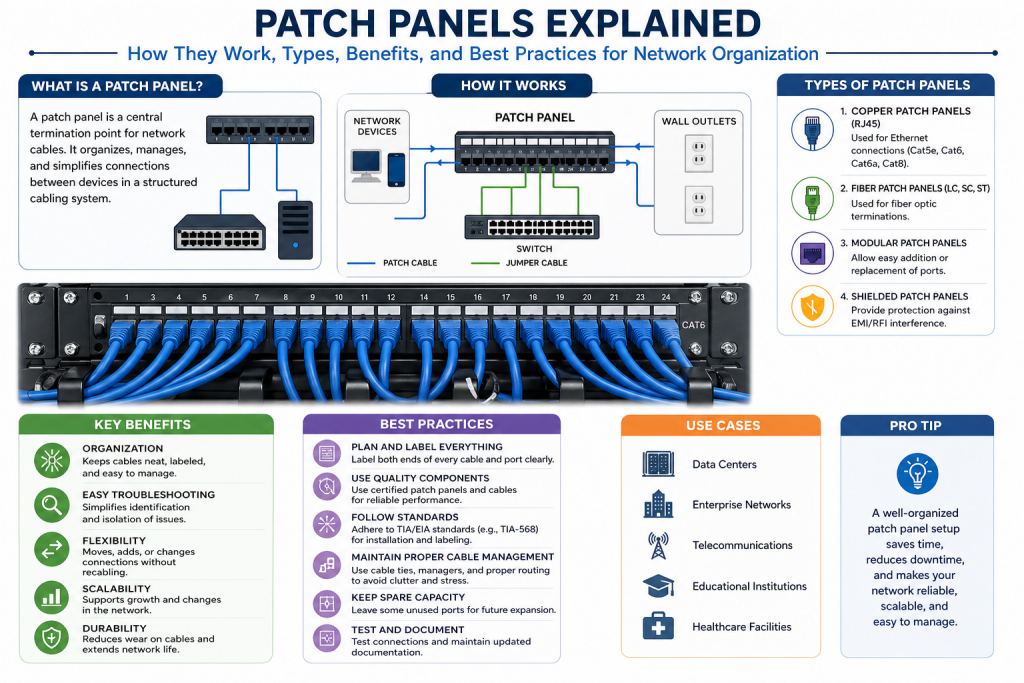
A patch panel is a fundamental component in structured cabling systems and modern computer networks. It serves as a central point where all network cables come together, making it easier to organize, manage, and maintain connections. In environments where multiple devices need to communicate—such as offices, data centers, schools, and enterprises—patch panels play a critical role in keeping everything efficient and orderly.
Without a patch panel, network cables would typically run directly from devices to switches or routers. This approach quickly becomes difficult to manage as the number of devices increases. Cables become tangled, difficult to trace, and prone to accidental disconnections. A patch panel eliminates this chaos by introducing a structured layout where each cable has a designated place.
In simple terms, a patch panel does not process or direct data. Instead, it provides a physical interface that allows cables to be connected in an organized way. This makes it easier for network administrators to handle changes, identify issues, and maintain the network over time.
What is a Patch Panel
A patch panel is a passive networking device that contains multiple ports into which network cables are plugged. It is typically mounted on a rack and positioned close to network switches. The cables from various locations, such as workstations or wall outlets, are connected to the back of the panel. On the front side, short cables—known as patch cords—are used to connect the panel to a network switch.
The term passive means that the patch panel does not require power and does not influence the flow of data. It simply acts as a bridge between incoming cables and networking equipment. This simplicity is one of the reasons patch panels are highly reliable and widely used.
Patch panels come in different sizes depending on the number of ports they provide. Common configurations include 12, 24, 48, and 96 ports. The choice of size depends on the scale of the network and the number of connections required.
They are also designed to support different types of cables. Most commonly, patch panels are used with Ethernet cables such as Cat5e, Cat6, and Cat6a. Some panels are also designed for fiber optic connections, allowing them to be used in high-speed or long-distance networks.
The Role of Patch Panels in Network Organization
One of the primary reasons for using a patch panel is to maintain organization within a network. As networks grow, the number of cables increases significantly. Without a proper system, managing these cables becomes extremely difficult.
A patch panel provides a centralized point where all network cables can be neatly terminated and labeled, making it much easier for administrators to identify and manage connections. This structured approach reduces clutter and helps prevent tangled or misplaced cables, which can otherwise lead to confusion and downtime.
In addition to improving physical organization, patch panels also simplify troubleshooting and maintenance. When an issue arises, technicians can quickly trace and isolate the problem by referring to labeled ports rather than following cables across an entire workspace or server room. This saves valuable time and minimizes disruptions to network operations. Furthermore, patch panels allow for easy reconfiguration of network connections without the need to handle the main cabling infrastructure directly. Instead of unplugging and reconnecting long cables, changes can be made using short patch cords at the panel, reducing wear and tear on permanent cabling.
Overall, patch panels contribute to a cleaner, more efficient, and scalable network environment, making them an essential component in both small and large network setups.
A patch panel provides a centralized location where all cables terminate. This allows administrators to label each connection clearly. For example, each port can be associated with a specific room, desk, or device. This labeling system makes it easy to identify where a cable leads without physically tracing it.
Organization also improves the overall appearance of the network setup. Instead of a cluttered mass of wires, cables are neatly arranged and secured. This not only looks professional but also reduces the risk of damage and interference.
Another advantage of organized cabling is improved airflow in network racks. When cables are neatly arranged, they do not block ventilation, which helps prevent overheating of active devices such as switches and routers.
How Patch Panels Fit into a Network Setup
In a typical network installation, the patch panel is installed in a rack along with other networking equipment. It is usually placed near the network switch to allow for short and efficient connections.
. This proximity helps reduce cable length, minimize signal loss, and maintain a clean and organized setup within the rack. By keeping patch panels and switches close together, administrators can use shorter patch cords, which not only improves airflow but also makes the overall system easier to manage.
Additionally, rack-mounted patch panels are designed to fit standardized rack units, making them compatible with most server racks and cabinets. This standardization ensures that different types of equipment can be integrated seamlessly within the same infrastructure. Proper placement within the rack also allows for better cable routing, often supported by cable management accessories such as horizontal and vertical organizers. These tools help guide cables neatly, prevent strain on connectors, and reduce the risk of accidental disconnections.
Another important benefit of this setup is accessibility. When patch panels are installed at a convenient height within the rack, technicians can quickly access ports for making changes, performing maintenance, or troubleshooting issues. Clear labeling on the patch panel further enhances this process by allowing easy identification of each connection. Overall, installing patch panels near switches within a rack creates a more efficient, organized, and professional network environment that supports long-term scalability and reliability.
Cables from different areas of a building are routed through walls or ceilings and brought into the back of the patch panel. These cables are permanently installed and are not meant to be frequently moved or disconnected. Once connected, they remain in place as part of the network’s infrastructure.
On the front side of the patch panel, each port corresponds to a cable connected at the back. Short patch cords are then used to connect these ports to the switch. This setup creates a flexible system where changes can be made easily by adjusting the front connections without disturbing the permanent wiring.
This separation between permanent and temporary connections is a key benefit. It reduces wear and tear on the main cables and ensures that the network remains stable even when changes are made.
The Purpose of a Patch Panel
The main purpose of a patch panel is to simplify cable management and improve network efficiency. By providing a central point for connections, it becomes much easier to manage multiple cables and devices.
One important function of a patch panel is to allow quick reconfiguration. If a device needs to be moved or a connection needs to be changed, it can be done by simply unplugging and reconnecting a patch cord. There is no need to reroute long cables or access difficult areas.
Patch panels also make troubleshooting easier. When a problem occurs, the administrator can quickly locate the relevant port and check the connection. This reduces the time needed to identify and fix issues.
Another purpose is to protect network equipment. Constantly plugging and unplugging cables directly into a switch can cause wear on its ports. By using a patch panel, these changes are made on the panel instead, preserving the switch and extending its lifespan.
When Should You Use a Patch Panel
A patch panel becomes increasingly useful as the size of a network grows. In very small setups with only a few devices, it may not be necessary. However, once the number of connections exceeds a manageable level, a patch panel becomes essential.
For example, in an office with multiple employees, each workstation requires a network connection. Without a patch panel, all cables would run directly to the switch, creating clutter and making management difficult. A patch panel solves this problem by organizing all connections in one place.
Patch panels are especially important in environments with rack-mounted equipment. In such setups, organization and accessibility are critical. A patch panel ensures that cables are neatly arranged and easy to access when needed.
They are also recommended when future expansion is expected. Installing a patch panel early allows the network to grow without major changes to the existing infrastructure.
How Patch Panels Work
The operation of a patch panel is straightforward. Cables enter the panel from the back and are terminated onto connectors. These connectors correspond to ports on the front of the panel.
When a connection is needed, a short patch cord is used to link a port on the panel to a port on the switch. This creates a complete path for data to travel from the device to the network.
The key idea is that the patch panel acts as an intermediary. It does not process or modify data in any way. Instead, it provides a convenient way to connect and disconnect cables without affecting the underlying infrastructure.
This design makes it easy to manage connections. If a device needs to be disconnected, the patch cord can simply be removed. The main cable remains untouched, ensuring stability and reliability.
Managing Physical Connections
Managing physical connections is one of the most important roles of a patch panel. In a network without one, cables would run directly from each device to the switch. This results in long, messy cables that are difficult to organize.
With a patch panel, all cables terminate in a single location. This creates a clean and structured layout where each connection is clearly defined. It becomes much easier to add, remove, or modify connections as needed.
Another advantage is that cables can be labeled at the panel. This makes it easy to identify which cable belongs to which device or location. In large networks, this level of organization is essential for efficient management.
Proper management of physical connections also reduces the risk of errors. When cables are clearly labeled and organized, there is less chance of connecting the wrong cable or disrupting other connections.
Benefits of Using a Patch Panel
Using a patch panel offers several benefits that improve the overall performance and maintainability of a network.
One major benefit is improved organization. By centralizing all connections, patch panels eliminate clutter and make it easier to manage cables. This leads to a more professional and efficient setup.
Another benefit is flexibility. Changes can be made quickly and easily by adjusting patch cords. This is especially useful in dynamic environments where devices are frequently added or moved.
Patch panels also enhance troubleshooting. When a problem occurs, it can be quickly isolated to a specific port. This reduces downtime and helps maintain productivity.
Additionally, patch panels protect network equipment. By reducing the need to frequently connect and disconnect cables from switches, they help extend the lifespan of these devices.
Do Patch Panels Affect Network Performance
A common question is whether patch panels impact network performance. The answer is no. Patch panels do not degrade signal quality because they are passive devices.
They do not amplify, filter, or alter data in any way. Instead, they simply provide a physical connection between cables. As long as the cables are properly installed and terminated, the signal will pass through the panel without any issues.
However, poor-quality cables or incorrect installation can affect performance. For example, a cable that is not properly crimped may cause signal loss or connectivity problems. These issues are related to the cables, not the patch panel itself.
By using high-quality cables and following proper installation practices, networks can maintain optimal performance while benefiting from the organization provided by patch panels.
Types of Patch Panels and Cable Categories
Patch panels are available in different types, mainly based on the kind of cables they support and the environments they are designed for. The most common patch panels used in modern networks are Ethernet patch panels, which support twisted-pair cables such as Cat5e, Cat6, and Cat6a. These cables are widely used in Local Area Networks because they offer reliable performance and are relatively easy to install.
Cat5e patch panels are designed for networks that require speeds up to 1 Gbps over distances of up to 100 meters. They are suitable for basic office environments where high-speed data transfer is not a critical requirement. Cat6 patch panels, on the other hand, are built to handle higher frequencies and support faster speeds, including up to 10 Gbps over shorter distances. Cat6a panels extend this capability even further, allowing 10 Gbps speeds over the full 100-meter distance.
In addition to copper-based patch panels, there are also fiber optic patch panels. These are used in environments where extremely high speeds and long-distance communication are required, such as data centers or telecommunications networks. Fiber patch panels are designed to manage delicate fiber cables and provide precise connections through specialized connectors.
Another type is the modular or keystone patch panel. Instead of fixed ports, these panels allow individual keystone modules to be inserted. This design provides flexibility, as different types of connectors can be used within the same panel, including Ethernet, fiber, HDMI, or even audio connections.
Understanding Cable Categories and Their Impact
The performance of a network depends heavily on the type of cables used. Patch panels themselves do not determine speed, but they must be compatible with the cable category to ensure proper performance.
Cat5e cables are an improved version of the original Cat5 standard. They are capable of handling gigabit speeds and are still widely used in many existing networks. However, as network demands increase, Cat6 cables have become more popular due to their higher bandwidth and improved performance.
Cat6 cables are designed with tighter twists and better insulation, which reduces interference and allows for faster data transmission. Cat6a cables take this a step further by offering even better shielding and performance over longer distances.
It is important to note that the entire network must be consistent in terms of cable category to achieve the best results. Using a high-quality patch panel with lower-grade cables will not improve performance. The network will always operate at the level of its weakest component.
Differences Between Cat5e and Cat6 Patch Panels
Although Cat5e and Cat6 patch panels may look similar, they are designed to meet different technical specifications. Cat6 patch panels are built to handle higher frequencies, which allows them to support faster data transmission.
The internal design of Cat6 panels includes better insulation and separation between wires to reduce crosstalk and interference. This makes them more suitable for high-performance networks where reliability and speed are critical.
Despite these differences, Cat5e and Cat6 patch panels are generally compatible with each other. You can use a Cat6 cable in a Cat5e patch panel and vice versa, but doing so may limit performance. For example, if a Cat6 cable is connected through a Cat5e panel, the network may only achieve Cat5e speeds.
For this reason, it is recommended to use matching components throughout the network. This ensures consistent performance and avoids unnecessary bottlenecks.
Wiring Standards Used in Patch Panels
Patch panels follow specific wiring standards that determine how the individual wires inside an Ethernet cable are connected to the panel. The two most widely used standards are T568A and T568B.
Both standards define the arrangement of the eight wires inside a twisted-pair cable. The main difference between them is the order of the wire pairs. Functionally, they are identical and provide the same level of performance.
The key requirement when using these standards is consistency. All cables in the network should follow the same wiring standard. Mixing T568A and T568B can lead to connectivity issues and signal problems.
Most modern networks use the T568B standard, but T568A is still common in certain installations. The choice between the two often depends on organizational preferences or existing infrastructure.
Compatibility Between Different Patch Panels
One of the strengths of patch panels is their compatibility with various networking components. As long as the cables and connectors follow standard specifications, different types of patch panels can be used together.
For example, a network may include both Cat5e and Cat6 patch panels. While this is technically possible, the overall performance will be limited by the lower category. This is because data transmission can only be as fast as the slowest link in the chain.
Compatibility also extends to connectors and keystone modules. Modular patch panels allow different types of connections to coexist within the same system. This makes it easier to integrate various technologies without major changes to the infrastructure.
Patch Panel Versus Network Switch
A patch panel is often confused with a network switch, but they serve completely different purposes. Understanding this distinction is essential for anyone working with network infrastructure.
A network switch is an active device that manages data traffic between connected devices. It receives data packets and determines where they should be sent. This process requires power and involves complex internal processing.
In contrast, a patch panel is a passive device. It does not process or direct data in any way. Its role is simply to provide a structured way to connect cables.
The switch can be thought of as the brain of the network, while the patch panel acts as the organizational framework. Both are important, but they perform very different functions.
Active and Passive Networking Components
Networking devices can be broadly categorized into active and passive components. Active components include switches, routers, and access points. These devices require power and perform tasks such as data routing, signal processing, and communication management.
Passive components, on the other hand, do not require power and do not process data. Patch panels, cables, and connectors fall into this category. Their role is to provide the physical infrastructure that supports the network.
Understanding this distinction helps clarify why patch panels are so reliable. Since they do not rely on electronic components, they are less likely to fail and require minimal maintenance.
Why Patch Panels Do Not Route Traffic
Patch panels do not route traffic because they lack the necessary electronic circuitry. They are essentially a collection of connectors that link cables together.
When data travels through a patch panel, it simply passes from one cable to another without any modification. The panel does not analyze, filter, or redirect the data.
All routing decisions are handled by active devices such as switches and routers. These devices use algorithms and protocols to determine the best path for data to travel.
The simplicity of patch panels is actually one of their greatest strengths. By focusing solely on physical connections, they provide a stable and dependable foundation for the network.
Introduction to Keystone Modules
Keystone modules are small, interchangeable components that can be inserted into patch panels or wall plates. They provide a way to support different types of connections within a single system.
For example, a keystone module can be used to connect Ethernet cables, telephone lines, fiber optics, or even multimedia connections such as HDMI. This flexibility makes them a valuable addition to modern networks.
Keystone modules are designed to snap into place, making them easy to install and replace. This modular approach allows networks to adapt to changing requirements without needing to replace the entire patch panel.
How Keystone Modules Work
A keystone module acts as an interface between a cable and the patch panel. It contains connectors that allow cables to be terminated securely and connected to other devices.
For example, in a network that includes both Ethernet and telephone systems, keystone modules can be used to accommodate both types of connections. A telephone line can be connected through a keystone module and then integrated into the network infrastructure.
This approach simplifies installation and maintenance. Instead of dealing with different types of panels, a single modular panel can be used with various keystone modules.
Patch Panel Versus Keystone Modules
While patch panels and keystone modules are closely related, they serve different roles. A patch panel is the central structure that holds multiple connections, while keystone modules are the individual connectors that fit into the panel.
The patch panel provides organization and structure, while the keystone modules provide flexibility. Together, they create a system that can support a wide range of connection types.
In some cases, keystone modules are installed in wall plates instead of patch panels. This allows devices to connect directly to the network from different locations within a building. The cables from these wall plates are then routed back to the patch panel.
Flexibility in Modern Network Design
One of the biggest advantages of using patch panels and keystone modules is flexibility. Networks are constantly evolving, with new devices and technologies being introduced regularly.
A modular approach allows these changes to be accommodated بسهولة. New types of connections can be added without replacing existing infrastructure. This reduces costs and minimizes disruption.
For example, if a network needs to support fiber optic connections in addition to Ethernet, keystone modules can be added to the existing patch panel. This allows the network to expand without requiring a complete redesign.
Practical Applications of Patch Panels
Patch panels are used in a wide range of environments, from small offices to large data centers. In office settings, they help organize connections for computers, printers, and other devices.
In data centers, patch panels play a critical role in managing large numbers of connections. They provide a structured way to handle complex cabling systems and ensure that everything remains accessible and organized.
They are also used in telecommunications networks, where they help manage connections between different systems and services. In these environments, reliability and organization are essential
Advantages of Using Patch Panels
Patch panels offer a wide range of advantages that make them an essential component in structured networking systems. One of the most significant benefits is improved cable organization. In any environment where multiple devices are connected, cables can quickly become disorganized and difficult to manage. A patch panel provides a centralized location where all cables can be neatly arranged and labeled, reducing clutter and confusion.
Another important advantage is efficiency. With a patch panel, network administrators can quickly identify and access specific connections. This makes it easier to perform maintenance tasks, troubleshoot issues, and make changes to the network without disrupting other connections. Instead of tracing cables through walls or ceilings, everything can be managed from a single location.
Patch panels also contribute to a more professional and visually appealing setup. Organized cabling not only improves functionality but also enhances the overall appearance of a network installation. This is particularly important in business environments where presentation and reliability are key factors.
Improved Cable Management and Organization
Cable management is one of the primary reasons for using a patch panel. In a network without proper organization, cables can become tangled and difficult to trace. This can lead to errors, increased maintenance time, and potential damage to cables.
A patch panel solves this problem by providing a structured layout for all connections. Each cable is terminated at a specific port, which can be labeled to indicate its destination. This labeling system makes it easy to identify and manage connections, even in large networks with hundreds of cables.
Organized cabling also reduces the risk of accidental disconnections. When cables are neatly arranged and secured, they are less likely to be disturbed during routine maintenance or when new devices are added. This helps maintain network stability and reduces downtime.
In addition, proper cable management improves airflow within network racks. When cables are not obstructing ventilation, active devices such as switches and routers can operate more efficiently and maintain optimal temperatures.
Simplified Troubleshooting
Troubleshooting network issues can be a complex and time-consuming process, especially in large installations. Patch panels make this process much easier by providing a clear and organized view of all connections.
When a problem occurs, the administrator can quickly locate the relevant port on the patch panel. By checking the connection at that point, it becomes easier to determine whether the issue is related to the cable, the device, or the network equipment.
This centralized approach reduces the need to trace cables physically, which can be difficult and time-consuming. It also minimizes the risk of disrupting other connections while trying to identify the source of a problem.
In many cases, issues can be resolved simply by replacing or reconnecting a patch cord. This quick and efficient troubleshooting process helps maintain network performance and reduces downtime.
Flexibility and Ease of Reconfiguration
One of the key benefits of using a patch panel is the flexibility it provides. Networks are constantly evolving, with devices being added, removed, or relocated. A patch panel makes it easy to accommodate these changes without major disruptions.
Instead of rerouting long cables, changes can be made by simply adjusting the patch cords on the front of the panel. This allows for quick reconfiguration of connections, saving time and effort.
For example, if a workstation is moved to a different location, the network connection can be updated by changing the patch cord at the panel. There is no need to install new cables or modify the existing infrastructure.
This flexibility is particularly valuable in dynamic environments such as offices, where changes are frequent. It allows the network to adapt to new requirements while maintaining a stable and organized structure.
Protection of Network Equipment
Patch panels also help protect valuable network equipment. Network switches and routers are designed to handle data traffic, but their ports can wear out over time if cables are frequently plugged and unplugged.
By using a patch panel, these changes are made on the panel instead of directly on the switch. This reduces wear and tear on the switch ports, extending the lifespan of the equipment.
In addition, patch panels provide a buffer between the permanent cabling and active devices. This separation helps prevent accidental damage to critical components and ensures that the network remains stable even when changes are made.
Scalability and Future Expansion
As networks grow, the need for scalability becomes increasingly important. Patch panels make it easier to expand a network without major changes to the existing infrastructure.
By providing additional ports, patch panels allow new devices to be connected بسهولة. This makes it possible to scale the network gradually, adding new connections as needed.
Patch panels also support future upgrades. For example, if a network needs to transition from Cat5e to Cat6 cables, the existing patch panel can often be reused or easily upgraded. This reduces the cost and complexity of network improvements.
In large organizations, scalability is a critical factor. Patch panels provide the flexibility needed to accommodate growth while maintaining organization and efficiency.
Cost Considerations
Patch panels are relatively affordable compared to other networking components. Basic models with fewer ports are inexpensive, while larger panels with more ports may cost more. However, even high-capacity patch panels are generally cost-effective when considering their benefits.
The main cost associated with patch panels is installation. Proper setup requires time and expertise, including cable termination, labeling, and rack mounting. This can increase the initial investment, especially in large networks.
Despite these costs, patch panels often provide long-term savings. Improved organization and easier maintenance reduce the time and effort required to manage the network. This leads to increased efficiency and lower operational costs.
In addition, the ability to reuse and upgrade patch panels makes them a cost-effective solution for growing networks.
Installation Requirements and Complexity
Installing a patch panel requires careful planning and attention to detail. The panel must be mounted securely in a rack, and cables must be properly routed and terminated.
Each cable needs to be connected to the correct port, and labeling should be applied to ensure easy identification. This process can be time-consuming, especially in large networks with many connections.
Accessibility is another important consideration. Both the front and back of the patch panel should be easily accessible for maintenance and troubleshooting. This ensures that changes can be made quickly and efficiently.
While installation may require some effort, the long-term benefits of using a patch panel outweigh the initial complexity. Once installed, the panel provides a stable and organized foundation for the network.
Space and Placement Considerations
Patch panels require space within a network rack, so proper planning is essential. They are typically installed close to network switches to allow for short and efficient connections.
In environments with limited space, careful arrangement of equipment is necessary to ensure that everything fits properly. Adequate spacing should be maintained to allow for airflow and easy access.
Placement also affects usability. A well-positioned patch panel makes it easier to manage connections and perform maintenance tasks. Poor placement, on the other hand, can make it difficult to access cables and may lead to inefficiencies.
By planning the layout of the network rack in advance, it is possible to optimize space and ensure that the patch panel is used effectively.
Maintenance and Upkeep
One of the advantages of patch panels is that they require minimal maintenance. Since they are passive devices, there are no electronic components that can fail.
Regular inspections should be conducted to ensure that cables are securely connected and properly labeled. Any loose or damaged cables should be repaired or replaced to maintain optimal performance.
Cleaning and organizing cables periodically can also help prevent issues. Keeping the panel tidy ensures that connections remain accessible and reduces the risk of errors.
With proper care, a patch panel can last for many years without requiring significant maintenance.
Signal Quality and Reliability
Patch panels do not degrade signal quality. Since they are passive devices, they do not interfere with data transmission. As long as the cables are properly installed and terminated, the signal will pass through the panel without any issues.
However, poor installation practices can affect performance. For example, improperly crimped cables or loose connections can cause signal loss or interference. These issues are not caused by the patch panel itself but by the quality of the cabling.
Using high-quality cables and following best practices for installation ensures reliable performance. This includes proper cable management, secure connections, and consistent wiring standards.
Limitations of Patch Panels
While patch panels offer many benefits, they also have some limitations. One of the main drawbacks is the initial setup effort. Installing a patch panel requires time and expertise, which may not be practical for very small networks.
Another limitation is space. Patch panels require room in a network rack, which may be limited in certain environments. This can make it challenging to incorporate them into smaller setups.
Cost can also be a factor, particularly when considering installation and labor. While the panels themselves are affordable, the overall cost of implementation can be higher.
Despite these limitations, the advantages of patch panels generally outweigh the drawbacks, especially in medium to large networks.
Real-World Use Cases
Patch panels are widely used in various environments, including offices, data centers, educational institutions, and industrial facilities. In offices, they help manage connections for computers, printers, and other devices.
In data centers, patch panels are essential for handling large numbers of connections. They provide a structured way to manage complex cabling systems and ensure that everything remains organized.
Educational institutions use patch panels to support networks across classrooms, labs, and administrative areas. This allows for efficient management of resources and easy expansion as needed.
In industrial settings, patch panels help maintain reliable communication between equipment and systems. Their durability and simplicity make them suitable for demanding environments.
Conclusion
Patch panels are a vital component in modern networking, providing a practical solution for organizing and managing cables. They simplify maintenance, improve efficiency, and support scalability, making them an essential tool for networks of all sizes.
By centralizing connections, patch panels create a structured and reliable system that is easy to manage and expand. They protect network equipment, reduce downtime, and make troubleshooting more efficient.
Although they require initial effort to install and may take up space, their long-term benefits far outweigh these challenges. With proper planning and implementation, patch panels can significantly enhance the performance and maintainability of a network.
In today’s increasingly connected world, where networks continue to grow in complexity, the importance of proper cable management cannot be overstated. Patch panels provide the foundation for a well-organized and efficient network, ensuring that it remains reliable and adaptable for years to come.
Continue exploring the technologies and certification concepts that matter most to you.