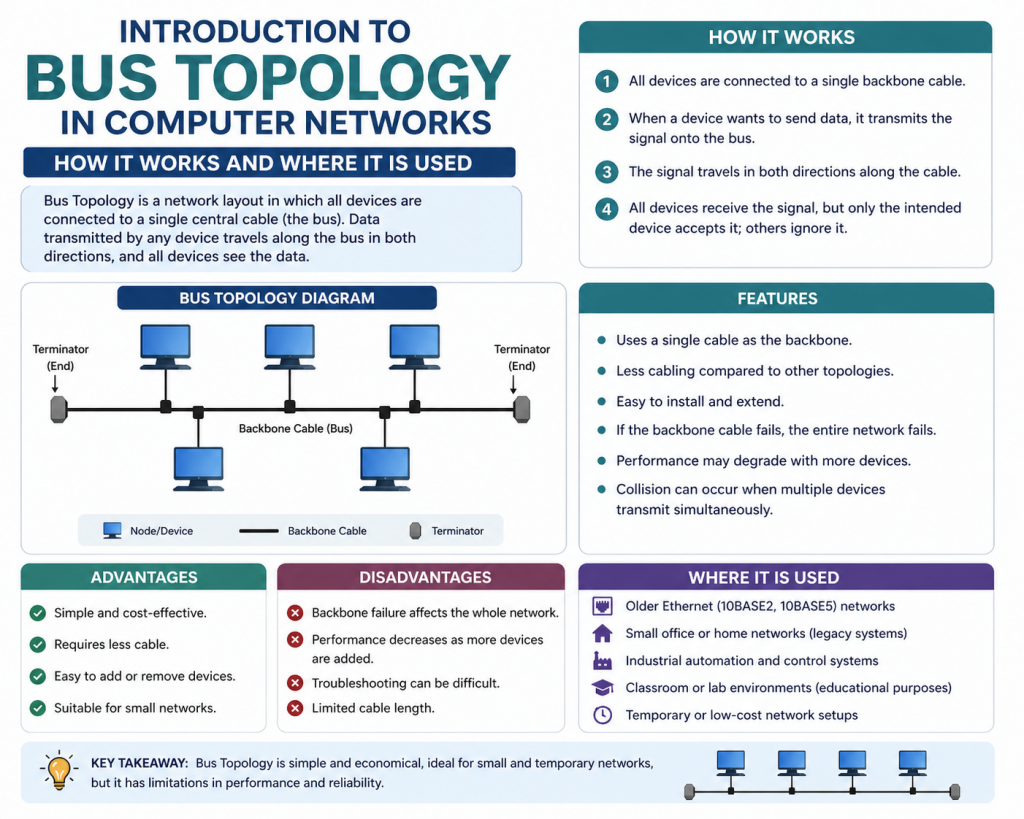
Bus topology is one of the earliest and simplest forms of network design used to connect multiple devices. In this configuration, all devices are linked to a single central cable known as the bus. This cable acts as the primary communication pathway, allowing devices to send and receive data across the network.
Unlike more complex network structures, bus topology does not rely on central devices such as switches or routers to manage communication. Instead, it uses a shared communication line where every connected device has equal access. When a device transmits data, that information travels across the entire length of the cable and becomes available to all connected devices.
Each device connected to the network listens to the transmitted data and determines whether it is the intended recipient. If the data matches its address, it processes the information. If not, it simply ignores the transmission. This mechanism is known as broadcasting and is a defining feature of bus topology.
Because of its simplicity and minimal hardware requirements, bus topology has historically been used in small-scale networks. It is easy to set up, cost-effective, and requires less cabling compared to many other topologies. However, as networks expand, this design begins to show limitations that make it less suitable for modern large-scale environments.
Understanding bus topology provides a strong foundation for learning networking concepts, especially for those studying computer networks or preparing for certifications.
Understanding Network Topology
To fully grasp bus topology, it is essential to understand what network topology means. Network topology refers to the arrangement or layout of devices in a network. It defines how devices are connected and how data flows between them.
There are two main perspectives of network topology. Physical topology describes the actual layout of cables, devices, and connections. Logical topology, on the other hand, explains how data moves through the network regardless of the physical arrangement.
Different types of topologies exist to meet different networking needs. Some prioritize performance, while others focus on reliability or cost efficiency. The most commonly used network topologies include bus, star, ring, mesh, and tree.
Each topology has its own characteristics, advantages, and disadvantages. For example, some are better suited for large networks with high traffic, while others are ideal for small and simple setups. Network designers evaluate factors such as budget, scalability, maintenance, and performance requirements before choosing a topology.
Bus topology stands out because of its minimalistic design. It requires fewer components and less planning compared to other structures. This makes it an excellent starting point for understanding how networks function at a basic level.
Purpose of Bus Topology
The primary purpose of bus topology is to create a simple and efficient network using a shared communication medium. By connecting all devices to a single cable, it eliminates the need for complex wiring and additional hardware.
This simplicity makes bus topology particularly useful in environments where resources are limited or where a temporary network is needed. It allows multiple devices to communicate without requiring sophisticated infrastructure.
Another purpose of bus topology is to provide an easy way to expand a network. New devices can be added by connecting them to the existing bus without major modifications. This flexibility makes it convenient for small setups that may need occasional expansion.
Bus topology also reduces installation time. Since there is only one main cable and fewer components involved, setting up the network is relatively quick. This can be beneficial in situations where time and cost are critical factors.
Despite these advantages, the purpose of bus topology is best fulfilled in smaller networks. As the number of devices increases, the efficiency of the system decreases due to higher traffic and increased chances of data collisions.
How Bus Topology Works
Bus topology operates through a straightforward communication process. All devices are connected to a single cable, and this cable carries all the data transmitted within the network.
When a device wants to send data, it places the data onto the bus. The signal then travels along the cable in both directions. Every device connected to the bus receives the signal and checks the destination address contained within the data packet.
If a device recognizes that the data is meant for it, it accepts and processes the information. If not, it discards the data. This ensures that only the intended recipient responds, even though all devices receive the transmission.
The communication process continues as different devices take turns sending data. Since the bus is shared, only one device can transmit at a time. If multiple devices attempt to send data simultaneously, a collision occurs.
This method of communication is simple but requires coordination among devices to avoid conflicts. Various mechanisms are used to manage access to the bus and ensure that data is transmitted successfully.
Half-Duplex Communication in Bus Topology
Bus topology uses half-duplex communication, which means that data can travel in both directions along the cable but not at the same time. A device can either send data or receive data at any given moment, but it cannot do both simultaneously.
This limitation affects how communication occurs in the network. Devices must wait for the bus to be free before transmitting data. If the bus is already in use, the device must delay its transmission until the line becomes available.
Half-duplex communication helps simplify the design of the network but can reduce efficiency, especially when multiple devices need to communicate frequently. As network traffic increases, the waiting time for transmission also increases.
This characteristic makes bus topology less suitable for environments that require high-speed communication or continuous data exchange. However, for small networks with limited traffic, half-duplex communication is usually sufficient.
Understanding Data Collisions
A significant challenge in bus topology is the occurrence of data collisions. A collision happens when two or more devices attempt to transmit data on the bus at the same time.
When this happens, the signals overlap and interfere with each other, resulting in corrupted data. The network must then handle the collision to ensure that the data is eventually transmitted correctly.
Typically, devices detect collisions and stop transmitting immediately. They then send a signal indicating that a collision has occurred. After that, each device waits for a random period before attempting to retransmit the data.
This process reduces the likelihood of repeated collisions but does not eliminate them entirely. As more devices are added to the network, the chances of collisions increase significantly.
Frequent collisions can slow down the network and reduce overall performance. This is one of the main reasons why bus topology is not commonly used in large or high-traffic networks.
The Role of the Bus Cable
The bus cable is the central component of the topology. It serves as the backbone of the network, connecting all devices and carrying all communication signals.
This cable is usually a coaxial cable or, in some cases, a twisted pair cable. The choice of cable depends on factors such as cost, performance requirements, and network design.
All devices rely on this single cable for communication. If the cable becomes damaged or disconnected, the entire network can fail. This makes the bus cable a critical point of dependency.
Because the bus cable is shared by all devices, it must be capable of handling the total data traffic of the network. As more devices are added, the demand on the cable increases, which can lead to congestion and reduced performance.
Maintaining the integrity of the bus cable is essential for the proper functioning of the network. Any faults or interruptions can have a significant impact on connectivity.
Drop Lines and Connections
Devices in a bus topology do not connect directly to each other. Instead, they connect to the main bus cable using smaller cables known as drop lines.
These drop lines attach to the bus through connectors or taps. This setup allows devices to access the communication line without interfering with the main cable.
Each connection point represents a potential weakness in the network. Loose or faulty connections can cause disruptions and affect the overall performance.
However, the use of drop lines also provides flexibility. Devices can be added or removed without affecting the rest of the network, as long as the main cable remains intact.
This modular approach makes bus topology easy to manage in small environments where changes are frequent.
Broadcast Communication Explained
Broadcast communication is a key feature of bus topology. When a device sends data, it is transmitted to all devices on the network simultaneously.
Each device receives the data and examines it to determine whether it is the intended recipient. Only the device with the matching address processes the data, while others ignore it.
This method simplifies communication because there is no need for complex routing or switching mechanisms. However, it can also be inefficient, as every device must process every transmission.
Broadcast communication works well in small networks where traffic is limited. In larger networks, it can lead to unnecessary processing and increased congestion.
Despite its limitations, broadcasting remains an important concept in networking and is used in various forms across different topologies.
Importance of Terminators
In a bus topology, terminators are placed at both ends of the main cable. Their role is to absorb signals that reach the end of the line.
Without terminators, signals would reflect back along the cable, causing interference with new transmissions. This reflection can lead to data corruption and communication errors.
Terminators ensure that signals travel in one direction and stop at the end of the cable. This helps maintain the stability and reliability of the network.
Proper installation of terminators is essential. If they are missing or faulty, the network may experience significant performance issues.
Characteristics of Bus Topology
Bus topology has several defining characteristics that distinguish it from other network designs. All devices share a single communication medium, which reduces complexity but increases dependency on the main cable.
Data is transmitted using a broadcast method, allowing all devices to receive the same signal. The network operates in half-duplex mode, limiting simultaneous communication.
Terminators are required at both ends of the cable to prevent signal reflection. The topology is best suited for small networks due to its limited scalability.
These characteristics make bus topology simple and cost-effective but also introduce limitations that affect performance and reliability.
Basic Example of Bus Topology
Consider a small network in a single room where several computers are connected using a single cable. Each computer is linked to the cable through a connector, forming a linear structure.
When one computer sends data, the signal travels along the cable and reaches all other computers. Each one checks the data to see if it is intended for them.
This setup allows communication without requiring complex hardware. It is easy to install and manage, making it suitable for small-scale use.
However, if the cable is damaged or disconnected, all communication stops. This highlights the importance of maintaining the integrity of the main cable.
Real-World Applications
Bus topology has been used in various real-world scenarios, particularly in earlier networking environments. It was common in small offices, schools, and temporary setups where simplicity and cost were important.
In such environments, the ease of installation and minimal hardware requirements made bus topology a practical choice. It allowed multiple devices to communicate without requiring advanced infrastructure.
Although it is less common today, the principles of bus topology are still relevant. Some modern network designs incorporate elements of this topology in hybrid configurations.
Understanding how bus topology works helps in learning more advanced networking concepts and appreciating the evolution of network design.
Limitations of Bus Topology
While bus topology offers several advantages, it also has notable limitations. The reliance on a single cable creates a single point of failure. If the cable is damaged, the entire network is affected.
As more devices are added, network performance decreases due to increased traffic and higher chances of collisions. Troubleshooting can also become challenging, as identifying faults in the cable or connections may require extensive effort.
These limitations make bus topology less suitable for large or high-performance networks. However, for small and simple setups, it remains a useful and effective solution.
Introduction to the Strengths and Weaknesses of Bus Topology
After understanding the structure and working principles of bus topology, the next step is to evaluate its practical value. Every network design comes with its own benefits and drawbacks, and bus topology is no exception. While it is often praised for its simplicity and low cost, it also presents several limitations that become more noticeable as the network grows.
In this section, the focus will be on examining the advantages, disadvantages, and overall performance behavior of bus topology. This includes how it handles traffic, how reliable it is, and what kind of environments it is best suited for.
Understanding these aspects is important because it helps determine whether bus topology is the right choice for a particular situation. It also provides insight into why modern networks tend to use alternative designs.
Advantages of Bus Topology
One of the most significant advantages of bus topology is its simplicity. The entire network is built around a single cable, and all devices connect directly to this central line. There is no need for complex routing mechanisms or advanced networking hardware.
Because of this straightforward structure, it is easy for beginners to understand how the network operates. This makes bus topology an excellent learning tool for students and individuals new to networking concepts.
The simplicity also reduces the chances of configuration errors. Since there are fewer components involved, there are fewer points where something can go wrong during setup.
Cost Effectiveness
Bus topology is one of the most cost-efficient network designs. It requires less cabling compared to other topologies, such as mesh or star. There is no need for expensive devices like switches or hubs, which further reduces the overall cost.
For small organizations or temporary setups, this can be a major advantage. The reduced hardware requirements make it possible to establish a network with minimal investment.
Maintenance costs are also relatively low. Since the system is simple, troubleshooting and repairs do not usually require specialized tools or expertise.
Easy Installation
Setting up a bus topology network is relatively quick and straightforward. All that is required is to lay down the main cable and connect each device using drop lines.
There is no need to configure central devices or establish complex connections between nodes. This makes installation less time-consuming compared to other network structures.
The ease of installation is particularly beneficial in situations where a network needs to be set up quickly, such as in temporary offices or event-based environments.
Minimal Cabling Requirements
Another advantage of bus topology is the reduced amount of cabling needed. Since all devices share a single communication line, there is no need for individual cables connecting each pair of devices.
This not only lowers the cost but also simplifies cable management. Fewer cables mean less clutter and a cleaner setup, which can be important in environments with limited space.
However, while minimal cabling is an advantage, it also introduces certain risks, which will be discussed later.
Easy Expansion for Small Networks
Adding new devices to a bus topology network is relatively simple. A new device can be connected to the existing bus without requiring significant changes to the network structure.
This flexibility makes it suitable for small networks that may need occasional expansion. Devices can also be removed easily without affecting the rest of the network, as long as the main cable remains intact.
However, this advantage is limited to small-scale expansions. As the network grows larger, the performance begins to degrade.
Disadvantages of Bus Topology
One of the most critical drawbacks of bus topology is its reliance on a single communication cable. This cable serves as the backbone of the network, and all devices depend on it for communication.
If the cable is damaged, disconnected, or malfunctioning, the entire network can go down. This makes the system highly vulnerable compared to other topologies that have multiple pathways for data transmission.
Even a minor fault in the cable can disrupt communication for all devices, making reliability a major concern.
Difficulty in Troubleshooting
While the design is simple, identifying and fixing problems in a bus topology network can be challenging. Since all devices share the same cable, it can be difficult to determine the exact location of a fault.
For example, if the network stops working, the issue could be anywhere along the cable or at any connection point. Technicians may need to inspect the entire length of the bus to find the problem.
This process can be time-consuming, especially in networks with many connected devices.
Limited Scalability
Bus topology does not scale well. As more devices are added to the network, the performance begins to decline. This is because all devices share the same communication medium, which becomes increasingly congested.
The more devices connected to the bus, the higher the chances of data collisions. This leads to delays and reduced efficiency.
Because of this limitation, bus topology is not suitable for large networks or environments with high data traffic.
Data Collisions and Network Congestion
Data collisions are a common issue in bus topology. When multiple devices attempt to transmit data at the same time, their signals interfere with each other, resulting in corrupted data.
As the number of devices increases, collisions become more frequent. This leads to repeated retransmissions, which consume bandwidth and slow down the network.
Network congestion occurs when too much data is being transmitted over the bus. Since the cable has limited capacity, excessive traffic can cause delays and reduced performance.
These issues make bus topology less efficient compared to modern network designs that use dedicated communication paths.
Performance Degradation Over Time
As the network grows and more devices are added, the overall performance of bus topology declines. This is due to increased traffic, higher collision rates, and greater demand on the shared cable.
The network becomes slower, and the time required to transmit data increases. This can affect the user experience, especially in applications that require fast and reliable communication.
In contrast, other topologies are designed to handle larger amounts of data more efficiently, making them more suitable for modern use.
Security Concerns
Bus topology also presents certain security challenges. Since all data is broadcast to every device, it is possible for unauthorized devices to intercept and read the information.
This lack of privacy can be a concern in environments where sensitive data is being transmitted. Additional security measures may be required to protect the network, which can increase complexity and cost.
Modern network designs often include built-in security features that address these issues more effectively.
Performance Factors in Bus Topology
Bandwidth refers to the amount of data that can be transmitted over a network within a given time. In bus topology, all devices share the same bandwidth, which can become a limiting factor.
As more devices use the network, the available bandwidth for each device decreases. This can lead to slower data transfer rates and reduced performance.
Bandwidth limitations are particularly noticeable in networks that handle large amounts of data, such as multimedia streaming or file transfers.
Impact of Network Size
The size of the network has a direct impact on its performance. Small networks with a limited number of devices tend to operate efficiently, with minimal collisions and delays.
However, as the network grows, the chances of collisions increase, and the overall efficiency decreases. This makes bus topology less suitable for large-scale implementations.
Keeping the network size small is essential for maintaining acceptable performance levels.
Cable Length Limitations
The length of the bus cable also affects network performance. Longer cables can lead to signal degradation, which reduces the quality of communication.
There is a maximum length beyond which the signal becomes too weak to be reliably transmitted. Exceeding this limit can result in errors and connectivity issues.
Proper planning is required to ensure that the cable length stays within acceptable limits.
Effect of Device Count
The number of devices connected to the network plays a significant role in its performance. Each additional device increases the load on the bus and contributes to potential congestion.
With more devices, the likelihood of simultaneous transmissions increases, leading to more collisions. This results in slower data transfer and reduced efficiency.
Limiting the number of devices helps maintain better performance.
Reliability Considerations
Dependence on Physical Infrastructure
Bus topology relies heavily on physical components, particularly the main cable and connectors. Any damage to these components can disrupt the entire network.
Regular maintenance is necessary to ensure that the cable and connections remain in good condition. This includes checking for wear and tear, loose connections, and other potential issues.
Lack of Redundancy
Unlike some other network topologies, bus topology does not provide alternative paths for data transmission. There is no backup route if the main cable fails.
This lack of redundancy makes the network less reliable, especially in critical applications where continuous connectivity is required.
Susceptibility to External Interference
The bus cable can be affected by external factors such as electromagnetic interference. This can disrupt signal transmission and lead to data errors.
Proper shielding and cable quality can help reduce the impact of interference, but it remains a potential issue.
Comparison with Modern Needs
Modern networks require high speed, reliability, scalability, and security. Bus topology struggles to meet these requirements, especially in large or complex environments.
While it is still useful for learning and small-scale applications, it has largely been replaced by more advanced topologies that offer better performance and reliability.
Introduction to Alternative Network Topologies
After exploring the structure, operation, advantages, and limitations of bus topology, it becomes important to understand how it compares to other network designs. While bus topology offers simplicity and cost benefits, modern networking environments often require higher performance, better reliability, and improved scalability.
To meet these needs, several alternative topologies have been developed. Each of these designs addresses specific shortcomings of bus topology while introducing its own unique characteristics. Understanding these alternatives provides a broader perspective on network design and helps in selecting the most appropriate topology for different scenarios.
In this section, the focus will be on comparing bus topology with other common network topologies, examining hybrid approaches, and exploring its relevance in modern networking environments.
Star Topology Compared to Bus Topology
Star topology is one of the most widely used network designs today. In this structure, all devices are connected to a central device, such as a switch or hub. This central device manages communication between all connected nodes.
Unlike bus topology, where all devices share a single communication line, star topology provides dedicated connections between each device and the central hub. This significantly reduces the chances of data collisions because each device communicates through its own link.
One of the biggest advantages of star topology is reliability. If one cable or device fails, it does not affect the rest of the network. This is a major improvement over bus topology, where a single cable failure can disrupt the entire system.
Star topology also offers better performance. Since communication is managed by a central device, data can be directed efficiently to the intended recipient without being broadcast to all nodes.
However, this topology requires more cabling and additional hardware, which increases the overall cost. Despite this, the benefits of reliability and performance make it a preferred choice in most modern networks.
Ring Topology Compared to Bus Topology
Ring topology organizes devices in a circular structure where each device is connected to two neighboring devices. Data travels in a specific direction around the ring until it reaches the intended recipient.
In contrast to bus topology, ring topology does not rely on broadcasting. Instead, data is passed from one device to another in sequence. This method eliminates the possibility of data collisions, as only one device transmits at a time.
Ring topology can provide more predictable performance compared to bus topology. Since data flows in a controlled manner, there is less risk of congestion and delays caused by collisions.
However, ring topology has its own limitations. If a single device or connection in the ring fails, it can disrupt the entire network. This makes it less reliable unless additional mechanisms are implemented to handle failures.
While it offers certain advantages over bus topology, its complexity and potential vulnerability to single points of failure limit its widespread use.
Mesh Topology Compared to Bus Topology
Mesh topology represents one of the most robust network designs. In this structure, devices are connected to multiple other devices, creating multiple pathways for data transmission.
This design offers high reliability and fault tolerance. If one connection fails, data can be rerouted through alternative paths. This is a significant advantage over bus topology, which depends on a single communication line.
Mesh topology also eliminates data collisions because devices can communicate directly with each other through dedicated links. This results in high performance and efficient data transmission.
However, mesh topology is complex and expensive to implement. It requires a large number of cables and connections, which increases both installation and maintenance costs.
Because of these factors, mesh topology is typically used in critical systems where reliability is more important than cost. While it is far superior to bus topology in terms of performance, it is not always practical for smaller networks.
Tree Topology Compared to Bus Topology
Tree topology is a hybrid structure that combines elements of bus and star topologies. It consists of multiple star networks connected to a central backbone, which often resembles a bus.
This design allows for better scalability compared to bus topology. Multiple groups of devices can be organized into smaller star networks, which are then connected to the main backbone.
Tree topology offers improved fault tolerance. If one branch of the network fails, other branches can continue to operate independently. This is a major advantage over bus topology, where a single failure can affect the entire network.
The hierarchical structure of tree topology also makes it easier to manage large networks. Devices can be grouped logically, which simplifies maintenance and troubleshooting.
However, tree topology is more complex and requires more hardware than bus topology. It also depends on the backbone cable, which can become a critical point of failure.
Hybrid Topologies and Their Importance
In modern networking, it is common to use hybrid topologies that combine features from multiple designs. These hybrid approaches aim to leverage the strengths of different topologies while minimizing their weaknesses.
For example, a network might use a star topology within departments and connect those departments using a backbone similar to bus topology. This creates a structure that is both efficient and scalable.
Hybrid topologies are flexible and can be customized to meet specific requirements. They allow network designers to optimize performance, reliability, and cost based on the needs of the organization.
Bus topology often plays a role in these hybrid designs, particularly as a backbone structure. While it may not be used alone, its principles continue to influence modern network architecture.
Modern Relevance of Bus Topology
Although bus topology is rarely used in its pure form today, it still holds educational and conceptual value. Understanding how it works helps in learning fundamental networking concepts such as data transmission, collisions, and shared communication mediums.
In some specialized or small-scale applications, bus topology may still be used due to its simplicity and low cost. For example, it can be found in certain embedded systems or temporary network setups.
Additionally, the concept of a shared communication line is still relevant in various technologies. Many modern systems use similar principles, even if they are implemented in more advanced ways.
Bus topology also serves as a foundation for understanding more complex network designs. By studying its strengths and weaknesses, learners can better appreciate the evolution of networking technologies.
When to Use Bus Topology
Bus topology is best suited for specific scenarios where its advantages outweigh its limitations. These include small networks with a limited number of devices and low data traffic.
It is also useful in situations where cost is a major concern. Since it requires minimal hardware, it can be an economical choice for basic networking needs.
Temporary setups, such as event-based networks or testing environments, can benefit from the quick and easy installation of bus topology.
However, it is not recommended for large or mission-critical networks. The lack of scalability, reliability, and security makes it unsuitable for modern enterprise environments.
Challenges in Modern Networking Environments
Modern networks demand high performance, reliability, and security. Bus topology struggles to meet these requirements due to its inherent limitations.
High data traffic can lead to congestion and collisions, which reduce efficiency. The reliance on a single cable creates a risk of complete network failure.
Security is another concern, as broadcast communication makes it easier for unauthorized devices to access data.
These challenges have led to the widespread adoption of more advanced topologies that offer better performance and protection.
Evolution of Network Design
Network design has evolved significantly over time. Early networks often used simple topologies like bus due to limited technology and resources.
As technology advanced, the need for faster and more reliable communication led to the development of new topologies. Star and mesh designs became more popular because they addressed many of the issues associated with bus topology.
Today, networks are more complex and capable of handling large amounts of data. They use advanced hardware and software to optimize performance and ensure reliability.
Despite these advancements, the basic principles of bus topology remain relevant and continue to influence modern designs.
Learning Value of Bus Topology
Bus topology plays an important role in education and training. It provides a clear and simple example of how networks operate.
Students can easily understand concepts such as data transmission, collisions, and shared communication. This makes it an ideal starting point for learning networking fundamentals.
By studying bus topology, learners gain a better understanding of the challenges involved in network design. This knowledge helps them appreciate the advantages of more advanced topologies.
Future Perspective
While bus topology is unlikely to be widely used in modern large-scale networks, its concepts will continue to be relevant. The idea of a shared communication medium is still present in many technologies.
Future networking solutions may incorporate similar principles in new and innovative ways. Understanding bus topology provides a foundation for exploring these developments.
As technology continues to evolve, the focus will remain on improving performance, reliability, and security. Bus topology serves as a reminder of how far networking has come and the importance of continuous innovation.
Conclusion
Bus topology is a fundamental network design that has played an important role in the development of computer networking. Its simplicity, low cost, and ease of installation made it a popular choice in early networking environments.
However, it also has significant limitations, including susceptibility to data collisions, limited scalability, and dependence on a single communication line. These drawbacks make it less suitable for modern networks that require high performance and reliability.
Alternative topologies such as star, ring, mesh, and tree offer improved performance and fault tolerance, which is why they are more commonly used today. Hybrid approaches further enhance flexibility and efficiency by combining the strengths of different designs.
Despite its reduced practical use, bus topology remains an essential concept in networking education. It provides valuable insights into how networks function and highlights the importance of choosing the right topology for specific needs.
Understanding bus topology not only helps in learning the basics of networking but also builds a strong foundation for exploring more advanced technologies.
Continue exploring the technologies and certification concepts that matter most to you.