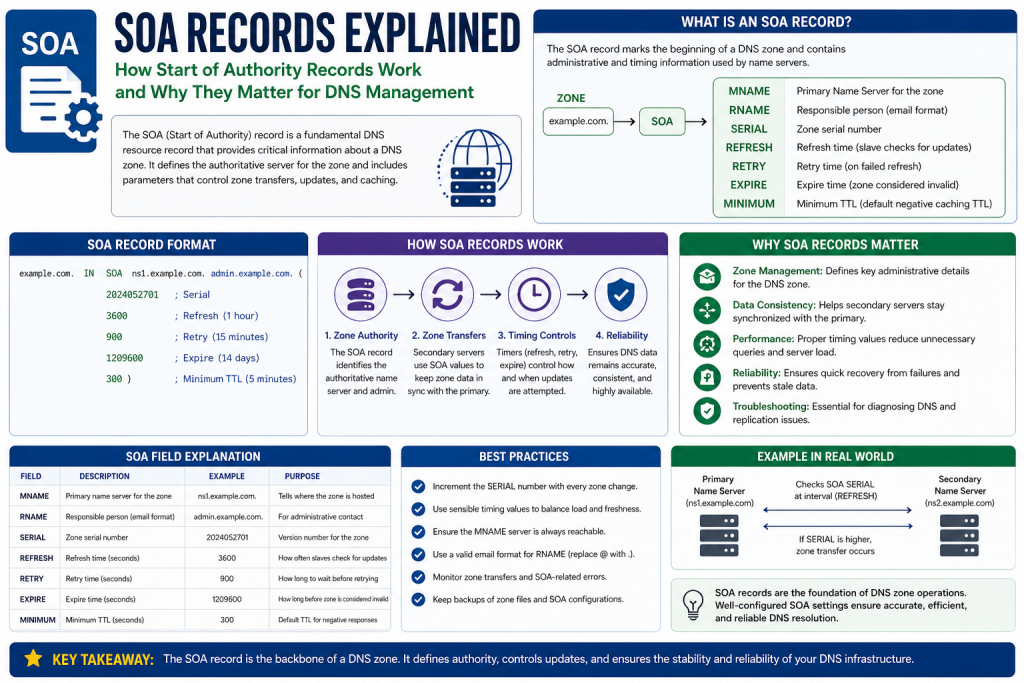
The Start of Authority (SOA) record is a fundamental element within the Domain Name System that establishes the authoritative source of information for a DNS zone. Every DNS zone begins with an SOA record, making it the first and most essential entry in the zone file. It serves as the backbone of DNS administration by defining how the zone operates, how updates are handled, and who is responsible for managing it.
In a distributed system like DNS, where multiple servers across different locations work together, consistency is critical. The SOA record ensures that all participating servers follow a unified structure and maintain synchronized data. Without it, DNS would lack coordination, leading to inconsistencies and unreliable resolution of domain names.
Although end users never directly interact with SOA records, their presence ensures that domain names resolve correctly and efficiently. They operate behind the scenes, quietly maintaining order in a system that billions of users rely on every day.
The Purpose of SOA in DNS Infrastructure
The primary purpose of an SOA record is to define authority within a DNS zone. It identifies the main server responsible for maintaining the original copy of the zone’s data. This server is known as the primary or master server, and it acts as the central point for all updates and changes.
Beyond identifying the authoritative server, the SOA record provides a framework for how other DNS servers should interact with the zone. Secondary servers, which hold copies of the zone, rely on the SOA record to determine when to check for updates and how to respond if communication fails.
This coordination is essential for maintaining a consistent and reliable DNS environment. When updates are made to a zone, they must be propagated to all secondary servers. The SOA record ensures that this process happens in an organized and predictable manner.
Without a properly configured SOA record, DNS zones could become fragmented. Different servers might serve different versions of the same data, leading to confusion and potential service disruptions.
Understanding DNS Zones and Authority
To fully grasp the importance of SOA records, it is necessary to understand the concept of DNS zones. A DNS zone is a portion of the domain namespace that is managed by a specific administrator or organization. It contains all the records associated with a particular domain, such as IP addresses, mail servers, and aliases.
Each zone operates independently but must still integrate with the global DNS system. The SOA record acts as the entry point for the zone, defining its authority and providing essential administrative information.
In many cases, a DNS zone is hosted on multiple servers to improve reliability and performance. One server acts as the primary source of data, while others serve as secondary copies. The SOA record ensures that all these servers remain synchronized by providing clear instructions on how and when to update their data.
This hierarchical structure allows DNS to scale efficiently while maintaining accuracy and consistency across the internet.
Key Components of an SOA Record
An SOA record is composed of several parameters, each serving a specific role in DNS management. These components work together to define how the zone is administered and how data is shared among servers.
One of the most important components is the primary name server, which identifies the authoritative source of the zone’s data. This server is responsible for managing updates and ensuring that changes are distributed to secondary servers.
Another critical component is the responsible party’s contact information. This identifies the individual or organization responsible for maintaining the zone. The format used in DNS replaces the traditional “@” symbol with a dot, ensuring compatibility with DNS syntax.
The serial number is another essential element. It acts as a version identifier for the zone file, allowing secondary servers to determine whether updates have been made. Each time a change occurs, the serial number must be incremented to reflect the new version.
In addition to these elements, the SOA record includes several timing parameters that control how data is refreshed, retried, and expired. These parameters play a crucial role in maintaining synchronization and reliability.
The Role of the Primary Name Server
The primary name server is the central authority for a DNS zone. It holds the original copy of the zone file and is responsible for managing all updates. Any changes to the zone must be made on this server before they can be propagated to others.
This server acts as the reference point for all secondary servers. When a secondary server needs to update its data, it consults the primary server to obtain the latest version of the zone file.
Because of its critical role, the primary server must be reliable and secure. Any issues with this server can affect the entire DNS zone, potentially leading to downtime or incorrect data being served to users.
Proper configuration and maintenance of the primary server are essential for ensuring the stability of the DNS infrastructure.
Administrative Contact and Responsibility
The SOA record includes a field that specifies the contact information for the person or entity responsible for the DNS zone. This ensures that there is a clear point of accountability for managing the zone.
The format of this contact information differs from standard email addresses. Instead of using the “@” symbol, a dot is used to separate the username and domain. This format aligns with DNS conventions and avoids conflicts with other elements of the record.
Having accurate contact information is important for troubleshooting and coordination. If issues arise with a DNS zone, other administrators need a way to reach the responsible party quickly.
This aspect of the SOA record highlights its role in both technical and administrative domains, ensuring that DNS zones are not only functional but also properly managed.
Serial Numbers and Version Control
The serial number in an SOA record serves as a version control mechanism for the DNS zone. It allows secondary servers to determine whether their copy of the zone is up to date.
Each time a change is made to the zone, the serial number must be incremented. Secondary servers periodically check this number against their own copy. If the number on the primary server is higher, they know that an update is required.
This system ensures that all servers eventually converge on the same version of the zone file. It also provides a simple and effective way to track changes over time.
Proper management of the serial number is critical. If it is not updated correctly, secondary servers may fail to detect changes, leading to inconsistencies in the DNS system.
Timing Parameters and Synchronization
SOA records include several timing parameters that regulate how DNS servers interact with each other. These parameters are essential for maintaining synchronization between primary and secondary servers.
The refresh interval determines how often secondary servers check the primary server for updates. This ensures that changes are detected and applied in a timely manner.
The retry interval specifies how long a server should wait before attempting to reconnect after a failed update. This helps maintain communication even in the presence of temporary network issues.
The expiration time defines how long a secondary server can continue to serve data if it cannot reach the primary server. Once this time has passed, the server stops responding authoritatively to prevent outdated information from being used.
These parameters must be carefully configured to balance performance and reliability. Incorrect values can lead to delayed updates or excessive network traffic.
Time to Live and Caching Behavior
The Time to Live (TTL) parameter in an SOA record controls how long DNS resolvers cache information. Caching improves performance by reducing the number of queries sent to authoritative servers.
However, caching also introduces the risk of serving outdated information. The TTL value helps manage this trade-off by defining how long cached data remains valid.
A shorter TTL ensures that updates are propagated quickly, but it increases the load on DNS servers. A longer TTL reduces server load but may delay the distribution of changes.
Choosing the right TTL depends on the specific needs of the zone. Administrators must consider factors such as update frequency and performance requirements when setting this value.
SOA Records and DNS Reliability
SOA records play a central role in ensuring the reliability of DNS systems. By defining authority, managing updates, and coordinating communication between servers, they provide a stable foundation for domain name resolution.
In large-scale environments, where multiple servers handle millions of queries, this reliability is essential. Even small inconsistencies can lead to significant issues, affecting user experience and service availability.
The structured approach provided by SOA records helps maintain consistency across distributed systems. It ensures that all servers operate with the same data and follow the same rules.
Common Challenges in SOA Configuration
Despite their importance, SOA records can be challenging to configure correctly. Misconfigurations can lead to a variety of issues, including delayed updates, increased network traffic, and inconsistent data.
One common mistake is failing to update the serial number when changes are made. This prevents secondary servers from detecting updates, leading to outdated records.
Another issue is setting inappropriate timing values. If the refresh interval is too long, updates may be delayed. If it is too short, it can increase network traffic unnecessarily.
Maintaining accurate administrative contact information is also important. Outdated details can make it difficult to resolve issues quickly.
Addressing these challenges requires a thorough understanding of how SOA records work and careful attention to detail during configuration.
The Enduring Importance of SOA Records
As the internet continues to evolve, the role of SOA records remains unchanged. They continue to serve as the authoritative reference point for DNS zones, providing essential information for management and synchronization.
Modern DNS systems may include additional features and security measures, but they still rely on the foundation established by SOA records. This highlights their enduring importance in maintaining a stable and reliable internet.
Understanding SOA records is essential for anyone involved in DNS management. They are not just a technical requirement but a critical component of the infrastructure that supports online communication.
Preparing for Deeper Insights
This section has provided a comprehensive overview of SOA records, including their purpose, structure, and importance in DNS management. It has also explored the key parameters and their roles in maintaining synchronization and reliability.
In the next section, the focus will shift toward how SOA records function in real-world scenarios. This will include a closer look at zone propagation, communication between servers, and best practices for optimizing performance.
By building on this foundation, it becomes easier to understand the more advanced aspects of DNS and how SOA records contribute to a robust and efficient system.
Introduction to SOA Record Functionality
The Start of Authority record does more than define ownership of a DNS zone. It actively governs how information flows between DNS servers and ensures that all copies of a zone remain consistent over time. While its structure provides the framework, its behavior determines how effectively a DNS environment operates in real-world conditions.
In a distributed system like DNS, where multiple servers may hold copies of the same zone, coordination is essential. The SOA record acts as the rulebook that guides this coordination. It ensures that updates are shared correctly, failures are handled gracefully, and outdated data does not persist in the system.
Understanding how SOA records function in practice requires examining the interaction between primary and secondary servers, the process of zone propagation, and the mechanisms that maintain synchronization.
Primary and Secondary DNS Server Interaction
At the heart of SOA functionality is the relationship between primary and secondary DNS servers. The primary server holds the original version of the DNS zone file, while secondary servers maintain copies of that file to provide redundancy and improve performance.
The SOA record defines how these servers communicate. Secondary servers do not automatically receive updates when changes are made. Instead, they periodically check the primary server to determine whether an update is needed.
This process begins with the secondary server querying the primary server for the current serial number of the zone. If the serial number on the primary server is higher than the one stored on the secondary server, it indicates that changes have been made. The secondary server then initiates a zone transfer to retrieve the updated data.
This system ensures that all servers eventually converge on the same version of the zone file, maintaining consistency across the network.
Zone Transfer Mechanisms
Zone transfers are the method by which DNS data is replicated from the primary server to secondary servers. The SOA record plays a critical role in initiating and regulating these transfers.
There are two main types of zone transfers. A full zone transfer involves copying the entire zone file from the primary server to the secondary server. This method is straightforward but can be resource-intensive, especially for large zones.
An incremental zone transfer, on the other hand, only transfers the changes made since the last update. This approach is more efficient and reduces network overhead, making it the preferred method in most modern DNS implementations.
The SOA record ensures that these transfers occur only when necessary by using the serial number as a trigger. This prevents unnecessary data transfer and helps optimize network performance.
The Role of the Refresh Interval
The refresh interval is one of the key timing parameters in the SOA record. It determines how often secondary servers check the primary server for updates.
When the refresh interval expires, the secondary server queries the primary server for the current serial number. If the serial number has changed, the secondary server initiates a zone transfer.
The length of the refresh interval can have a significant impact on DNS performance. A shorter interval ensures that updates are propagated quickly, but it increases the frequency of queries to the primary server. A longer interval reduces network traffic but may delay the distribution of updates.
Administrators must carefully balance these factors when configuring the refresh interval to ensure both efficiency and responsiveness.
Handling Failures with the Retry Interval
Network communication is not always reliable, and there may be times when a secondary server cannot reach the primary server. The retry interval defines how long the secondary server should wait before attempting to reconnect.
If a refresh attempt fails, the secondary server does not immediately give up. Instead, it waits for the retry interval to pass before trying again. This process continues until the connection is successfully reestablished or the expiration time is reached.
The retry interval helps ensure that temporary network issues do not disrupt the synchronization process. By allowing repeated attempts, it increases the likelihood that the secondary server will eventually obtain the latest data.
Proper configuration of the retry interval is important for maintaining resilience in the DNS system. If it is set too high, recovery from failures may be slow. If it is set too low, it may result in excessive network traffic.
Expiration Time and Data Validity
The expiration time is another critical parameter in the SOA record. It defines how long a secondary server can continue to serve data if it cannot contact the primary server.
If the secondary server is unable to refresh its data within the expiration period, it assumes that its copy of the zone is no longer reliable. At this point, it stops responding authoritatively to queries for that zone.
This mechanism prevents outdated or potentially incorrect information from being served to users. While it may result in temporary unavailability, it ensures that the integrity of the DNS system is preserved.
The expiration time must be set carefully to balance availability and accuracy. A longer expiration time allows secondary servers to continue operating during extended outages, but it increases the risk of serving outdated data. A shorter expiration time reduces this risk but may lead to more frequent disruptions.
Serial Number Synchronization in Action
The serial number is the driving force behind synchronization in DNS. It acts as a simple yet effective version control system that enables secondary servers to detect changes.
When a change is made to the DNS zone, the administrator updates the serial number on the primary server. This change signals to secondary servers that a new version of the zone is available.
During the next refresh cycle, secondary servers compare their stored serial number with the one on the primary server. If the numbers differ, they initiate a zone transfer to update their data.
This process ensures that all servers eventually align with the latest version of the zone. It also provides a clear and straightforward method for tracking changes over time.
However, the effectiveness of this system depends on proper management of the serial number. If it is not updated correctly, secondary servers may fail to detect changes, leading to inconsistencies.
TTL and Resolver Behavior
While the SOA record primarily governs server-to-server communication, it also influences how DNS resolvers interact with the system. The Time to Live value determines how long a resolver can cache a DNS record before requesting fresh data.
When a resolver receives a response from a DNS server, it stores the information in its cache for the duration specified by the TTL. During this time, it can respond to queries without contacting the authoritative server again.
This caching behavior improves performance and reduces the load on DNS servers. However, it also means that changes to DNS records may not be immediately visible to users.
The SOA record helps manage this trade-off by defining appropriate TTL values. Administrators must consider how quickly changes need to propagate when setting these values.
Zone Propagation Across the Internet
Zone propagation refers to the process by which updates to a DNS zone are distributed across all servers and resolvers. The SOA record plays a central role in this process by coordinating updates between primary and secondary servers.
When a change is made to the zone, it is first updated on the primary server. Secondary servers then detect the change through the refresh process and update their copies accordingly.
Once the updated data is available on authoritative servers, DNS resolvers begin to receive the new information as cached records expire. Over time, the updated data spreads across the entire network.
The speed of propagation depends on several factors, including the refresh interval, TTL values, and network conditions. Proper configuration of the SOA record can help ensure that updates are distributed efficiently.
Communication Flow in DNS Queries
The SOA record also influences how DNS queries are handled. When a user requests information about a domain, the resolver begins a process of querying DNS servers to find the answer.
If the resolver does not have the information cached, it queries authoritative servers for the zone. These servers rely on the SOA record to determine their authority and provide accurate responses.
While the SOA record itself is not typically returned in standard queries, it underpins the entire process by ensuring that authoritative servers are properly synchronized and up to date.
This indirect role highlights the importance of the SOA record in maintaining the overall functionality of DNS.
Ensuring Consistency Across Distributed Systems
One of the greatest challenges in DNS is maintaining consistency across a distributed network of servers. The SOA record addresses this challenge by providing a structured approach to synchronization.
Through the use of serial numbers and timing parameters, it ensures that all servers eventually converge on the same version of the zone. This consistency is essential for providing reliable and predictable DNS resolution.
Without this mechanism, different servers might serve different versions of the same data, leading to confusion and potential errors.
The SOA record acts as a unifying force that keeps the system aligned, even in the face of network delays and failures.
Impact of Misconfiguration on Operations
Improper configuration of SOA records can have significant consequences for DNS operations. Incorrect timing values can lead to delayed updates, excessive network traffic, or synchronization failures.
For example, if the refresh interval is set too high, secondary servers may take too long to detect changes. If it is set too low, it may result in unnecessary queries to the primary server.
Similarly, an incorrect expiration time can either cause servers to stop responding prematurely or continue serving outdated data for too long.
These issues highlight the importance of careful planning and testing when configuring SOA records.
Real-World Considerations for DNS Environments
In real-world environments, DNS systems must handle a wide range of conditions, including network outages, high traffic volumes, and frequent updates. The SOA record provides the tools needed to manage these challenges effectively.
By adjusting timing parameters and ensuring proper synchronization, administrators can optimize DNS performance and reliability. This requires a deep understanding of how SOA records function and how they interact with other components of the system.
Modern DNS implementations often include additional features, such as monitoring and automation, to help manage these complexities. However, the underlying principles defined by the SOA record remain unchanged.
Preparing for Optimization and Best Practices
This section has explored how SOA records function in practice, focusing on server interaction, zone transfers, and synchronization mechanisms. It has highlighted the importance of timing parameters and the role they play in maintaining consistency and reliability.
In the next section, the focus will shift toward best practices for configuring and optimizing SOA records. This will include strategies for improving performance, enhancing security, and avoiding common pitfalls.
By building on this understanding, administrators can ensure that their DNS systems operate efficiently and provide a reliable foundation for online services.
Understanding How SOA Works in DNS Operations
The Start of Authority record is not just a static configuration entry within a DNS zone file. It plays an active and continuous role in the operation of DNS systems. From the moment a DNS zone is created, the SOA record begins influencing how data is managed, distributed, and maintained across servers.
At the operational level, the SOA record defines the authoritative source of truth for a DNS zone. This authority is critical because DNS operates as a distributed system, where multiple servers must coordinate to provide accurate responses to user queries. The SOA record ensures that all participating servers recognize a single source for updates and rely on it for synchronization.
The functionality of the SOA record extends beyond authority. It also governs timing, communication, and data validity. These aspects work together to ensure that DNS systems remain consistent and reliable, even in complex network environments.
Understanding how SOA operates in real-world scenarios helps administrators appreciate its importance. It is not merely a requirement but a central mechanism that drives DNS behavior.
Lifecycle of a DNS Zone and the Role of SOA
The lifecycle of a DNS zone begins with its creation, and the SOA record is the first element defined. This initial configuration establishes the framework for all future operations within the zone.
During the early stages, the SOA record defines the primary server and sets the parameters that control synchronization and caching. As the zone becomes active, these parameters begin to influence how data is distributed to secondary servers and how clients interact with the DNS system.
As updates occur over time, the SOA record continues to play a role by tracking changes through the serial number and guiding synchronization through refresh and retry intervals. This ongoing involvement ensures that the DNS zone evolves in a controlled and predictable manner.
Even during decommissioning or migration, the SOA record remains relevant. It helps manage the transition by ensuring that all servers are aligned and that outdated data is not served beyond acceptable limits.
Step-by-Step Flow of SOA in Action
To understand the practical operation of the SOA record, it is helpful to examine the step-by-step process that occurs during DNS activity.
When a DNS zone is created, the SOA record is established with its parameters. The primary server becomes the authoritative source, and secondary servers are configured to replicate the zone.
As time progresses, secondary servers periodically check the primary server using the refresh interval. They compare the serial number to determine whether updates are needed. If a change is detected, a zone transfer is initiated.
If a secondary server fails to reach the primary server, it follows the retry interval to attempt communication again. This process continues until the connection is restored or the expiration time is reached.
Meanwhile, DNS resolvers query authoritative servers and cache responses based on the TTL value. This reduces the load on servers while ensuring that users receive timely responses.
This sequence of operations highlights how the SOA record orchestrates communication and synchronization across the DNS system.
Zone Propagation and Data Distribution
Zone propagation is one of the most important processes in DNS management, and the SOA record is central to its execution. When changes are made to a DNS zone, they must be distributed to all secondary servers to maintain consistency.
The SOA record facilitates this process by providing a mechanism for detecting changes. The serial number acts as an indicator of updates, allowing secondary servers to identify when a new version of the zone is available.
Once an update is detected, the zone transfer process begins. This can involve transferring the entire zone or only the changes, depending on the configuration. The SOA record ensures that this process is initiated at the right time and under the right conditions.
Efficient zone propagation is essential for maintaining accurate DNS records. Delays or failures in this process can lead to inconsistencies and affect the reliability of domain resolution.
Communication Between DNS Servers
Effective communication between DNS servers is critical for maintaining synchronization and reliability. The SOA record defines how this communication occurs by specifying timing parameters and conditions for interaction.
The refresh interval determines when secondary servers initiate communication with the primary server. The retry interval provides a fallback mechanism in case of failure, ensuring that communication is reattempted without waiting for the next refresh cycle.
The expiration parameter adds another layer of control by defining how long a secondary server can operate without successful communication. This prevents outdated data from being served indefinitely.
Together, these parameters create a structured communication model that ensures consistent data exchange between servers.
Handling Failures and Ensuring Resilience
Network failures and server outages are inevitable in any distributed system. The SOA record includes mechanisms to handle these situations and maintain service continuity.
When a secondary server cannot reach the primary server, it relies on the retry interval to attempt reconnection. During this time, it continues to serve DNS data based on its existing copy of the zone.
If the outage persists and the expiration time is reached, the server stops serving authoritative responses. This prevents the risk of providing outdated or incorrect information to users.
These built-in safeguards ensure that DNS systems remain resilient in the face of failures. They balance availability with accuracy, allowing services to continue operating while minimizing the risk of inconsistencies.
Impact of SOA on DNS Performance
The configuration of SOA parameters has a direct impact on DNS performance. Properly tuned parameters can improve response times, reduce network traffic, and ensure timely updates.
For example, shorter refresh intervals and TTL values can speed up the propagation of changes, making them visible to users more quickly. However, this comes at the cost of increased load on servers.
Conversely, longer intervals reduce load but may delay updates. The key is to find a balance that aligns with the needs of the environment.
Performance optimization requires careful consideration of traffic patterns, update frequency, and infrastructure capabilities. The SOA record provides the tools needed to achieve this balance.
Best Practices for Configuring SOA Records
Configuring SOA records effectively requires a thoughtful approach. Administrators must consider multiple factors to ensure that their settings support both performance and reliability.
One important practice is to align refresh and retry intervals with the expected frequency of updates. This ensures that changes are propagated efficiently without overloading the network.
Expiration times should be set to allow for temporary outages while preventing prolonged reliance on outdated data. This balance is essential for maintaining both availability and accuracy.
TTL values should be optimized based on how frequently records change. Shorter TTLs are suitable for dynamic environments, while longer TTLs work well for stable configurations.
Another best practice is to maintain consistency across zones where possible. Standardizing configurations can simplify management and reduce the risk of errors.
Securing Zone Transfers and Communication
Security is a critical aspect of DNS management, and the SOA record plays a role in defining how zone transfers occur. Ensuring that these transfers are secure is essential for protecting sensitive data.
Unauthorized zone transfers can expose DNS information and create vulnerabilities. To prevent this, administrators should implement authentication mechanisms and restrict transfers to trusted servers.
Secure communication between primary and secondary servers ensures that data remains intact and unaltered during transmission. This is particularly important in environments where DNS plays a critical role in infrastructure.
By combining proper SOA configuration with security measures, organizations can protect their DNS systems from potential threats.
Monitoring and Maintaining SOA Configurations
DNS management is an ongoing process, and SOA configurations must be regularly reviewed and updated. Monitoring tools can provide insights into how DNS systems are performing and whether adjustments are needed.
Administrators should track metrics such as query volume, update frequency, and synchronization success rates. These metrics can help identify potential issues and guide optimization efforts.
Regular audits of SOA parameters can also prevent misconfigurations. As network conditions change, parameter values may need to be adjusted to maintain optimal performance.
Maintenance is not just about fixing problems but also about adapting to new requirements. A proactive approach ensures that DNS systems remain efficient and reliable over time.
Aligning SOA Configuration with Organizational Needs
Different organizations have different requirements when it comes to DNS management. Some may prioritize rapid updates, while others focus on minimizing resource usage.
The flexibility of SOA parameters allows administrators to tailor configurations to meet these needs. By understanding the specific goals of the organization, they can set parameters that align with operational priorities.
For example, a company with frequently changing services may require shorter intervals and lower TTL values. In contrast, a more static environment may benefit from longer intervals and reduced network traffic.
Aligning SOA configuration with organizational needs ensures that DNS systems support broader business objectives.
Future Considerations in DNS and SOA Evolution
As technology evolves, DNS systems continue to adapt to new challenges and requirements. The role of the SOA record remains central, but its implementation may evolve to support modern infrastructure.
Trends such as cloud computing, distributed applications, and global services place new demands on DNS systems. These environments require greater flexibility, scalability, and security.
The principles behind SOA records, such as authority, synchronization, and control, remain relevant. However, administrators must be prepared to adapt their configurations to meet changing conditions.
Staying informed about developments in DNS technology helps ensure that SOA configurations remain effective in the future.
Conclusion
The Start of Authority record is a cornerstone of DNS operations, providing the structure and control needed to manage domain information effectively. It governs how zones are created, how data is synchronized, and how servers communicate.
Through its parameters, the SOA record influences performance, reliability, and security. Proper configuration ensures that DNS systems operate efficiently and remain resilient in the face of challenges.
By understanding the operational workflow of SOA and applying best practices, administrators can optimize their DNS environments for both current needs and future growth. A well-configured SOA record not only improves technical performance but also supports the overall stability and success of network infrastructure.
Continue exploring the technologies and certification concepts that matter most to you.