Ethernet networks form the backbone of modern communication systems, enabling devices to share data reliably across homes, offices, and large-scale infrastructures. While much attention is often given to routers, switches, and wireless technologies, the physical cabling that connects these devices plays an equally critical role. At the heart of this cabling are wiring standards that define how Ethernet cables are structured and terminated.
A wiring standard is essentially a set of rules that determines how the eight individual wires inside an Ethernet cable are arranged when connected to a connector, typically an RJ45 plug. These standards ensure that signals are transmitted correctly between devices, allowing seamless communication across a local area network. Without such guidelines, network installations would be inconsistent, leading to confusion, incompatibility, and unreliable performance.
Two primary wiring standards dominate the world of Ethernet cabling: T568A and T568B. Although they are very similar in many respects, they differ in the arrangement of certain wire pairs. Understanding these standards is essential for anyone involved in networking, whether in a professional setting or a home environment.
This section focuses on T568A, exploring its structure, purpose, and relevance in both historical and modern networking contexts. By understanding T568A in detail, it becomes easier to grasp how Ethernet cabling works and why consistency in wiring is so important.T568A is more than just a sequence of colored wires; it represents a standardized approach to organizing physical network connections. At its core, it defines how the eight conductors inside an Ethernet cable are within an RJ45 connector so that devices can communicate effectively. This structured arrangement ensures that signal pairs are aligned correctly, which is essential for maintaining data integrity and minimizing interference.
Looking at its structure, T568A follows a logical pattern that preserves the twisted pairs of wires. These pairs are carefully arranged to reduce electromagnetic interference and crosstalk, both of which can negatively impact network performance. By keeping each pair intact and properly positioned, T568A helps maintain the electrical balance required for reliable data transmission. This attention to detail is one of the reasons why standardized wiring is so critical in networking.
From a historical perspective, T568A played a significant role during the transition from traditional telephone systems to modern data networks. Many early communication systems relied on wiring schemes that were compatible with voice transmission. T568A was designed in a way that aligned with these older systems, making it easier to integrate new Ethernet networks into existing infrastructure. This backward compatibility allowed organizations to upgrade their networks without completely replacing their cabling systems.
In modern networking contexts, T568A continues to be relevant despite the emergence of newer technologies. While high-speed and advanced networking have evolved significantly, the basic principles of structured cabling remain unchanged. T568A still provides a reliable method for terminating Ethernet cables, ensuring consistent performance across various applications.
Understanding T568A also helps in recognizing the importance of uniformity in network design. When all cables follow the same standard, it creates a predictable environment where connections can be easily managed and maintained. This is especially important in larger networks, where even small inconsistencies can lead to significant problems.
Additionally, learning about T568A builds a strong foundation for understanding other wiring standards, including T568B. Once the principles behind one standard are clear, it becomes easier to compare and work with others. This knowledge is valuable for anyone involved in network installation, maintenance, or troubleshooting.
Another important aspect is how T568A supports long-term reliability. Properly installed cables using a consistent standard are less likely to experience faults or issues. This reduces the need for frequent repairs and ensures that the network remains stable over time.
In practical terms, understanding T568A empowers technicians to work more efficiently. They can terminate cables with confidence, identify wiring issues , and ensure that all connections meet industry expectations. This level of expertise is essential for building networks that are both functional and durable.
Overall, focusing on T568A provides valuable insight into the fundamentals of Ethernet cabling. It highlights how careful planning, standardized practices, and attention to detail contribute to the creation of reliable and scalable network systems.
The Purpose of Wiring Standards in Networking
Wiring standards exist to bring order and uniformity to network installations. Ethernet cables contain eight conductors grouped into four twisted pairs. Each pair is designed to carry signals in a way that minimizes interference and maintains signal integrity. However, for these pairs to function correctly, they must be arranged in a specific order within the connector.
This is where wiring standards come into play. They define the exact sequence in which the wires should be placed, ensuring that each pin on one end of the cable corresponds correctly to the pin on the other end. This alignment is crucial because Ethernet communication relies on precise electrical connections between devices.
Without standardized wiring, different installations might use different configurations, making it difficult or impossible for devices to communicate. For example, a cable wired in one pattern might not work with a device expecting a different pattern. This lack of consistency could lead to frequent connectivity issues and increased troubleshooting efforts.
Wiring standards also simplify the process of installation and maintenance. Technicians can follow a known pattern rather than inventing their own, reducing the likelihood of errors. When problems do occur, having a standard makes it easier to diagnose and fix them, as the expected wiring arrangement is already known.
In addition to improving reliability, wiring standards support scalability. As networks grow, maintaining a consistent approach to cabling ensures that new components can be added without disrupting existing connections. This is especially important in large organizations where networks may span multiple buildings or floors.
Organizations Behind Ethernet Standards
The development and maintenance of Ethernet wiring standards are handled by industry organizations that specialize in telecommunications and electronics. These organizations bring together experts from various fields, including manufacturers, engineers, service providers, and academic researchers, to establish guidelines that benefit the entire industry.
One of the key contributors is the Telecommunications Industry Association, which works alongside the Electronic Industries Alliance to define structured cabling standards. These groups collaborate to create specifications that ensure compatibility across different devices and systems.
Another important organization is the Institute of Electrical and Electronics Engineers, which plays a significant role in defining networking technologies, including Ethernet protocols. While the IEEE focuses more on data transmission standards, its work complements the physical wiring guidelines established by other organizations.
Together, these groups ensure that Ethernet technology remains consistent and reliable across different environments. Their standards are widely adopted around the world, making it possible for devices from different manufacturers to work together seamlessly.
By adhering to these standards, network professionals can build systems that are not only functional but also future-proof. As technology evolves, these organizations continue to update their guidelines to accommodate new requirements and advancements.
Introduction to T568A
T568A is one of the two primary wiring standards used for terminating Ethernet cables. It defines the order in which the eight wires inside the cable are arranged when connected to an RJ45 connector. This standard has been in use for many years and is often associated with older network installations.
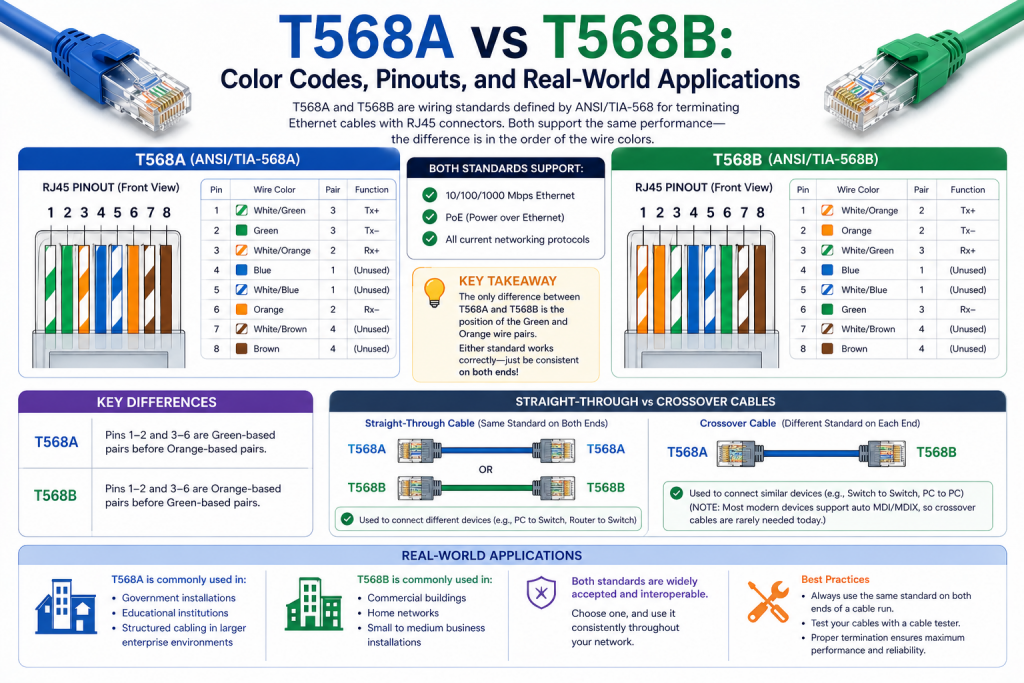
The T568A configuration is based on a specific sequence of colored wires. Ethernet cables use four pairs of wires, each identified by a color: green, blue, orange, and brown. Within each pair, one wire is a solid color, while the other is striped with white.
In T568A, the of these wires from pin 1 to pin 8 is as follows: white with green stripe, solid green, white with orange stripe, solid blue, white with blue stripe, solid orange, white with brown stripe, and solid brown. This arrangement ensures that the pairs are aligned for proper signal transmission.
This specific order is not random; it is carefully designed to maintain the integrity of the twisted pairs داخل the Ethernet cable. Each pair of wires is responsible for carrying signals in a balanced way, which helps reduce electromagnetic interference and signal degradation. By keeping the pairs properly aligned within the connector, T568A preserves the electrical characteristics for stable communication.
Another important aspect of this is how it supports both data and voice applications. The placement of the blue pair in the center pins allows compatibility with traditional telephone systems, which historically relied on these pins for voice transmission. This makes T568A particularly useful in environments where legacy telephony and modern networking need to coexist.
Maintaining the correct sequence also ensures that each pin on one end of the cable connects directly to the corresponding pin on the other end. This straight-through alignment is essential for standard Ethernet communication between devices such as computers, switches, and routers. Any deviation from this can result in miscommunication between devices or complete connection failure.
During installation, technicians must pay close attention to the color coding and positioning of each wire. Even a small mistake, such as swapping two wires, can disrupt the entire connection. For this reason, many professionals use visual guides or follow strict procedures when terminating cables.
Overall, the T568A wiring order provides a reliable and structured approach to Ethernet cabling, ensuring consistent performance and compatibility across a wide range of networking scenarios.
Although the sequence may seem complex at first, it becomes easier to remember with practice. Many technicians use reference charts or mnemonic devices to keep track of the wire order during installation.
T568A is considered the original standard among the two, and it has been widely used in various networking environments. Its design reflects the to support both data and voice communication systems, making it particularly useful in setups that integrate telephone with Ethernet networks.
Wire Color Coding and Pair Structure
Understanding the color coding of Ethernet cables is essential for working with T568A. Each cable contains four twisted pairs, and each pair is assigned a specific color. The twisting of the wires helps reduce electromagnetic interference, which can degrade signal quality.
The four pairs are green, blue, orange, and brown. Within each pair, one wire is solid, and the other is striped with white. This distinction allows technicians to identify the pairs easily and arrange them according to the chosen standard.
In T568A, the green pair is placed at the beginning of the sequence, followed by the orange pair, then the blue pair, and finally the brown pair. The of these pairs is designed to optimize signal and maintain compatibility with existing systems.
The blue pair, which occupies the middle pins, is often associated with voice communication in traditional telephone systems. This is one of the reasons why T568A is compatible with legacy phone setups. By maintaining this arrangement, T568A allows for seamless integration of voice and data services.
Proper handling of these wire pairs is crucial during installation. Untwisting the wires too much or them incorrectly can lead to signal loss and reduced network performance. Therefore, technicians must follow best practices to ensure that the integrity of the cable is maintained.
Compatibility with Legacy Systems
One of the defining features of T568A is its compatibility with older communication systems. In the early days of networking, many buildings were with telephone wiring that followed specific pin configurations. T568A was designed to align with these configurations, making it easier to transition from voice-based systems to data networks.
This compatibility is particularly important in environments where both telephone and Ethernet services are required. By using T568A, organizations can leverage existing infrastructure without the need for extensive rewiring. This not only saves time and money but also simplifies the installation process.
T568A is also compatible with connectors used in traditional telephone systems, such as RJ11 plugs. This backward compatibility allows for greater flexibility in network design, especially in older buildings where upgrading infrastructure may be challenging.
Despite the decline of traditional telephone systems, this feature still makes T568A relevant in certain scenarios. For example, government facilities and with strict standards may require the use of T568A to maintain consistency across their networks.
Importance of Consistency in Wiring
Regardless of whether T568A or T568B is used, consistency is the most important factor in Ethernet cabling. A network must follow a single wiring standard throughout all its components to function correctly. Mixing different standards can lead to serious connectivity issues.
Each wire in an Ethernet cable corresponds to a specific pin on the connector. If the of these wires does not match on both ends of the cable, the electrical signals will not align properly. This misalignment can prevent devices from communicating or cause intermittent connections.
Consistency simplifies not only installation but also troubleshooting. When all cables follow the same standard, technicians can quickly identify and resolve issues without having to consider multiple wiring patterns. This reduces downtime and improves overall network reliability
.
When a network is built using a single wiring standard, it creates a predictable environment where every connection behaves in the same way. This predictability is extremely valuable during troubleshooting because it eliminates uncertainty. A technician does not need to guess which wiring scheme was used on a particular cable or port. Instead, they can focus directly on identifying faults such as damaged cables, loose connections, or hardware issues.
Inconsistent wiring, on the other hand, can make troubleshooting much more complicated. If different parts of the network use different standards, technicians may need to test multiple possibilities before finding the root cause of a problem. This not only increases the time required to fix issues but also raises the risk of misdiagnosis. In some cases, a problem might be incorrectly attributed to a device or configuration when the real issue lies in mismatched cabling.
Consistency also improves teamwork and communication among network professionals. When everyone knows that a single standard is being followed, it becomes easier to collaborate on installations, upgrades, and repairs. New technicians joining the team can quickly understand the system without needing to learn multiple wiring patterns.
Additionally, consistent cabling supports better documentation and labeling practices. Network diagrams, cable maps, and maintenance records become more accurate and easier to interpret. This is especially important in large networks where hundreds or even thousands of connections must be managed efficiently.
Over time, the benefits of consistency become even more apparent. Routine maintenance tasks can be performed faster, and unexpected issues can be resolved with minimal disruption. Ultimately, maintaining a single wiring standard is a simple yet powerful way to ensure a stable, efficient, and easy-to-manage network infrastructure.
In structured cabling systems, where hundreds or even thousands of connections may exist, maintaining consistency is essential. Even a single incorrectly wired cable can disrupt the network and be difficult to locate without proper documentation.
Role of T568A in Modern Networks
Although T568A is often associated with older installations, it still plays an important role in modern networking. Its compatibility with legacy systems and its inclusion in official standards ensure that it remains a valid choice for new installations in certain contexts.
Some organizations adopt T568A as their standard to maintain uniformity across all locations. This is particularly common in government and institutional settings consistency is prioritized over preference. By using a single standard, these organizations can ensure that their networks remain organized and manageable.
T568A is also used in residential settings where homeowners may need to integrate Ethernet with existing telephone wiring. Its design makes it suitable for such hybrid environments, providing flexibility without sacrificing performance.
From a technical standpoint, T568A performs just as well as T568B. Both standards support the same data rates and technologies, meaning that the choice between them does not affect network speed or capacity. The decision is primarily based on compatibility and organizational requirements.
Understanding the Core Difference Between T568A and T568B
When comparing T568A and T568B, the most important distinction lies in the arrangement of two specific wire pairs the Ethernet cable. Both standards use the same eight wires and the same four color-coded pairs, but they differ in how the green and orange pairs are positioned within the connector.
In T568A, the green pair appears before the orange pair, while in T568B, the orange pair is placed before the green pair. This simple swap changes the alignment of the pins in the RJ45 connector. Even though the difference may seem minor, it directly affects how signals are transmitted across the cable.
It is important to understand that this difference does not impact performance in terms of speed or bandwidth. Both standards are designed to meet the same technical requirements and support the same Ethernet technologies. The issue is not about which one is better, but about ensuring that the same standard is used consistently across the network.
This distinction becomes especially important during installation and troubleshooting. If cables are wired using different standards without proper planning, it can lead to confusion and connectivity problems that are difficult to diagnose.
Electrical Functionality and Signal Transmission
From an electrical perspective, T568A and T568B operate in the same way. Ethernet communication relies on differential signaling, where pairs of wires carry signals that are opposite in phase. This method helps reduce noise and interference, ensuring that data is transmitted accurately.
Both standards the integrity of these twisted pairs. The blue and brown pairs remain in the same positions in both configurations, while the green and orange pairs are simply rearranged. Because the pairs themselves are not altered internally, the overall electrical behavior of the cable remains unchanged.
This means that devices connected using either standard will experience the same level of performance, provided the wiring is correct and consistent. Factors such as cable quality, length, and installation practices have a much greater impact on performance than the choice of wiring standard.
Understanding this concept helps clarify why there is no advantage to choosing one standard over the other. The real importance lies in how the standard is applied throughout the network.
The Impact of Mixing Wiring Standards
One of the most common mistakes in Ethernet cabling is mixing T568A and T568B within the same network. This typically occurs when different cables or termination points are wired using different standards without proper coordination.
When a single cable has one end terminated using T568A and the other end using T568B, it becomes a crossover cable. While crossover cables have specific uses, they are not suitable for most standard network connections.
In a typical network, devices are connected using straight-through cables, where both ends follow the same wiring pattern. This ensures that each pin on one end connects directly to the corresponding pin on the other end. Mixing standards disrupts this alignment, causing signals to be misrouted.
The result can be a range of issues, including failure to establish a connection, intermittent communication, or reduced network performance. In some cases, devices may appear to work initially but experience instability over time.
Although modern networking equipment often includes auto-negotiation features that can compensate for certain wiring differences, relying on these features is not recommended. Proper cabling practices should always be followed to ensure consistent and predictable results.
Choosing the Right Standard for Your Network
Selecting between T568A and T568B depends on several factors, including existing infrastructure, organizational requirements, and future expansion plans. In many cases, the decision is not about preference but about maintaining compatibility with what is already in place.
If a network is already wired using T568A, it is generally best to continue using that standard for any additions or modifications. This approach ensures consistency and avoids potential caused by mixing configurations.
Similarly, if T568B is already in use, new cables and connections should follow the same pattern. Consistency simplifies installation, maintenance, and troubleshooting, making the network easier to manage over time.
In new installations where no prior standard exists, either T568A or T568B can be chosen. Many organizations opt for T568B due to its widespread use, while others prefer T568A for its compatibility with legacy systems or specific requirements.
The key is to make a clear decision at the beginning of the project and document it thoroughly. This ensures that all technicians involved in the installation follow the same guidelines.
Practical Installation Considerations
Proper installation techniques are essential for achieving reliable network performance. Regardless of the chosen standard, attention to detail during the wiring process can make a significant difference.
When terminating cables, it is important to arrange the wires carefully according to the selected standard. The must match exactly, with each wire placed in the correct position. Even a single misplaced wire can disrupt the entire connection.
Another important consideration is maintaining the twist of each wire pair. The twisting helps reduce electromagnetic interference, which can degrade signal quality. Untwisting the wires too much during installation can negatively impact performance.
Using high-quality tools and connectors also contributes to a successful installation. Crimping tools should be properly calibrated, and connectors should be for the type of cable being used. Poor-quality components can lead to unreliable connections and increased maintenance needs.
After installation, testing should be performed to verify that each cable is functioning correctly. Cable testers can detect issues such as неправиль connections, short circuits, and signal loss. Identifying these problems early helps prevent future disruptions.
Role of Standards in Structured Cabling Systems
Structured cabling systems are designed to provide a standardized approach to network infrastructure. These systems rely heavily on consistent wiring practices to ensure scalability and reliability.
In such environments, the choice of wiring standard becomes part of a larger framework that includes cable management, labeling, and documentation. Whether T568A or T568B is used, it must be applied uniformly across all components.
Structured cabling systems often support a wide range of applications, including data, voice, and video. Maintaining a consistent wiring standard helps ensure that all these services can operate without interference.
In large organizations, where networks may span multiple locations, standardization becomes even more important. Using a single wiring standard across all simplifies management and reduces the risk of errors during expansion or upgrades.
Troubleshooting and Maintenance
When network issues arise, understanding the wiring standard used can significantly облегчить the troubleshooting process. Technicians can quickly verify whether cables are terminated correctly and identify any inconsistencies.
Common problems related to wiring include incorrect pin assignments, loose connections, and damaged cables. By following a consistent standard, these issues can be detected and resolved more efficiently.
Maintenance also benefits from standardization. When all cables follow the same pattern, repairs can be made without having to determine the wiring configuration each time. This reduces downtime and improves overall network reliability.
Regular inspections and testing should be part of ongoing maintenance practices. Over time, cables may degrade environmental factors or physical stress. Identifying and replacing faulty cables helps maintain optimal performance.
Organizational and Regulatory Considerations
In some cases, the choice of wiring standard is influenced by organizational policies or regulatory requirements. Certain may mandate the use of a specific standard to ensure consistency across all their facilities.
These requirements are often based on long-term planning and the need to maintain uniformity across large networks. Adhering to these guidelines is essential for compliance and interoperability.
In government or institutional environments, standardization helps ensure that different departments and locations can work together seamlessly. It also simplifies training and documentation, as all personnel follow the same practices.
Understanding these requirements before starting a network project is important. It helps avoid costly changes later and ensures that the installation meets all necessary standards.Before any physical work begins, careful planning is essential to identify the specific requirements of the network. This includes selecting the appropriate wiring standard, determining the type of cables to be used, and understanding any organizational or regulatory guidelines that must be followed. Taking the time to evaluate these factors early in the process reduces the risk of mistakes that could lead to expensive rework or delays.
One of the key benefits of early planning is cost control. Network installations can involve significant investment in materials, labor, and equipment. If incorrect assumptions are made at the beginning, such as choosing the wrong wiring standard or incompatible components, correcting these errors later can be both time-consuming and costly. In some cases, entire sections of cabling may need to be replaced, which disrupts operations and increases expenses.
Another important consideration is compliance with industry standards and organizational policies. Many companies, institutions, and government entities have specific requirements for how their networks should be designed and implemented. These requirements may include the use of a particular wiring standard, specific cable categories, or structured cabling practices. Understanding and following these guidelines from the start ensures that the network meets all necessary expectations and avoids potential compliance issues.
Proper planning also improves efficiency during installation. When requirements are clearly defined, technicians can work with confidence, knowing exactly what needs to be done. This reduces confusion and minimizes the likelihood of errors. It also allows for better coordination between different teams involved in the project, such as network engineers, electricians, and IT staff.
In addition, understanding requirements in creating accurate documentation. Detailed plans, diagrams, and specifications can be prepared in advance, providing a clear roadmap for the installation process. This documentation not only supports the initial deployment but also serves as a valuable reference for future maintenance, upgrades, and troubleshooting.
Scalability is another factor that benefits from early planning. Networks often need to expand over time to accommodate new devices, users, and applications. By considering future growth during the design phase, it is possible to build a system that can be easily extended without major modifications. This includes choosing a wiring standard and infrastructure that will remain relevant as technology evolves.
Risk reduction is also a significant advantage. Identifying potential challenges before installation begins allows for proactive solutions. For example, environmental factors, cable planning, and equipment placement can all be addressed заранее to prevent issues during deployment.
Ultimately, taking the time to understand all requirements before starting a network project leads to a more organized, efficient, and reliable outcome. It ensures that the installation aligns with both current needs and future expectations, providing a strong foundation for long-term network performance.
Future Relevance of Wiring Standards
As technology continues to evolve, the importance of reliable network infrastructure remains constant. While wireless communication is becoming more prevalent, wired connections still provide unmatched stability, speed, and security.
Ethernet standards continue to advance, supporting higher data rates and new applications. However, the fundamental principles of wiring standards like T568A and T568B remain unchanged. Proper and consistent implementation are still essential for effective communication.
Future developments may introduce new cable types or methods, but the need for standardized practices will always be present. These standards provide the foundation upon which modern networks are built.
As networking technology continues to evolve, we are already seeing the introduction of higher-performance cable categories such as Cat6A, Cat7, and even Cat8, which support faster data speeds and greater bandwidth. At the same time, innovations like fiber optics, Power over Ethernet (PoE), and high-speed data center interconnects are changing how networks are designed and deployed. Despite these advancements, the underlying principle of standardization remains unchanged. Every new technology still depends on clearly defined rules to ensure compatibility, reliability, and efficiency.
Standardized practices allow different technologies to work together seamlessly. For example, a network may include a combination of copper Ethernet cables, fiber links, wireless access points, and cloud-based systems. Without consistent standards guiding how these components connect and communicate, the network would become fragmented and difficult to manage. Standards act as a common language that enables and systems from different manufacturers to operate together without conflict.
Another important factor is backward compatibility. As new cable types and methods are introduced, they are often designed to work alongside existing infrastructure. This is only possible because earlier standards were well-defined and widely adopted. By following established practices like T568A or T568B, organizations create a stable base that can support future upgrades without requiring a complete overhaul of the network.
Standardization also plays a key role in supporting emerging technologies such as smart buildings, Internet of Things (IoT) devices, and high-speed data applications. These systems rely on consistent and reliable connectivity to function properly. A well-structured cabling system ensures that these technologies can be integrated smoothly into existing networks.
In addition, industry standards continue to evolve through the efforts of global organizations that monitor technological trends and new guidelines. This ongoing development ensures that networking practices remain relevant and capable of meeting future demands. However, even as these standards evolve, the core idea remains the same: consistency and structure are essential for effective communication.
Ultimately, while the tools and technologies used in networking may change, the importance of standardized practices will never diminish. They provide the stability and predictability needed to build networks that are not only high-performing but also adaptable to future innovations.
By understanding and applying these principles, network professionals can ensure that their systems are prepared for future growth and technological advancements.
Conclusion
T568A and T568B are two closely related Ethernet wiring standards that differ primarily in the arrangement of the green and orange wire pairs. Despite this difference, both standards offer identical performance and can be used with all modern networking equipment.
The most important factor in choosing between them is consistency. A network must follow a single wiring standard throughout all its components to function reliably. Mixing standards can lead to connectivity issues, reduced performance, and increased troubleshooting complexity.
T568A is often associated with compatibility and structured environments, while T568B is commonly used in modern installations due to its widespread adoption. However, neither standard is technically superior to the other.
Successful network implementation depends on careful planning, accurate installation, thorough testing, and proper documentation. By adhering to these best practices, network professionals can build systems that are stable, efficient, and easy to maintain.
In the end, understanding the differences between T568A and T568B is not just about memorizing wire arrangements. It is about recognizing the importance of standardization in creating reliable and scalable network infrastructure.
Standardization plays a central role in ensuring that networks function smoothly, regardless of their size or complexity. When a clear and consistent wiring approach is followed, it creates a strong foundation that supports all other aspects of the network. Devices can communicate without errors, technicians can work efficiently, and future upgrades can be implemented without unnecessary complications. Without standardization, even the most advanced networking equipment can fail to deliver consistent results mismatched or poorly structured cabling.
Another important aspect of standardization is its impact on scalability. Modern networks are rarely static; they grow and evolve over time as new devices, users, and services are added. A standardized wiring system makes this expansion much easier. When new cables are installed, they can follow the same pattern as the existing infrastructure, ensuring seamless integration. This reduces the risk of compatibility issues and allows the network to expand without disrupting current operations.
Standardization also contributes to long-term cost efficiency. While it may seem like a small detail during the initial installation, using a consistent wiring standard can save significant time and resources in the future. Troubleshooting becomes faster, maintenance requires less effort, and the likelihood of major failures is reduced. Organizations that prioritize structured and standardized cabling often experience fewer network and lower operational costs over time.
In addition, standardization improves documentation and knowledge transfer. Networks are often managed by multiple technicians over their lifespan, and having a clearly defined wiring standard ensures that everyone works within the same framework. This makes it easier to train new staff, share information, and maintain accurate records of the network’s structure. When documentation aligns with actual installations, diagnosing and resolving issues becomes far more efficient.
It is also important to consider the role of standardization in ensuring compatibility with industry practices. Ethernet standards are designed to work universally across different devices and environments. By following recognized wiring patterns like T568A or T568B, networks remain compatible with a wide range of equipment from manufacturers. This flexibility allows organizations to choose the best devices for their needs without worrying about connectivity limitations.
Beyond the technical benefits, standardization reflects a disciplined and professional approach to network design. It shows that careful planning has been applied to ensure reliability and consistency. This is especially important in large-scale environments such as corporate offices, data centers, and institutional networks, where even small inconsistencies can lead to significant disruptions.
Ultimately, understanding T568A and T568B is about more than just knowing which wire goes where. It is about appreciating how small details contribute to the overall stability and efficiency of a network. By committing to a single standard and applying it consistently, network professionals can build systems that are not only functional but also resilient, scalable, and easy to maintain over time.
Continue exploring the technologies and certification concepts that matter most to you.