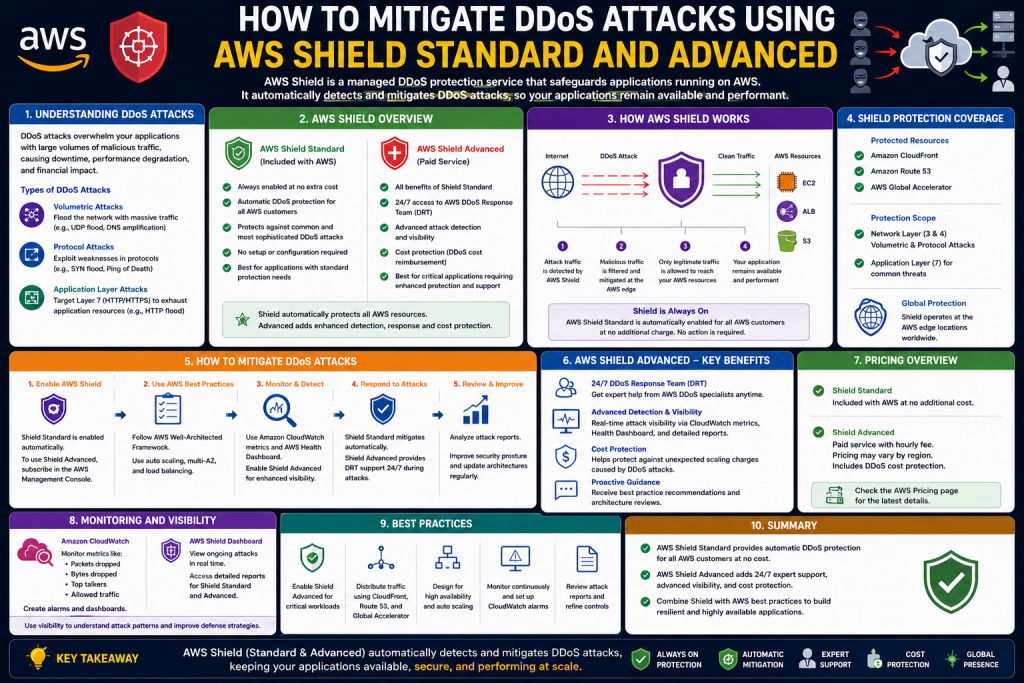
Distributed Denial of Service (DDoS) attacks are among the most disruptive threats to modern online systems. They work by overwhelming a server, application, or network with massive amounts of traffic, often generated by compromised devices known as botnets. When successful, these attacks can slow down services, make applications unreachable, and cause financial and reputational damage.
Cloud environments are not immune to these threats. In fact, because they host critical workloads and internet-facing applications, they are frequent targets. To address this, AWS provides a managed protection system designed specifically to detect and mitigate DDoS attacks automatically. This protection is delivered through two main levels: a default protection layer and an advanced subscription-based service.
Understanding the differences between these two levels is important for choosing the right security strategy for different types of workloads.
Understanding the Nature of DDoS Attacks
DDoS attacks can be compared to a situation where a store is suddenly flooded with thousands of people trying to enter at the same time, blocking access for legitimate customers. In digital systems, attackers achieve this by coordinating large networks of infected devices to send continuous requests to a target system.
These attacks generally fall into different categories based on the layer of the system they target. Some focus on network and transport layers by overwhelming bandwidth or connection tables, while others target application layers by exhausting server resources through repeated HTTP requests. Because of this variety, protection mechanisms must also operate at multiple levels.
AWS Shield Standard: Built-In Protection
AWS Shield Standard is the default DDoS protection service automatically enabled for all AWS customers. It does not require any additional configuration or payment. Its main purpose is to provide baseline protection against common and widely known attack types.
This service focuses primarily on safeguarding infrastructure-level components. It protects services such as load balancers, content delivery systems, DNS services, and traffic distribution layers. The protection works continuously in the background, monitoring traffic patterns and identifying anomalies that may indicate an ongoing attack.
AWS Shield Standard primarily defends against network and transport layer attacks. These include techniques that aim to overwhelm systems with excessive connection requests, spoofed traffic, or reflection-based attacks. It uses automated detection systems to identify unusual traffic spikes and applies mitigation strategies without user intervention.
One of the key advantages of this service is its simplicity. Users do not need to configure rules or manage settings, making it ideal for general-purpose applications and small to medium workloads. However, because it is a baseline solution, it offers limited customization and does not allow deep control over mitigation behavior.
While AWS Shield Standard provides a strong foundation, it does not guarantee full protection against highly sophisticated or large-scale attacks. Its focus is primarily on commonly observed threats rather than advanced multi-layered attack strategies.
AWS Shield Advanced: Enhanced Security and Control
AWS Shield Advanced is a premium protection service designed for organizations that require stronger security guarantees and deeper visibility into attack patterns. It builds on the foundation of the standard protection layer and extends it with additional capabilities across multiple system layers.
Unlike the standard version, Shield Advanced is a paid service that provides enhanced monitoring, faster response mechanisms, and access to specialized support during active attacks. It is designed for mission-critical applications where downtime or performance degradation can have significant consequences.
One of its major improvements is expanded protection coverage. While the standard service focuses mainly on network and transport layers, Shield Advanced also provides defense at the application layer. This means it can help protect against more complex attacks such as HTTP floods, which aim to exhaust application resources by simulating legitimate user behavior at scale.
Shield Advanced also allows users to organize resources into protection groups. This feature helps apply consistent security policies across multiple applications or services, making it easier to manage large-scale environments.
Another important enhancement is detailed visibility. Users gain access to real-time monitoring tools that provide insights into attack patterns, traffic anomalies, and mitigation actions. This level of transparency is valuable for security teams that need to analyze incidents or improve long-term defense strategies.
Integration with Web Application Protection
A key advantage of AWS Shield Advanced is its integration with web application protection tools. When an attack is detected, the system can automatically adjust security rules to filter malicious traffic. This helps reduce the impact of DDoS attacks in real time by blocking or rate-limiting suspicious requests before they reach critical application components. It can also identify patterns such as abnormal request rates, malformed traffic, or repeated access attempts from specific sources. By responding dynamically, it minimizes downtime and ensures that legitimate users can continue accessing services without interruption, even during active attack scenarios. For example, if a website experiences a sudden surge of suspicious HTTP requests, the system can analyze request patterns and identify abnormal behavior. It may then create filtering rules that block specific request types, limit traffic from certain sources, or restrict suspicious activity in real time.
This automated response helps reduce the time needed to react to an attack. Instead of waiting for manual intervention, mitigation measures are applied immediately, minimizing potential damage.
However, users still have the option to define custom rules. This flexibility allows organizations to tailor security policies based on geographic restrictions, application behavior, or known threat sources.
Support and Response Capabilities
Another major difference between the two services is the level of support provided during an attack.
AWS Shield Standard operates fully in the background without human involvement. It relies entirely on automated systems to detect and respond to threats. While this is sufficient for many scenarios, it may not be enough for complex or prolonged attacks.
AWS Shield Advanced includes access to a dedicated response team that operates around the clock. This team assists during active attacks, helping analyze traffic, recommend mitigation strategies, and support recovery efforts. This human-assisted layer of protection is especially useful when automated systems alone are not sufficient.
Additionally, Shield Advanced includes financial protection mechanisms. If an attack leads to unexpected scaling costs due to increased resource usage, the service may help offset some of those expenses. This provides an additional layer of reassurance for businesses that operate high-traffic applications.
Types of Attacks Covered
Both services are designed to handle a wide range of DDoS attack types, but their depth of coverage differs.
AWS Shield Standard typically handles common attacks such as:
- Network flooding attacks that overwhelm bandwidth
- Connection-based attacks targeting system resources
- Reflection and amplification techniques that exploit external servers
AWS Shield Advanced extends this coverage to include more sophisticated threats such as:
- Application-layer HTTP floods
- Resource exhaustion attacks targeting session handling
- DNS query flooding attempts
- Complex multi-vector attacks that combine different techniques
This broader coverage makes Shield Advanced more suitable for environments where applications are exposed to diverse and evolving threats.
Choosing Between Standard and Advanced Protection
The decision between these two options depends largely on the importance of the workload, risk tolerance, and operational requirements.
AWS Shield Standard is suitable for general applications, small websites, and systems that can tolerate brief disruptions. It provides essential protection without additional cost or configuration complexity. For many users, this level of protection is sufficient because it automatically handles common attack scenarios.
AWS Shield Advanced is better suited for organizations that operate critical systems where downtime is not acceptable. This includes industries such as finance, healthcare, large-scale e-commerce, gaming platforms, and media streaming services. These environments often require higher availability, faster response times, and stronger guarantees of continuity.
Organizations that experience high traffic volumes or are frequent targets of cyberattacks may also benefit from the enhanced visibility and control offered by the advanced service.
Operational and Strategic Considerations
Beyond technical differences, choosing between the two services also involves strategic planning. Security is not just about preventing attacks but also about ensuring business continuity.
For smaller workloads, simplicity and automation are often the priority. In these cases, the default protection layer offers a balance between security and ease of use.
For larger enterprises, security becomes part of a broader operational strategy. This includes compliance requirements, customer trust, brand reputation, and financial risk management. In such cases, investing in advanced protection can be seen as a risk mitigation strategy rather than just a technical upgrade.
It is also important to consider scalability. As applications grow, their exposure to threats increases. A service that may seem unnecessary at an early stage can become critical as traffic and business value expand.
Conclusion
DDoS attacks remain a persistent threat to online systems, and effective protection is essential for maintaining service availability and trust. AWS provides two levels of defense to address this challenge.
AWS Shield Standard offers automatic, always-on protection against common network and transport layer attacks. It is suitable for most general workloads and requires no additional configuration or cost.
AWS Shield Advanced builds on this foundation by adding deeper protection across multiple layers, enhanced visibility, automated web application defense, financial safeguards, and access to specialized support. It is designed for mission-critical environments where security and uptime are top priorities.
Choosing between these two options depends on the nature of the applications being protected, the level of risk involved, and the operational importance of continuous availability. A thoughtful evaluation of these factors helps ensure that the chosen protection strategy aligns with both technical needs and business goals.
Continue exploring the technologies and certification concepts that matter most to you.