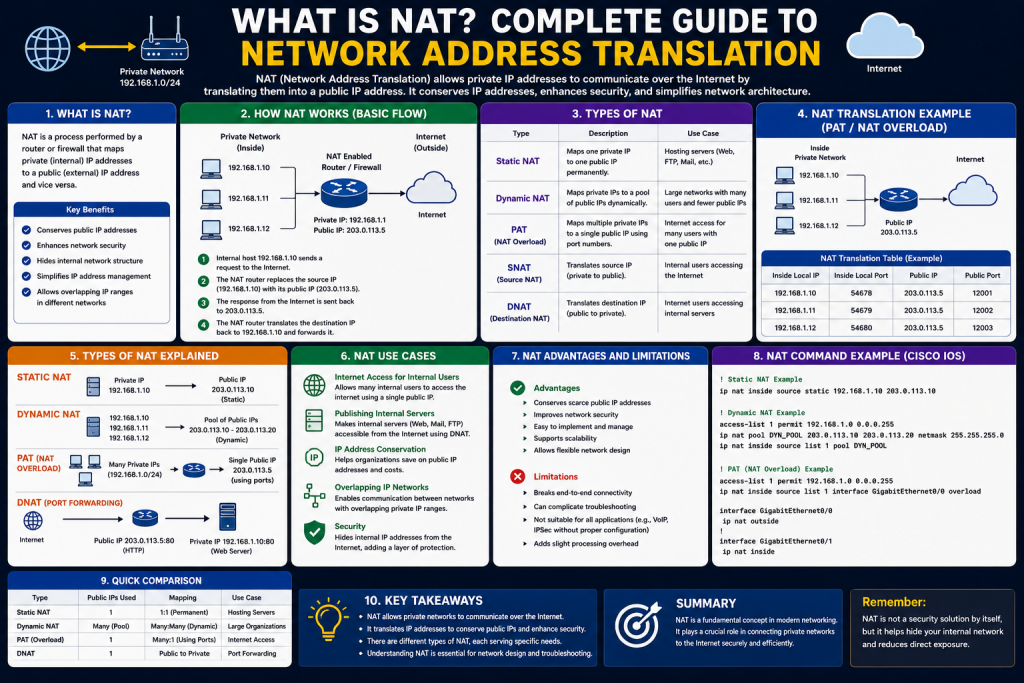
Network Address Translation, commonly known as NAT, is a core networking process used in modern networks to manage how devices with private IP addresses access external networks such as the internet. NAT works by modifying IP address information in packet headers as they pass through a router or firewall. In simple terms, it allows multiple devices inside a private network to share a single public IP address when communicating with external systems.
This process is essential because it bridges the gap between private internal networks and the globally accessible internet while conserving the limited supply of public IP addresses.
Understanding Private IP Addresses
Every device connected to a network requires an IP address to communicate. However, not all IP addresses are meant to be accessible from the internet. Private IP addresses are reserved for internal network use only and are not routable on the public internet.
These private IP addresses fall within specific reserved ranges:
- 10.0.0.0 to 10.255.255.255
- 172.16.0.0 to 172.31.255.255
- 192.168.0.0 to 192.168.255.255
These ranges are used freely by organizations, businesses, and home networks. A key advantage is that multiple networks around the world can use the same private IP ranges without conflict because these addresses are isolated within their own local environments.
For example, many home routers commonly use addresses in the 192.168.x.x range. Devices like phones, laptops, printers, and smart TVs are assigned private IPs within this range to communicate internally.
However, these addresses cannot be used directly on the internet, which is where NAT becomes essential.
What are Public or Global IP Addresses
Public IP addresses, sometimes referred to as global IP addresses, are unique identifiers assigned to devices or networks that need direct access to the internet. These addresses are managed and distributed by regional internet authorities and internet service providers.
Unlike private IPs, public IP addresses must be unique across the entire internet. If two devices had the same public IP, communication would fail. These addresses allow devices on different networks to communicate with each other across the global internet infrastructure.
Since public IP addresses are limited, they are carefully allocated and often shared using NAT techniques.
Why NAT is Necessary
The main reason NAT exists is the shortage of IPv4 addresses. IPv4 provides about 4.3 billion unique addresses, which is not enough for the billions of devices connected today. NAT helps extend the usability of IPv4 by allowing many devices to share a single public IP address.
This becomes especially important when considering how rapidly internet-connected devices have increased over time. Today, not only computers and servers use IP addresses, but also smartphones, tablets, smart TVs, gaming consoles, security cameras, and even household appliances. Each of these devices requires network connectivity, which places a huge demand on available public IP addresses. Without NAT, the internet would have reached its address capacity long ago, making it extremely difficult for new users and devices to connect.
NAT also provides a practical way for organizations and households to manage their internal networks without needing to request large blocks of public IP addresses from internet service providers. Instead, they can use private IP ranges internally and rely on a single public IP for all outgoing traffic. This reduces cost and simplifies network configuration significantly.
Another important benefit is scalability. Large enterprises with thousands of devices can operate efficiently without needing a unique public IP for every device. NAT handles the translation process dynamically, ensuring smooth communication between internal systems and external services.
In addition, NAT helps reduce external exposure of internal devices. Since private IPs are hidden behind a public address, it becomes more difficult for external systems to directly target internal hosts. This indirect protection adds a basic layer of security to network communication.
Another important reason is security. NAT hides internal network structures from the outside world. External systems only see the public IP address of the router, not the individual private IP addresses inside the network. This creates a basic layer of protection by making internal devices less visible to potential attackers.
How NAT Works in a Network
To understand NAT clearly, consider how a device accesses a website or any external service.
When a device inside a private network wants to connect to the internet, it first generates a request. This request contains its private IP address as the source and the destination IP address of the external server.
Since private IP addresses cannot be routed on the internet, the request is sent to the local router. The router then performs NAT before forwarding the request externally.
Here is the general process:
First, the device sends a request to a destination on the internet. The packet includes the device’s private IP address.
Next, the router receives this packet and checks its NAT table. The NAT table is a record that keeps track of active connections and their translations.
The router replaces the private source IP address with its own public IP address. This allows the packet to travel across the internet.
When the response returns from the external server, it arrives at the router’s public IP address. The router then checks its NAT table again to determine which internal device originally sent the request.
Finally, the router translates the destination back to the correct private IP address and forwards the response to the correct device inside the local network.
This entire process happens extremely quickly, often in milliseconds, making it invisible to the user.
NAT Table and Its Role
The NAT table is one of the most important components in this process. It keeps track of active connections between private and public IP addresses.
Each entry typically includes:
- Source private IP address
- Translated public IP address
- Destination IP address
- Connection details
This mapping ensures that when responses come back from external servers, they are correctly delivered to the right internal device.
Without this table, routers would not know where to send incoming traffic.
Types of NAT
There are different types of NAT used depending on the network design.
Static NAT maps one private IP address to one public IP address. This is often used when a specific internal device needs to be accessible from outside the network.
Dynamic NAT assigns a public IP address from a pool of available addresses whenever a device requests internet access. The mapping is temporary and changes over time.
Port Address Translation (PAT), also known as NAT overload, is the most widely used form. It allows multiple devices to share a single public IP address by tracking not only IP addresses but also port numbers. This is how home routers allow many devices to access the internet simultaneously.
Port Address Translation (PAT) Explained
PAT is an advanced form of NAT that solves the limitation of sharing a single public IP address among many devices.
Each device connection is assigned a unique port number. Even if multiple devices are using the same public IP, the router distinguishes them using these port numbers.
For example, one device might use port 50001 while another uses port 50002. The router uses this combination of IP address and port number to keep traffic separated.
This method allows thousands of simultaneous connections using a single public IP address, making it extremely efficient for home and enterprise networks.
Advantages of NAT
NAT provides several important benefits.
One major advantage is IP address conservation. It reduces the need for large numbers of public IP addresses by allowing private networks to reuse internal addressing schemes.
Another benefit is improved security. Since internal IP addresses are hidden, external users cannot directly access devices inside the network.
NAT also simplifies network management. Organizations can redesign internal networks without changing public IP configurations.
It also allows flexibility in addressing. Multiple organizations can use the same private IP ranges without conflict.
Limitations of NAT
Despite its advantages, NAT also has some limitations.
One challenge is that it can cause difficulties for certain applications like peer-to-peer services, VoIP, or online gaming, which require direct inbound connections.
NAT can also introduce latency because of the additional processing required to translate addresses.
Another limitation is reduced end-to-end connectivity, which can complicate troubleshooting and certain network protocols.
Finally, NAT can sometimes conflict with encryption and security protocols that rely on consistent IP addressing.
NAT and Modern Networking
With the introduction of IPv6, which provides a massive number of unique IP addresses, the reliance on NAT is expected to decrease over time. IPv6 removes the need for address translation by giving every device a globally unique IP address.
However, NAT is still widely used today due to the slow adoption of IPv6 and the continued reliance on IPv4 infrastructure.
In modern networks, NAT remains a foundational technology that enables efficient and secure communication between private networks and the global internet.
Conclusion
Network Address Translation plays a critical role in how modern networks function. By allowing multiple devices to share a single public IP address, it solves the problem of limited IPv4 availability while also adding a layer of network security.
Through mechanisms like NAT tables and port-based translation, routers efficiently manage traffic between private internal networks and external systems. Although it has some limitations, NAT continues to be an essential technology in both home and enterprise environments.
As networking evolves with IPv6 adoption, NAT’s role may change, but its impact on the development of the internet remains significant and foundational.
Continue exploring the technologies and certification concepts that matter most to you.