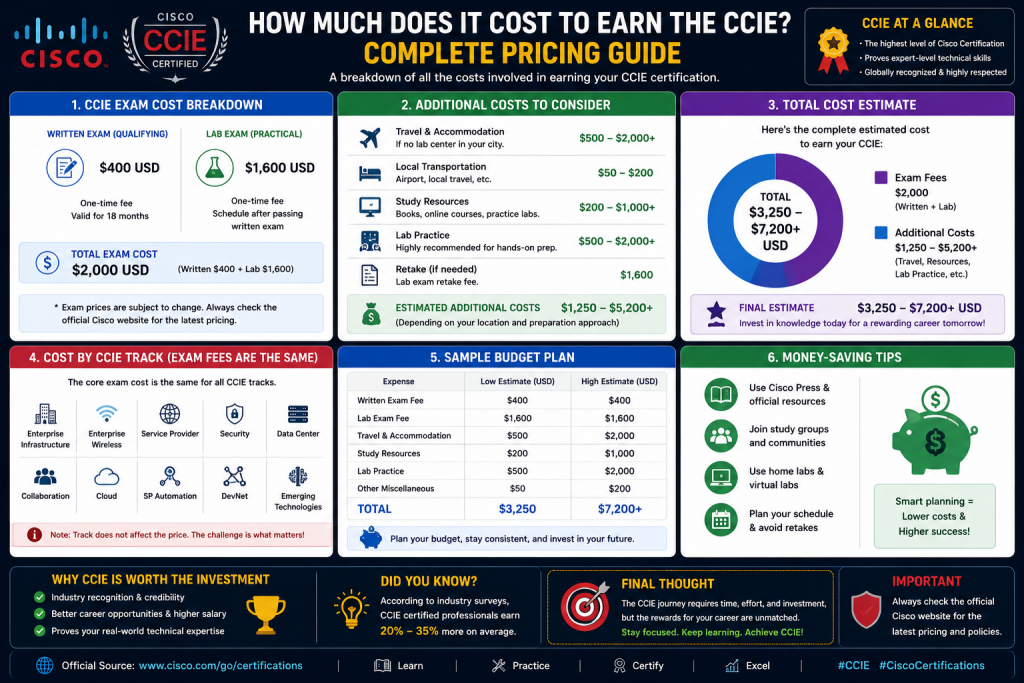
Earning the Cisco Certified Internetwork Expert (CCIE) is one of the most respected achievements in the networking world. It represents advanced expertise, deep technical knowledge, and real-world problem-solving skills. However, along with its prestige comes a significant investment of both time and money. Before pursuing this certification, it is essential to understand the full cost involved so you can plan properly and avoid surprises along the way.
This guide explores every major expense associated with earning the CCIE, from prerequisite certifications and exam fees to study materials, lab practice, and travel costs.
Understanding the CCIE Journey
The CCIE is not an entry-level certification. It is designed for experienced professionals who already have a strong foundation in networking concepts and hands-on experience. While there are no official prerequisites, most candidates spend years building their skills before attempting the CCIE.
Typically, candidates begin with foundational certifications such as CCNA and move on to professional-level certifications like CCNP. These earlier certifications help build the knowledge required to succeed at the expert level and should be considered part of the overall investment.
If you are starting from scratch, the journey to CCIE will include multiple certifications, each with its own cost. Even though these are not mandatory, skipping them is rarely practical for most learners.
Cost of Prerequisite Certifications
Before attempting the CCIE, many candidates invest in earlier certifications to build their knowledge. Exam fees alone for these certifications can add up quickly.
CCNA exams generally cost around $300. Some candidates may take multiple exams depending on the track. After that, CCNP exams also cost approximately $300 per exam. When you combine these, the cost of reaching the CCIE level can easily exceed $600 to $1,000 just in certification exams.
For many professionals, the journey begins even earlier with entry-level certifications in IT or networking. While optional, these certifications further increase the total investment.
CCIE Written Exam Cost
The first official step toward earning the CCIE is passing the written exam. This exam tests your theoretical knowledge and understanding of advanced networking concepts.
The fee for the written exam is approximately $450 per attempt. While some candidates pass on their first try, others may need multiple attempts, which increases the overall cost.
The written exam is valid for a limited time, typically three years. After passing it, you become eligible to schedule the lab exam, which is the most challenging and expensive part of the process.
CCIE Lab Exam Cost
The lab exam is where the real challenge begins. This hands-on exam requires you to configure, troubleshoot, and optimize complex network environments under time pressure.
The cost of the lab exam is about $1,600 per attempt. Many candidates do not pass on their first try. In fact, it is common for candidates to attempt the lab exam multiple times before succeeding.
If you take the lab exam two or three times, the cost can quickly rise to $3,200 to $4,800 or more. This makes it one of the biggest expenses in the CCIE journey.
Study Materials and Training Costs
Preparation is critical for success in the CCIE, and study materials can vary widely in price depending on your approach.
Basic study resources such as books and online courses may cost a few hundred dollars. However, more comprehensive training options like bootcamps can cost anywhere from $2,000 to $5,000.
Many candidates combine multiple resources, including video courses, practice exams, lab guides, and community forums. While this improves the chances of success, it also increases the total cost.
Investing in quality study materials can actually save money in the long run by reducing the number of exam attempts required.
Practice Lab Costs
Hands-on practice is essential for passing the CCIE lab exam. You need extensive experience working with real or simulated network environments.
There are two main approaches to lab practice. One option is building your own physical lab, which can be very expensive due to the cost of networking equipment. The other option is using virtual labs or renting rack time from providers.
Virtual labs are generally more affordable and flexible. Some providers charge hourly rates, while others offer packages or subscriptions. Costs can range from a few dollars per hour to several hundred dollars per month depending on usage.
While lab practice is a significant expense, it is also one of the most important investments you can make during your preparation.
Travel and Accommodation Expenses
One often overlooked cost is travel. The CCIE lab exam is not available everywhere, and candidates usually need to travel to specific testing centers.
Travel costs include airfare, hotel stays, local transportation, and meals. Depending on your location and travel preferences, this can cost anywhere from $800 to $1,500 per attempt.
Since the lab exam starts early in the morning, most candidates arrive at least one day before the exam. This means additional hotel nights and expenses.
If you need to take the lab exam multiple times, travel costs can quickly become a major part of your total investment.
Total Cost Scenarios
The total cost of earning the CCIE varies greatly depending on your preparation strategy and the number of attempts required.
In the best-case scenario, where you pass both the written and lab exams on your first try and minimize study expenses, the total cost may be around $2,000 to $4,000.
A more realistic scenario, including study materials, lab practice, and travel, often falls between $8,000 and $12,000.
For candidates who require multiple lab attempts and invest heavily in training and resources, the total cost can exceed $15,000 or even $20,000.
These estimates highlight why proper planning and preparation are so important.
Time Investment and Opportunity Cost
Beyond financial costs, earning the CCIE requires a significant time commitment. Many candidates spend six months to a year preparing for the exam, often studying several hours per day. This level of preparation is necessary because the CCIE is not just about memorizing concepts but mastering how to apply them in complex, real-world scenarios. Candidates must build a deep understanding of networking technologies, including routing, switching, security, automation, and troubleshooting under pressure.
A typical study routine involves a mix of theory and hands-on practice. Candidates often dedicate time daily to reading technical materials, watching training videos, and reviewing configuration guides. However, the most critical part of preparation is lab practice. Spending hours working on virtual labs or rack rentals helps candidates develop the speed and accuracy needed to succeed in the actual exam. Many candidates follow strict schedules, sometimes studying early in the morning before work and continuing late into the night.
Balancing this preparation with a full-time job can be challenging. Professionals often have to sacrifice weekends, holidays, and personal time to stay consistent with their study plans. This intense routine can be mentally exhausting, requiring strong discipline and motivation to maintain progress over several months. Burnout is a real risk, which is why many candidates incorporate short breaks and structured study plans to stay productive.
Consistency plays a crucial role in success. Studying a few hours every day is far more effective than cramming occasionally. Over time, this consistent effort builds confidence and helps reinforce complex concepts. Many candidates also join study groups or online communities where they can discuss topics, share resources, and stay motivated throughout the journey.
In addition to technical preparation, candidates must also train themselves to manage time effectively during the lab exam. The eight-hour lab requires not only knowledge but also the ability to think clearly and work efficiently under pressure. Practicing full-length lab scenarios helps simulate exam conditions and improves endurance.
Ultimately, the time investment required for the CCIE goes beyond just passing an exam. It transforms the way you think about networking, improves problem-solving skills, and prepares you for high-level responsibilities in your career. While the journey is demanding, the skills and experience gained during this process are invaluable and continue to benefit professionals long after they achieve certification.
This level of dedication can impact your personal life and free time. You may need to reduce social activities, limit hobbies, and focus intensely on your studies.
There is also an opportunity cost to consider. Time spent preparing for the CCIE could be used for other professional or personal pursuits. However, for many professionals, the long-term benefits outweigh these sacrifices.
How to Reduce the Cost of CCIE
While the CCIE is expensive, there are ways to manage and reduce costs.
Careful planning is essential. Start by assessing your current skill level and identifying gaps in your knowledge. This helps you avoid unnecessary spending on resources you do not need.
Focus on quality study materials rather than buying multiple resources. Choose trusted courses and stick to a structured study plan.
Practice labs are critical, but you can save money by using virtual environments instead of building a physical lab. Renting lab time only when needed is another effective strategy.
Most importantly, aim to pass the exams on your first attempt. This requires more preparation upfront but can save thousands of dollars in retake fees and travel costs.
Career Benefits and Return on Investment
Despite the high cost, the CCIE is often considered a worthwhile investment. It is recognized globally as a top-tier certification and can significantly enhance your career prospects. Professionals who achieve this certification are often seen as experts capable of designing, implementing, and troubleshooting complex network infrastructures in real-world environments. This level of recognition can set you apart in a competitive job market where advanced skills are in high demand.
Earning the CCIE can also lead to substantial salary growth. Many organizations are willing to pay a premium for individuals who hold expert-level certifications because they bring proven technical depth and problem-solving ability. In addition, CCIE-certified professionals are often trusted with critical projects, leadership roles, and decision-making responsibilities within IT teams.
Another important benefit is the global credibility that comes with the certification. Whether you plan to work locally or internationally, the CCIE is widely respected by employers across industries. It also opens doors to specialized roles such as network architect, senior engineer, or consultant, giving you more flexibility in your career path.
Beyond financial and career advantages, achieving the CCIE builds confidence and validates years of hard work. It demonstrates not only technical expertise but also discipline, persistence, and a commitment to continuous learning in a rapidly evolving field.
Professionals with a CCIE often qualify for higher-paying roles, leadership positions, and specialized networking jobs. Employers value the expertise and dedication required to achieve this certification.
In addition to financial benefits, the CCIE also provides personal satisfaction and professional credibility. It demonstrates your ability to handle complex networking challenges and positions you as an expert in your field.
Conclusion
Earning the CCIE is a major commitment that requires both financial investment and personal dedication. From exam fees and study materials to lab practice and travel, the total cost can range from a few thousand dollars to well over $15,000 depending on your path.
While the expense may seem high, it is important to view the CCIE as a long-term investment in your career. With proper planning, disciplined study, and hands-on practice, you can manage costs effectively and increase your chances of success.
For those willing to put in the effort, the rewards of achieving the CCIE go far beyond the certification itself. It opens doors to advanced opportunities, higher salaries, and a respected position in the networking industry.
Continue exploring the technologies and certification concepts that matter most to you.