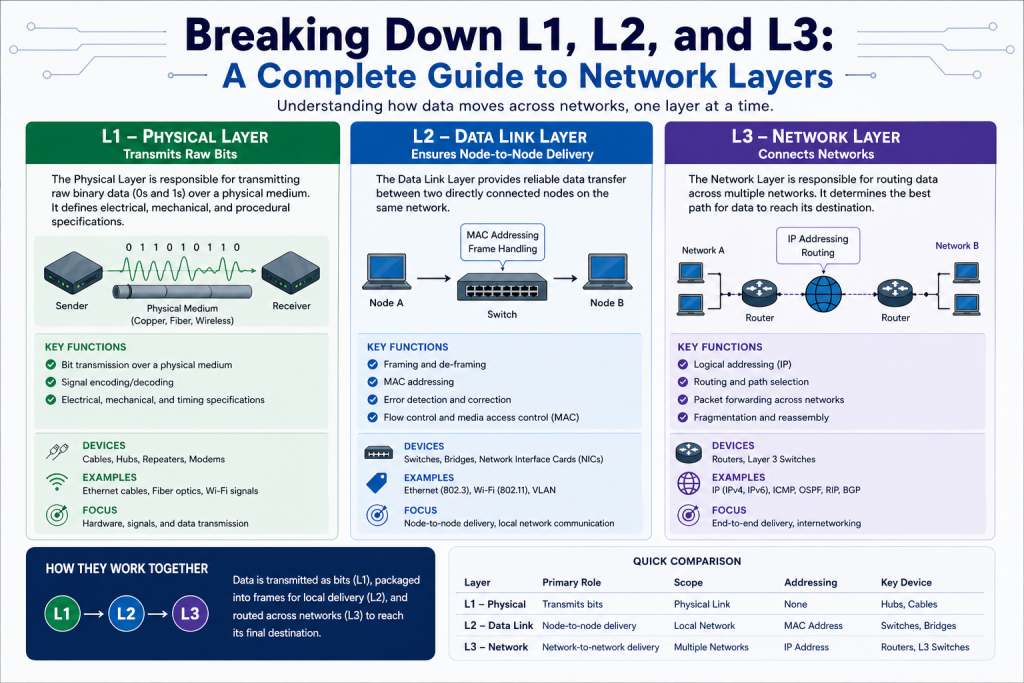
The Physical Layer is the first and most fundamental layer of the OSI model. It serves as the base upon which all other layers are built, making it essential for understanding how networks operate at their most basic level. While higher layers focus on logic, addressing, and communication rules, this layer is entirely concerned with the physical transmission of data. It deals with tangible components such as cables, connectors, electrical signals, and wireless frequencies.
In simple terms, the Physical Layer is responsible for moving raw data from one device to another in the form of bits. These bits are represented as electrical signals in copper cables, light pulses in fiber optics, or radio waves in wireless communication. Without this layer, no data could physically travel across a network, making it one of the most critical components in networking.
Understanding this layer is often overlooked because it appears straightforward compared to higher layers. However, its importance cannot be overstated. Any issue at this level can disrupt the entire network, regardless of how well the upper layers are configured. This makes a strong grasp of the Physical Layer essential for both learning and troubleshooting.
Role of the Physical Layer in Data Transmission
The primary function of the Physical Layer is to transmit raw binary data across a communication medium. This involves converting digital data into signals that can travel over physical or wireless channels. On the receiving end, these signals are converted back into digital form so they can be processed by the device.
Data at this layer is not structured into packets or frames. Instead, it exists purely as a stream of bits, which are sequences of zeros and ones. These bits represent all forms of digital information, whether it is text, images, or video. The Physical Layer does not interpret this data; it simply ensures that it is transmitted from one point to another.
Another important aspect of this layer is signal timing and synchronization. Devices must agree on when a bit starts and ends to ensure accurate communication. Without proper timing, data could become corrupted or misinterpreted.
The Physical Layer also defines how multiple devices share a communication medium. In wired networks, this involves managing how signals travel through cables. In wireless networks, it involves managing frequencies and signal strength to prevent interference.
Types of Transmission Media
One of the key responsibilities of the Physical Layer is defining and utilizing transmission media. This refers to the physical paths through which data travels. There are two main categories of transmission media: guided and unguided.
Guided media includes physical cables that direct signals along a specific path. Common examples include twisted pair cables, coaxial cables, and fiber optic cables. Twisted pair cables are widely used in Ethernet networks due to their cost-effectiveness and reliability. Coaxial cables, while less common today, are still used in certain applications such as cable television. Fiber optic cables, on the other hand, use light to transmit data and offer extremely high speeds and long-distance capabilities.
Unguided media refers to wireless communication, where signals travel through the air rather than a physical cable. This includes technologies such as Wi-Fi, Bluetooth, and microwave communication. These systems rely on radio frequencies to transmit data and are essential for modern mobile and wireless networks.
Each type of transmission medium has its own advantages and limitations. Factors such as distance, speed, cost, and susceptibility to interference all play a role in determining which medium is used in a given situation.
Signal Representation and Encoding
At the Physical Layer, data must be converted into a form that can be transmitted over a medium. This process is known as encoding. Encoding determines how binary data is represented as physical signals.
In electrical systems, bits are represented by changes in voltage. For example, a high voltage might represent a binary one, while a low voltage represents a zero. In fiber optic systems, bits are represented by light pulses, with the presence or absence of light indicating different values.
Encoding schemes are designed to ensure reliable transmission and minimize errors. They also help maintain synchronization between devices by providing predictable patterns in the signal.
Another important concept is modulation, which is used in wireless communication. Modulation involves altering a carrier signal to encode data. This allows information to be transmitted over long distances using radio waves.
Signal quality is a major concern at this layer. Factors such as noise, interference, and attenuation can affect the integrity of the signal. Proper design and implementation are necessary to ensure that data is transmitted accurately.
Hardware Components in the Physical Layer
The Physical Layer includes a wide range of hardware components that facilitate data transmission. These components are generally simple and do not perform complex processing. Their primary role is to transmit and receive signals.
Cables are one of the most obvious components. They provide the physical pathway for data to travel. Connectors are used to attach cables to devices, ensuring a stable and reliable connection.
Repeaters are devices that regenerate signals to extend the distance over which data can travel. As signals move through a medium, they can weaken over time. Repeaters amplify these signals, allowing them to reach farther distances without degradation.
Hubs are another example of Physical Layer devices. They act as central connection points for multiple devices, broadcasting incoming signals to all connected ports. While simple, hubs are largely obsolete in modern networks due to their inefficiency.
Wireless access points also have a Physical Layer component, as they handle the transmission and reception of radio signals. However, they also operate at higher layers, making them more complex than traditional Layer 1 devices.
Standards and Specifications
The Physical Layer relies on a variety of standards to ensure compatibility between devices. These standards define everything from cable types and connector layouts to signal voltage levels and transmission speeds.
For example, Ethernet standards specify how data should be transmitted over different types of cables. These standards ensure that devices from different manufacturers can communicate without issues.
Wiring standards are also important. They define how wires are arranged within a cable and how connectors should be configured. This ensures consistency and reliability in network installations.
Wireless standards define how data is transmitted over radio frequencies. These standards specify frequency ranges, modulation techniques, and other parameters necessary for communication.
Adhering to these standards is essential for building reliable networks. Without them, devices would not be able to communicate effectively, leading to compatibility issues and performance problems.
Limitations of the Physical Layer
While the Physical Layer is essential, it also has limitations. One of its main constraints is distance. Signals weaken as they travel, which limits how far data can be transmitted without amplification or regeneration.
Interference is another major issue. Electrical signals can be affected by electromagnetic interference from other devices, while wireless signals can be disrupted by physical obstacles or competing frequencies.
Bandwidth limitations also play a role. The capacity of a transmission medium determines how much data can be transmitted at a given time. Higher bandwidth allows for faster data transfer, but it often comes at a higher cost.
The Physical Layer does not provide any form of error correction or data validation. It simply transmits signals, leaving error handling to higher layers. This means that issues at this level can result in corrupted data being passed up the stack.
Importance of the Physical Layer in Networking
Despite its simplicity, the Physical Layer is crucial for the overall functionality of a network. It provides the foundation upon which all other layers operate. Without a reliable physical connection, higher-level processes cannot function.
This layer also plays a key role in network performance. The choice of transmission medium, signal quality, and hardware components all impact the speed and reliability of data transmission.
In troubleshooting, the Physical Layer is often the first place to check. Issues such as damaged cables, loose connections, or interference can prevent communication entirely. Identifying and resolving these problems is essential for maintaining a stable network.
Understanding this layer also helps in designing networks. Choosing the right cables, connectors, and technologies can significantly improve performance and scalability.
Real World Analogy
A helpful way to understand the Physical Layer is to compare it to a transportation system. In this analogy, the Physical Layer represents the roads, bridges, and tunnels that allow vehicles to travel. These structures do not determine where vehicles go or what they carry; they simply provide the means for movement.
Just as a damaged road can disrupt traffic, a faulty cable can disrupt data transmission. Similarly, the quality of infrastructure affects how efficiently movement occurs. A well-designed road system allows for smooth traffic flow, just as a well-designed network ensures efficient data transfer.
This analogy highlights the importance of the Physical Layer as the foundation of all communication. Without it, no data could move, and the entire network would cease to function.
A strong grasp of the Physical Layer not only helps in learning networking concepts but also provides a solid foundation for troubleshooting and network design. It is the starting point of all communication, making it an essential area of study for anyone interested in networking.
Introduction to the Physical Layer
The Physical Layer is the first and most fundamental layer of the OSI model. It serves as the base upon which all other layers are built, making it essential for understanding how networks operate at their most basic level. While higher layers focus on logic, addressing, and communication rules, this layer is entirely concerned with the physical transmission of data. It deals with tangible components such as cables, connectors, electrical signals, and wireless frequencies.
In simple terms, the Physical Layer is responsible for moving raw data from one device to another in the form of bits. These bits are represented as electrical signals in copper cables, light pulses in fiber optics, or radio waves in wireless communication. Without this layer, no data could physically travel across a network, making it one of the most critical components in networking.
Understanding this layer is often overlooked because it appears straightforward compared to higher layers. However, its importance cannot be overstated. Any issue at this level can disrupt the entire network, regardless of how well the upper layers are configured. This makes a strong grasp of the Physical Layer essential for both learning and troubleshooting.
Role of the Physical Layer in Data Transmission
The primary function of the Physical Layer is to transmit raw binary data across a communication medium. This involves converting digital data into signals that can travel over physical or wireless channels. On the receiving end, these signals are converted back into digital form so they can be processed by the device.
Data at this layer is not structured into packets or frames. Instead, it exists purely as a stream of bits, which are sequences of zeros and ones. These bits represent all forms of digital information, whether it is text, images, or video. The Physical Layer does not interpret this data; it simply ensures that it is transmitted from one point to another.
Another important aspect of this layer is signal timing and synchronization. Devices must agree on when a bit starts and ends to ensure accurate communication. Without proper timing, data could become corrupted or misinterpreted.
The Physical Layer also defines how multiple devices share a communication medium. In wired networks, this involves managing how signals travel through cables. In wireless networks, it involves managing frequencies and signal strength to prevent interference.
Types of Transmission Media
One of the key responsibilities of the Physical Layer is defining and utilizing transmission media. This refers to the physical paths through which data travels. There are two main categories of transmission media: guided and unguided.
Guided media includes physical cables that direct signals along a specific path. Common examples include twisted pair cables, coaxial cables, and fiber optic cables. Twisted pair cables are widely used in Ethernet networks due to their cost-effectiveness and reliability. Coaxial cables, while less common today, are still used in certain applications such as cable television. Fiber optic cables, on the other hand, use light to transmit data and offer extremely high speeds and long-distance capabilities.
Unguided media refers to wireless communication, where signals travel through the air rather than a physical cable. This includes technologies such as Wi-Fi, Bluetooth, and microwave communication. These systems rely on radio frequencies to transmit data and are essential for modern mobile and wireless networks.
Each type of transmission medium has its own advantages and limitations. Factors such as distance, speed, cost, and susceptibility to interference all play a role in determining which medium is used in a given situation.
Signal Representation and Encoding
At the Physical Layer, data must be converted into a form that can be transmitted over a medium. This process is known as encoding. Encoding determines how binary data is represented as physical signals.
In electrical systems, bits are represented by changes in voltage. For example, a high voltage might represent a binary one, while a low voltage represents a zero. In fiber optic systems, bits are represented by light pulses, with the presence or absence of light indicating different values.
Encoding schemes are designed to ensure reliable transmission and minimize errors. They also help maintain synchronization between devices by providing predictable patterns in the signal.
Another important concept is modulation, which is used in wireless communication. Modulation involves altering a carrier signal to encode data. This allows information to be transmitted over long distances using radio waves.
Signal quality is a major concern at this layer. Factors such as noise, interference, and attenuation can affect the integrity of the signal. Proper design and implementation are necessary to ensure that data is transmitted accurately.
Hardware Components in the Physical Layer
The Physical Layer includes a wide range of hardware components that facilitate data transmission. These components are generally simple and do not perform complex processing. Their primary role is to transmit and receive signals.
Cables are one of the most obvious components. They provide the physical pathway for data to travel. Connectors are used to attach cables to devices, ensuring a stable and reliable connection.
Repeaters are devices that regenerate signals to extend the distance over which data can travel. As signals move through a medium, they can weaken over time. Repeaters amplify these signals, allowing them to reach farther distances without degradation.
Hubs are another example of Physical Layer devices. They act as central connection points for multiple devices, broadcasting incoming signals to all connected ports. While simple, hubs are largely obsolete in modern networks due to their inefficiency.
Wireless access points also have a Physical Layer component, as they handle the transmission and reception of radio signals. However, they also operate at higher layers, making them more complex than traditional Layer 1 devices.
Standards and Specifications
The Physical Layer relies on a variety of standards to ensure compatibility between devices. These standards define everything from cable types and connector layouts to signal voltage levels and transmission speeds.
For example, Ethernet standards specify how data should be transmitted over different types of cables. These standards ensure that devices from different manufacturers can communicate without issues.
Wiring standards are also important. They define how wires are arranged within a cable and how connectors should be configured. This ensures consistency and reliability in network installations.
Wireless standards define how data is transmitted over radio frequencies. These standards specify frequency ranges, modulation techniques, and other parameters necessary for communication.
Adhering to these standards is essential for building reliable networks. Without them, devices would not be able to communicate effectively, leading to compatibility issues and performance problems.
Limitations of the Physical Layer
While the Physical Layer is essential, it also has limitations. One of its main constraints is distance. Signals weaken as they travel, which limits how far data can be transmitted without amplification or regeneration.
Interference is another major issue. Electrical signals can be affected by electromagnetic interference from other devices, while wireless signals can be disrupted by physical obstacles or competing frequencies.
Bandwidth limitations also play a role. The capacity of a transmission medium determines how much data can be transmitted at a given time. Higher bandwidth allows for faster data transfer, but it often comes at a higher cost.
The Physical Layer does not provide any form of error correction or data validation. It simply transmits signals, leaving error handling to higher layers. This means that issues at this level can result in corrupted data being passed up the stack.
Importance of the Physical Layer in Networking
Despite its simplicity, the Physical Layer is crucial for the overall functionality of a network. It provides the foundation upon which all other layers operate. Without a reliable physical connection, higher-level processes cannot function.
This layer also plays a key role in network performance. The choice of transmission medium, signal quality, and hardware components all impact the speed and reliability of data transmission.
In troubleshooting, the Physical Layer is often the first place to check. Issues such as damaged cables, loose connections, or interference can prevent communication entirely. Identifying and resolving these problems is essential for maintaining a stable network.
Understanding this layer also helps in designing networks. Choosing the right cables, connectors, and technologies can significantly improve performance and scalability.
Real World Analogy
A helpful way to understand the Physical Layer is to compare it to a transportation system. In this analogy, the Physical Layer represents the roads, bridges, and tunnels that allow vehicles to travel. These structures do not determine where vehicles go or what they carry; they simply provide the means for movement.
Just as a damaged road can disrupt traffic, a faulty cable can disrupt data transmission. Similarly, the quality of infrastructure affects how efficiently movement occurs. A well-designed road system allows for smooth traffic flow, just as a well-designed network ensures efficient data transfer.
This analogy highlights the importance of the Physical Layer as the foundation of all communication. Without it, no data could move, and the entire network would cease to function.
Introduction to the Data Link Layer
The Data Link Layer is the second layer of the OSI model and serves as the bridge between the raw signal transmission of the Physical Layer and the logical communication handled by higher layers. While the Physical Layer focuses on sending bits across a medium, the Data Link Layer gives structure to those bits and ensures they are delivered reliably between directly connected devices.
This layer is essential because raw bits alone are not meaningful without organization. The Data Link Layer groups these bits into structured units known as frames, which include addressing and control information. This allows devices on the same network segment to communicate effectively and accurately.
Understanding this layer is critical because it is where local network communication happens. Most day-to-day networking tasks, especially within a local area network, rely heavily on the functions performed at this level.
Purpose and Responsibilities
The main purpose of the Data Link Layer is to provide node-to-node communication. This means it ensures that data can travel from one device to another device on the same network segment without errors or confusion.
One of its primary responsibilities is framing. Instead of dealing with a continuous stream of bits, this layer organizes data into frames. Each frame contains not only the actual data but also important information such as source and destination addresses. This allows devices to identify where the data is coming from and where it needs to go.
Another key responsibility is error detection. The Data Link Layer can identify whether a frame has been corrupted during transmission. If an error is detected, the frame may be discarded or retransmitted, depending on the protocol being used.
Flow control is also handled at this layer in some protocols. This ensures that a fast sender does not overwhelm a slower receiver by sending too much data at once.
Frames and Their Structure
At the Data Link Layer, data is encapsulated into frames. A frame is a structured package of data that includes both payload and control information. The payload is the actual data being transmitted, while the control information helps manage the delivery process.
Each frame typically contains a header and a trailer. The header includes addressing information such as the source and destination MAC addresses. The trailer often contains error-checking data, which helps verify the integrity of the frame.
Frames allow the network to handle data in manageable units. This makes it easier to detect errors and ensures that communication remains organized and efficient.
The structure of frames can vary depending on the protocol being used. For example, Ethernet frames differ from those used in other technologies, but they all follow the same general concept of encapsulating data with control information.
MAC Addressing
One of the most important features of the Data Link Layer is the use of MAC addresses. A MAC address is a unique identifier assigned to a network interface. It is used to identify devices within a local network.
These addresses are typically hard-coded into the hardware by the manufacturer, making them unique for each device. This ensures that data can be delivered to the correct destination within a network segment.
When a device sends a frame, it includes both the source and destination MAC addresses. Network devices such as switches use this information to determine where the frame should be forwarded.
MAC addressing operates only within the local network. It does not work across multiple networks, which is why higher layers are needed for broader communication.
Sublayers of the Data Link Layer
The Data Link Layer is divided into two sublayers, each with its own specific role. These sublayers help organize the functions of the layer and make communication more efficient.
The first sublayer is responsible for controlling how devices access the transmission medium. This involves managing how multiple devices share the same communication channel without causing conflicts.
The second sublayer acts as a bridge between the Data Link Layer and the Network Layer. It allows multiple network protocols to operate over the same physical medium, ensuring compatibility and flexibility.
This division into sublayers helps simplify the design of networking systems and allows different technologies to coexist within the same network.
Media Access Control
Media Access Control is a critical function of the Data Link Layer. It determines how devices gain access to the communication medium and how they avoid conflicts.
In networks where multiple devices share the same medium, there is a risk of collisions. A collision occurs when two devices attempt to send data at the same time. To prevent this, various mechanisms are used.
One common method is collision detection, where devices monitor the network to detect collisions and respond accordingly. Another method is collision avoidance, where devices take steps to prevent collisions before they occur.
These mechanisms ensure that data transmission remains efficient and that devices can share the network without interfering with each other.
Logical Link Control
The Logical Link Control sublayer provides a connection between the Data Link Layer and the Network Layer. It allows multiple Layer 3 protocols to use the same network interface.
This sublayer is responsible for identifying which protocol should receive the data once it reaches the device. It also provides basic error handling and flow control in some implementations.
By separating these functions into a distinct sublayer, the network can support multiple protocols without requiring changes to the underlying hardware.
Devices Operating at Layer 2
Several types of devices operate at the Data Link Layer, each with specific roles in managing network communication.
Switches are among the most common Layer 2 devices. They use MAC addresses to forward frames to the correct destination. Unlike hubs, which broadcast data to all devices, switches send data only to the intended recipient. This improves efficiency and reduces unnecessary traffic.
Bridges are similar to switches but are typically used to connect separate network segments. They help reduce traffic by filtering frames based on MAC addresses.
Network interface cards also operate at this layer. They provide the physical connection to the network and handle framing and addressing functions.
These devices add intelligence to the network, allowing it to operate more efficiently than at the Physical Layer alone.
VLANs and Network Segmentation
Virtual local area networks are an important concept within the Data Link Layer. They allow a single physical network to be divided into multiple logical networks.
This segmentation helps improve performance and security by limiting broadcast traffic and isolating groups of devices. Devices within the same VLAN can communicate directly, while communication between VLANs requires routing through a higher layer.
VLANs are implemented by adding tags to frames, which identify the VLAN to which the data belongs. This allows multiple VLANs to share the same physical infrastructure.
By using VLANs, network administrators can create flexible and scalable network designs that meet the needs of different users and applications.
Error Detection and Handling
Error detection is a key function of the Data Link Layer. It ensures that data is transmitted accurately and identifies any issues that occur during transmission.
One common method of error detection is the use of checksums or cyclic redundancy checks. These techniques involve adding extra data to the frame, which can be used to verify its integrity.
If an error is detected, the frame may be discarded or retransmitted. The specific response depends on the protocol being used.
While this layer can detect errors, it does not always correct them. In many cases, error correction is handled by higher layers.
Differences from Other Layers
The Data Link Layer differs from the Physical Layer in that it adds structure and intelligence to data transmission. While the Physical Layer simply transmits bits, the Data Link Layer organizes those bits into frames and ensures they are delivered correctly.
Compared to the Network Layer, the Data Link Layer operates within a limited scope. It handles communication between directly connected devices, while the Network Layer manages communication across multiple networks.
This distinction is important because it defines the role of each layer and ensures that networking tasks are handled efficiently.
Real World Analogy
A useful way to understand the Data Link Layer is to think of it as a local delivery system. In this analogy, the Physical Layer provides the roads, while the Data Link Layer acts as the delivery service that ensures packages reach the correct address within a neighborhood.
Each package has a label with a sender and recipient address, similar to how frames contain source and destination MAC addresses. The delivery service ensures that packages are delivered correctly and handles any issues that arise during the process.
This analogy highlights the role of the Data Link Layer in managing local communication and ensuring reliable delivery.
Importance in Modern Networking
The Data Link Layer plays a crucial role in modern networking. It enables efficient communication within local networks and provides the foundation for higher-level processes.
Technologies such as Ethernet and wireless networking rely heavily on this layer. Without it, devices would not be able to communicate effectively within a network segment.
This layer also contributes to network performance and security. By controlling access to the medium and segmenting networks, it helps optimize traffic flow and protect sensitive data.
Understanding this layer is essential for anyone working with networks, as it provides the foundation for many common networking
Introduction to the Network Layer
The Network Layer is the third layer of the OSI model and plays a central role in enabling communication across different networks. While the lower layers focus on transmitting data over a single link or within a local network, this layer is responsible for moving data between networks, regardless of distance. It is the point where communication becomes scalable, allowing devices from different locations, cities, or even continents to exchange information.
At this level, data is no longer limited to local delivery. Instead, it is prepared for a journey that may involve multiple intermediate devices, different transmission technologies, and varying network conditions. The Network Layer ensures that data can travel from its source to its destination efficiently, even when the path is complex.
This layer introduces logical addressing and routing, which are essential for identifying devices and determining the best path for data. Without these functions, communication beyond a single network segment would not be possible.
Purpose and Core Responsibilities
The primary purpose of the Network Layer is to provide end-to-end delivery of data across multiple networks. It ensures that data originating from one device can reach another device, even if they are separated by several network boundaries.
One of its key responsibilities is logical addressing. Unlike physical addresses used at lower layers, logical addresses are assigned and managed in a way that supports large-scale communication. These addresses allow devices to be uniquely identified across different networks.
Another important responsibility is routing. The Network Layer determines the best path for data to travel based on various factors such as distance, network conditions, and available routes. This decision-making process is essential for efficient communication.
Packet forwarding is also a core function. Once a path is determined, the Network Layer ensures that data is passed from one device to the next along that path. Each intermediate device plays a role in moving the data closer to its final destination.
Packets and Data Handling
At the Network Layer, data is organized into units known as packets. A packet contains both the payload and control information needed for delivery. The payload is the actual data being transmitted, while the control information includes addressing and routing details.
Packets are designed to be independent units of data. This means that each packet can travel separately and may take a different path to reach the destination. This approach improves efficiency and flexibility, especially in large and dynamic networks.
The Network Layer does not guarantee that packets will arrive in order or even reach their destination. Instead, it focuses on forwarding them as efficiently as possible. Reliability is handled by higher layers, which may reorder packets or request retransmission if needed.
This stateless nature allows the Network Layer to operate quickly and efficiently, making it suitable for handling large volumes of data.
Logical Addressing and IP
Logical addressing is one of the defining features of the Network Layer. It provides a way to identify devices across different networks using a structured addressing system.
IP addressing is the most widely used form of logical addressing. Each device on a network is assigned an IP address, which serves as its identifier. These addresses can be configured manually or assigned automatically.
Logical addresses differ from physical addresses in that they can be changed and are organized hierarchically. This structure allows networks to be divided into smaller segments, making routing more efficient.
IP addresses also provide information about the network to which a device belongs. This helps routers determine the best path for data and ensures that packets are delivered to the correct destination.
Routing and Path Selection
Routing is one of the most important functions of the Network Layer. It involves determining the best path for data to travel from its source to its destination.
Routers use routing tables to store information about available paths. These tables are built using routing protocols or manual configuration. When a packet arrives, the router examines its destination address and uses the routing table to decide where to send it next.
Path selection is based on various factors, including network topology, link cost, and current conditions. The goal is to choose the most efficient route, minimizing delays and avoiding congestion.
In large networks, routing becomes more complex as multiple paths may exist between two points. Dynamic routing protocols help manage this complexity by automatically updating routing information as network conditions change.
Role of Routers and Layer 3 Devices
Devices operating at the Network Layer are responsible for forwarding packets between networks. Routers are the most common example of such devices.
A router connects multiple networks and directs traffic between them. It examines the destination address of each packet and determines the next hop in its journey. This process is repeated at each router until the packet reaches its destination.
Layer 3 switches are another type of device that combines the functions of switches and routers. They can perform routing at high speeds, making them suitable for large and complex networks.
Firewalls can also operate at this layer by filtering traffic based on IP addresses. This adds a level of security by controlling which packets are allowed to pass through the network.
Fragmentation and Reassembly
In some cases, packets may need to be broken into smaller pieces to fit the requirements of different networks. This process is known as fragmentation.
Each network has a maximum transmission size, which limits how large a packet can be. If a packet exceeds this size, it must be divided into smaller fragments before being transmitted.
These fragments are then reassembled at the destination to reconstruct the original data. This process ensures that data can travel across networks with different limitations.
Fragmentation adds complexity to the Network Layer, but it is necessary for maintaining compatibility between different systems.
Differences from Lower Layers
The Network Layer differs significantly from the Physical and Data Link Layers. While those layers focus on local communication and direct connections, the Network Layer operates on a much larger scale.
The Physical Layer is concerned with transmitting bits, and the Data Link Layer manages frames within a local network. In contrast, the Network Layer deals with packets and ensures they can travel across multiple networks.
Another key difference is addressing. Lower layers use physical addresses that are fixed and limited in scope, while the Network Layer uses logical addresses that can be configured and support global communication.
These differences highlight the unique role of the Network Layer in enabling large-scale networking.
Interaction with Higher Layers
The Network Layer works closely with higher layers to ensure complete communication. While it is responsible for delivering packets, it does not guarantee reliability or order.
Higher layers, such as the Transport Layer, handle tasks like error correction, flow control, and reassembly of data. This division of responsibilities allows each layer to focus on specific functions.
Applications rely on this cooperation to provide reliable and efficient communication. The Network Layer provides the path, while higher layers ensure that data arrives correctly and in the proper sequence.
Real World Analogy
A useful way to understand the Network Layer is to compare it to a postal system that operates on a global scale. In this analogy, the Data Link Layer handles local deliveries, while the Network Layer manages long-distance shipping.
When a package is sent, it may pass through several distribution centers before reaching its destination. Each center examines the address and decides where to send it next. This process is similar to how routers forward packets through a network.
The package does not necessarily take a single direct route. Instead, it may follow different paths depending on availability and efficiency. This reflects the way packets are routed across networks.
This analogy helps illustrate how the Network Layer enables communication across vast distances.
Importance in Modern Networking
The Network Layer is essential for modern communication systems. It enables devices to connect across large and complex networks, including the internet.
Without this layer, communication would be limited to small, isolated networks. The ability to route data across multiple networks is what makes global connectivity possible.
This layer also plays a key role in scalability. As networks grow, the Network Layer ensures that data can still be delivered efficiently. It supports the expansion of networks without compromising performance.
Security is another important aspect. By controlling how data is routed and filtered, the Network Layer helps protect networks from unauthorized access.
Challenges and Limitations
Despite its importance, the Network Layer faces several challenges. One of the main issues is congestion, which occurs when too much data is sent through a network at once.
Routing complexity is another challenge. As networks grow larger, maintaining accurate and efficient routing information becomes more difficult.
Packet loss can also occur due to network issues or congestion. Since the Network Layer does not guarantee delivery, higher layers must handle these situations.
Address management is another concern, especially in large networks. Ensuring that addresses are assigned and managed correctly is essential for avoiding conflicts and ensuring smooth communication.
Conclusion
The Network Layer is a critical component of the OSI model, responsible for enabling communication across multiple networks. It introduces logical addressing, routing, and packet forwarding, allowing data to travel from one device to another regardless of distance.
By organizing data into packets and determining the best path for delivery, this layer ensures efficient and scalable communication. It works in conjunction with other layers to provide a complete networking solution.
Understanding the Network Layer provides valuable insight into how modern networks operate. It highlights the complexity and sophistication involved in moving data across the world, making it an essential area of study for anyone interested in networking.
Continue exploring the technologies and certification concepts that matter most to you.