The digital world we rely on every day is built on a vast and complex system of interconnected networks. Whether you are browsing a website, sending a message, or streaming a video, you are using a structure that connects devices across homes, cities, and continents. This structure is often described as a “network of networks,” a phrase that highlights how smaller networks link together to form much larger systems.
To better understand how these systems function, networks are commonly grouped into three main categories based on their size and geographic coverage. These categories are Local Area Networks (LANs), Metropolitan Area Networks (MANs), and Wide Area Networks (WANs). Each type serves a unique purpose, uses different technologies, and operates at a different scale.
This classification helps simplify the complex structure of modern networking by breaking it down into manageable and easy-to-understand segments. Instead of viewing the entire internet as one massive system, dividing it into LAN, MAN, and WAN allows learners and professionals to focus on specific layers of connectivity. Each category reflects not only the physical distance between devices but also differences in ownership, performance, cost, and design.
For example, a LAN is typically private and controlled by a single user or organization, while a WAN often depends on shared infrastructure managed by service providers. MANs fall somewhere in between, offering regional connectivity within cities. These distinctions are important when designing networks, troubleshooting issues, or planning for expansion.
By understanding how these categories differ and how they interact, it becomes easier to see how data travels from a device in your home to servers located across the world. This layered approach also highlights how smaller networks connect to form larger ones, ultimately creating the global communication system we rely on every day.
In this first part, the focus will be on understanding the basics of network classification and taking a deep look at Wide Area Networks. WANs form the backbone of global communication, making them one of the most important concepts in networking.
Introduction to Network Categories
Networks are created to allow devices to communicate with one another. These devices can include computers, smartphones, servers, printers, and many other types of hardware. The way these devices are connected depends largely on how far apart they are and what kind of communication is required.
A small home network that connects a few devices operates very differently from a system that connects entire countries. Because of this, network types are categorized to simplify understanding and design. The three main categories—LAN, MAN, and WAN—are defined primarily by their geographic reach.
A Local Area Network covers a small area such as a home, office, or campus. A Metropolitan Area Network spans a larger area, usually a city or a large urban region. A Wide Area Network, on the other hand, covers very large distances, often connecting multiple cities, countries, or even continents.
These categories are not just labels. They reflect real differences in how networks are built, how they perform, and how they are managed. Each type uses specific technologies and equipment suited to its scale and purpose.
Understanding these categories is essential for anyone learning networking because it helps explain how data moves from one device to another, no matter how far apart those devices are.
What is a Wide Area Network
A Wide Area Network, commonly known as a WAN, is the largest type of network in terms of geographic coverage. It connects devices and smaller networks over long distances, enabling communication across regions, countries, and continents.
The most well-known example of a WAN is the internet. It is a global system that connects billions of devices and allows users to share information instantly. When you access a website hosted in another country, your request travels across a WAN.
WANs are designed to support long-distance communication. They make it possible for organizations to connect offices in different locations, for individuals to communicate across the globe, and for services to be delivered regardless of physical distance.
Unlike smaller networks, WANs do not rely solely on equipment owned by a single individual or organization. Instead, they use infrastructure provided by telecommunications companies and service providers. This shared infrastructure is what makes it possible to achieve global connectivity.
Core Purpose of WANs
The main purpose of a WAN is to connect multiple smaller networks into one large system. These smaller networks are usually LANs, which exist in homes, offices, schools, and businesses.
By linking these LANs together, WANs enable seamless communication between devices that are far apart. For example, a company with offices in different cities can use a WAN to allow employees to share files, access central servers, and communicate as if they were in the same location.
WANs also play a critical role in providing access to online services. Websites, cloud platforms, and online applications all depend on WAN infrastructure to deliver content to users.
Another important purpose of WANs is to ensure reliable data transmission over long distances. This involves managing traffic efficiently, handling large volumes of data, and maintaining stable connections even when network conditions change.
Key Characteristics of WANs
One of the defining characteristics of WANs is their ability to cover large geographic areas. This can range from a few hundred kilometers to the entire globe. Because of this, WANs must be designed to handle long-distance communication effectively.
WANs typically rely on infrastructure provided by external organizations. This includes internet service providers and large telecommunications companies that maintain cables, data centers, and routing equipment. Users and businesses usually pay for access to this infrastructure rather than building it themselves.
Another important characteristic is the use of routers. Routers are devices that direct data between networks. In a WAN, routers determine the best path for data to travel, ensuring that it reaches its destination as quickly and efficiently as possible.
WANs also use public IP addresses to identify devices on the network. These addresses allow devices to communicate with others across the internet. This is different from local networks, which use private IP addresses that are not accessible from outside the network.
Speed is another factor to consider. Historically, WANs have been slower than LANs due to the long distances involved and the complexity of routing data. However, advances in technology have greatly improved WAN speeds, making high-speed internet connections widely available.
Security is a major concern in WANs. Since data often travels through shared or public infrastructure, it is more vulnerable to interception. To protect data, various security measures are used, including encryption and secure communication protocols.
Technologies Used in WANs
WANs depend on a combination of technologies to function effectively. Among these, fiber-optic communication and routing systems are the most important.
Fiber-optic cables are widely used in modern WANs because they can transmit data at very high speeds over long distances. These cables use light signals to carry information through thin strands of glass. This method is much faster and more reliable than traditional copper cables.
Another key technology is routing. Routers are responsible for managing data traffic and determining the best path for each data packet. In large-scale WANs, routers are highly advanced devices capable of handling massive amounts of data.
In addition to fiber optics, WANs may also use other communication methods such as satellite links and wireless technologies. These are especially useful in areas where physical cables are difficult to install.
Data transmission in WANs involves breaking information into small units called packets. These packets travel independently across the network and are reassembled at their destination. This approach allows for efficient use of network resources and helps ensure reliable communication.
Role of Internet Service Providers
Internet service providers play a central role in the operation of WANs. They provide the infrastructure that connects users to the internet and to other networks.
ISPs maintain large networks of cables, routers, and data centers. They manage the flow of data across these networks and ensure that users can access online services.
Different ISPs are interconnected, forming a global network that allows data to travel from one part of the world to another. This interconnected system is what makes the internet possible.
Users typically connect to an ISP through a modem or router. This device serves as a gateway between the user’s local network and the wider WAN.
ISPs also offer different levels of service, including varying speeds and bandwidth options. These services are designed to meet the needs of different users, from individuals to large organizations.
Data Transmission in WANs
Data transmission in WANs is a complex process that involves multiple steps. When a user sends a request, such as opening a website, the data is broken into packets and sent across the network.
Each packet contains information about its destination, allowing routers to direct it along the best possible path. These paths can change depending on network conditions, ensuring efficient delivery.
As packets travel across the network, they may pass through multiple routers and communication links. Once they reach their destination, they are reassembled into the original data.
This process happens very quickly, often in a matter of milliseconds. Despite the complexity of the system, users experience it as near-instant communication.
Reliability is a key aspect of data transmission in WANs. Various protocols are used to ensure that data arrives correctly and in the right order. If a packet is lost or corrupted, it can be retransmitted.
Security Considerations in WANs
Security is one of the most important aspects of WAN design. Because WANs often use shared infrastructure, they are more exposed to potential threats.
To protect data, encryption is commonly used. Encryption converts data into a form that cannot be easily understood by unauthorized users. Only the intended recipient can decode the information.
Another important security measure is the use of virtual private networks. These create secure connections over public networks, allowing users to transmit data safely.
Firewalls and intrusion detection systems are also used to monitor and control network traffic. These tools help prevent unauthorized access and detect potential threats.
Organizations must carefully plan their security strategies to protect sensitive information. This includes implementing strong authentication methods and regularly updating security systems.
Evolution of Wide Area Networks
The development of WANs has a long history that dates back to early communication technologies. One of the earliest examples is the telegraph, which allowed messages to be sent over long distances using electrical signals.
The telegraph was followed by telephone networks, which enabled voice communication across large areas. These systems relied on physical connections and manual or mechanical switching.
With the advent of digital technology, communication systems became faster and more efficient. Data could be transmitted electronically, leading to the development of modern networking technologies.
The introduction of the internet marked a major milestone in the evolution of WANs. It created a global network that connects people and devices around the world.
In recent years, advancements in fiber-optic technology have further improved WAN performance. High-speed connections are now available in many areas, enabling faster data transmission and better user experiences.
Importance of WANs in Modern Life
WANs play a critical role in modern society. They enable communication, support business operations, and provide access to information and services.
Many everyday activities depend on WANs, including online banking, video conferencing, and cloud computing. Without WANs, these services would not be possible.
Businesses rely on WANs to connect offices, manage data, and communicate with customers. Governments use WANs to deliver public services and maintain communication systems.
WANs also support education by enabling online learning and access to digital resources. Students and teachers can connect from different locations and share information .
As technology continues to evolve, the importance of WANs is only expected to grow. They will remain a fundamental part of the global communication infrastructure.
Introduction to Local Area Networks
While wide area networks connect the world across vast distances, most digital interactions actually begin much closer to home. Inside houses, offices, schools, and campuses, devices communicate through smaller and more contained systems known as Local Area Networks. These networks form the foundation of everyday connectivity, allowing devices in a limited area to share resources and communicate efficiently.
A Local Area Network, commonly referred to as a LAN, is designed to connect devices within a small geographic space. This could be as small as a single room or as large as a multi-building campus. Unlike large-scale networks that depend on external infrastructure, LANs are typically owned, managed, and maintained by individuals or organizations.
LANs are essential because they provide fast, reliable, and secure communication within a limited area. They are the networks people interact with most frequently, even if they are not always aware of it. Every time a device connects to a home Wi-Fi network or accesses resources in an office environment, it is operating within a LAN.
What is a Local Area Network
A Local Area Network is a network that connects devices within a confined geographic area. This area is usually limited to a single building, home, or campus. The purpose of a LAN is to enable communication and resource sharing among devices that are physically close to each other.
In a typical LAN, devices such as computers, printers, servers, and mobile devices are connected using wired or wireless technologies. These devices can communicate directly with each other or access shared resources like files, applications, and internet connections.
One important aspect of LANs is that they can function independently of the internet. Even without an external connection, devices within a LAN can still communicate with one another. For example, computers in an office can share files and printers without needing access to the wider internet.
LANs are designed for high performance. Because the distances involved are short, data can be transmitted بسرعة عالية with minimal delay. This makes LANs ideal for tasks that require fast and reliable communication.
Core Purpose of LANs
The main purpose of a LAN is to facilitate communication and resource sharing within a limited area. By connecting devices together, a LAN allows users to access shared resources efficiently.
One of the primary benefits of a LAN is file sharing. Users can store data on centralized servers or share files directly between devices. This makes collaboration easier and reduces the need for physical storage devices.
LANs also enable shared access to hardware resources such as printers and scanners. Instead of connecting each device individually, multiple users can access a single resource through the network.
Another important purpose of LANs is to provide internet access to multiple devices through a single connection. A router connects the LAN to an external network, allowing all connected devices to share the same internet connection.
LANs also support communication tools such as messaging systems, internal email, and collaborative applications. These tools are essential in business and educational environments where efficient communication is critical.
Key Characteristics of LANs
One of the defining characteristics of LANs is their limited geographic scope. They are designed to operate within a confined area, which allows for better control and management.
LANs are usually owned and maintained by a single entity. This could be a homeowner, a business, or an educational institution. Because of this, users have full control over the network’s configuration, security, and performance.
Another important characteristic is high data transfer speed. LANs typically offer much faster speeds compared to larger networks because the distance between devices is small and the infrastructure is optimized for performance.
LANs also use private IP addressing. Devices within the network are assigned addresses that are only valid . This helps improve security and reduces the need for globally unique addresses.
Reliability is another key feature. Since LANs operate in a controlled environment, they are less prone to disruptions caused by external factors. This results in stable and consistent performance.
Security within a LAN is easier to manage compared to larger networks. Access to the network can be controlled physically and digitally, reducing the risk of unauthorized access.
Technologies Used in LANs
LANs rely on a combination of hardware and protocols to function effectively. The most common technologies used in LANs include Ethernet, switches, and wireless communication.
Ethernet is the standard technology for wired LAN connections. It uses cables to connect devices and transmit data. Ethernet connections are known for their reliability and high speed.
Switches are a central component of wired LANs. They connect multiple devices and manage data transmission between them. Switches operate by identifying devices using their unique hardware addresses and directing data accordingly.
Wireless technologies, such as Wi-Fi, are also widely used in LANs. These allow devices to connect to the network without physical cables. Wireless LANs provide flexibility and convenience, especially in environments where mobility is important.
LANs also rely on various communication protocols. These protocols define how data is transmitted and received. Common protocols include those responsible for addressing, data transfer, and error checking.
Modern LANs often combine wired and wireless technologies to create hybrid networks. This approach provides both high performance and flexibility, meeting the needs of different users and devices.
Role of Switches in LANs
Switches play a central role in the operation of LANs. They are responsible for connecting devices and ensuring efficient communication within the network.
When a device sends data, the switch receives it and determines the correct destination. It then forwards the data only to the intended device rather than broadcasting it to all devices. This improves efficiency and reduces network congestion.
Switches operate at a lower level of networking compared to routers. They focus on local communication within the network and do not handle data routing between different networks.
Modern switches support high-speed connections, often ranging from one gigabit per second to much higher speeds. This allows LANs to handle large volumes of data without performance issues.
In larger networks, multiple switches can be connected to expand the network and support more devices. This scalability makes LANs suitable for environments of different sizes.
IP Addressing in LANs
IP addressing is an important aspect of LAN operation. Each device on the network is assigned a unique address that allows it to be identified and communicate with other devices.
LANs typically use private IP addresses. These addresses are not accessible from outside the network, which adds a layer of security. Private addressing also allows multiple devices to share a single public IP address when accessing the internet.
Addresses in a LAN are often assigned automatically using a system that manages address distribution. This ensures that each device receives a unique address without manual configuration.
Addressing plays a key role in data transmission. When a device sends data, it includes the destination address so that the network can deliver it correctly.
Proper management of IP addresses is essential for maintaining network performance and avoiding conflicts between devices.
Data Transfer in LANs
Data transfer within a LAN is designed to be fast and efficient. Because devices are located close to each other, data can be transmitted with very low delay.
When a device sends data, it is broken into smaller units and transmitted across the network. Switches ensure that this data reaches the correct destination quickly.
LANs support high-speed data transfer rates, making them suitable for activities such as file sharing, video streaming, and online collaboration. The performance of a LAN depends on the quality of its hardware and the network design.
Wireless LANs may experience variations in speed due to interference and signal strength. However, modern wireless technologies have significantly improved performance and reliability.
Efficient data transfer is one of the main advantages of LANs, allowing users to perform tasks quickly and without interruption.
Security in Local Area Networks
Security in LANs is an important consideration, even though these networks operate in controlled environments. Protecting data and preventing unauthorized access are key priorities.
Access to a LAN can be restricted using authentication methods such as passwords and network keys. This ensures that only authorized users can connect to the network.
Firewalls and security software are often used to monitor network activity and block potential threats. These tools help protect devices from malware and unauthorized access.
Encryption is also used in wireless LANs to secure data transmission. This prevents attackers from intercepting sensitive information.
Physical security is another factor. Since LANs are confined to a specific location, controlling access to network equipment can help prevent unauthorized use.
Regular updates and maintenance are essential for maintaining security. Keeping software and hardware up to date helps protect against vulnerabilities.
LAN in Modern Environments
Local Area Networks are an integral part of modern life. They are used in homes, businesses, educational institutions, and many other environments.
In homes, LANs connect devices such as computers, smartphones, smart TVs, and home automation systems. These networks provide internet access and enable communication between devices.
In businesses, LANs support daily operations by connecting employees, servers, and resources. They enable collaboration, data sharing, and access to applications.
Educational institutions rely on LANs to provide access to digital resources and support learning activities. Students and teachers use these networks to communicate and share information.
LANs also play a role in emerging technologies such as smart homes and the Internet of Things. These technologies depend on local networks to function effectively.
As technology continues to advance, LANs will remain a fundamental component of network infrastructure. Their role in connecting devices and supporting communication will continue to grow, making them essential for both personal and professional use.
Introduction to Metropolitan Area Networks
As networks evolved to meet growing demands for connectivity, a need emerged for solutions that could bridge the gap between small local networks and large global systems. This led to the development of Metropolitan Area Networks. A Metropolitan Area Network, commonly known as a MAN, is designed to cover a geographic area larger than a Local Area Network but smaller than a Wide Area Network. Typically, a MAN spans a city or a large urban region.
MANs were created to address the limitations of earlier communication systems. In many cases, organizations within the same city required faster and more reliable connections than what traditional wide area connections could provide at the time. By offering high-speed connectivity across metropolitan regions, MANs became an important part of networking infrastructure, especially in densely populated and technology-driven areas.
These networks allowed multiple LANs within a city to connect efficiently without relying entirely on long-distance WAN infrastructure. This made communication faster, reduced latency, and improved overall performance for organizations operating within the same metropolitan area.
What is a Metropolitan Area Network
A Metropolitan Area Network is a network that connects multiple Local Area Networks across a city or urban region. It acts as an intermediate layer between LANs and WANs, providing high-speed communication within a defined geographic area.
Unlike LANs, which are usually owned and managed by a single organization, MANs are often operated by service providers. These providers build and maintain the infrastructure needed to connect different networks within a metropolitan region.
MANs are typically built using high-capacity communication technologies, including fiber-optic cables. These technologies allow large amounts of data to be transmitted quickly across relatively short distances compared to WANs.
One important characteristic of MANs is that they are designed for regional communication. While WANs connect distant locations, MANs focus on linking networks within a specific urban area. This makes them particularly useful for organizations that operate across multiple locations within the same city.
Core Purpose of MANs
The primary purpose of a MAN is to provide high-speed connectivity between multiple LANs within a metropolitan area. This enables organizations to share data and resources efficiently across different locations.
For example, a university with multiple campuses spread across a city can use a MAN to connect all its buildings into a unified network. Similarly, government offices, hospitals, and large businesses can use MANs to ensure seamless communication between their various branches.
MANs also help reduce the load on WAN infrastructure. By handling local traffic within the metropolitan area, they prevent unnecessary data from traveling long distances. This improves network efficiency and reduces latency.
Another important purpose of MANs is to provide reliable connectivity for urban environments. In cities where large volumes of data are transmitted ежедневно, MANs help maintain consistent performance and support high-demand applications.
Key Characteristics of MANs
One of the main characteristics of MANs is their geographic scope. They are designed to cover a city or metropolitan region, making them larger than LANs but smaller than WANs.
MANs often offer higher data transfer speeds compared to older WAN technologies. This is because they operate over shorter distances and use advanced communication infrastructure.
Another important feature is that MANs are usually managed by service providers. These providers are responsible for maintaining the network, ensuring reliability, and delivering services to customers.
MANs typically use private communication channels rather than public internet connections. This enhances security and allows organizations to transmit sensitive data without exposing it to external risks.
Low latency is another key characteristic. Because data does not have to travel long distances, communication within a MAN is faster and more efficient.
Scalability is also an important aspect. MANs can be expanded to include additional networks as needed, making them suitable for growing urban environments.
Technologies Used in MANs
MANs rely on high-capacity communication technologies to deliver fast and reliable connectivity. One of the most important technologies used in MANs is fiber-optic communication.
Fiber-optic cables enable the transmission of large amounts of data over relatively short distances with minimal signal loss. This makes them ideal for connecting multiple networks within a city.
Routing and switching technologies are also essential components of MANs. These technologies ensure that data is delivered efficiently between connected networks.
In addition to fiber optics, MANs may use wireless communication technologies to extend connectivity to areas where physical cables are difficult to deploy. These wireless systems provide flexibility and help ensure comprehensive coverage.
Network management systems are used to monitor performance, detect issues, and optimize data flow. These systems play a crucial role in maintaining the reliability and efficiency of MANs.
Applications of MANs
MANs are used in a variety of urban environments where high-speed connectivity is required. One common application is in educational institutions. Large universities often have multiple campuses spread across a city, and MANs allow them to connect these campuses into a single network.
Government organizations also rely on MANs to connect offices and departments within a city. This enables efficient communication and data sharing, which is essential for public services.
Healthcare systems use MANs to link hospitals, clinics, and research facilities. This allows medical professionals to access patient records, share information, and coordinate care more effectively.
Businesses with multiple locations within a city use MANs to maintain consistent communication and access to centralized resources. This improves productivity and supports collaboration.
MANs have also been used in technology-driven cities to support high-bandwidth applications and reduce network congestion.
MANs in Modern Networking
Over time, the role of MANs has changed significantly. In the past, they were essential for providing high-speed connectivity within cities, especially when WAN technologies were limited.
However, advancements in WAN technology, particularly the widespread adoption of fiber-optic connections, have reduced the need for dedicated MANs in many areas. Modern WANs are capable of delivering high-speed connectivity that can handle both local and long-distance communication.
Despite this, MANs are still relevant in certain situations. In areas where specialized infrastructure is required or where organizations need dedicated high-speed connections within a city, MANs continue to be used.
MANs also play a role in smart city initiatives, where large amounts of data are generated and processed within urban environments. These networks help support applications such as traffic management, surveillance systems, and public services.
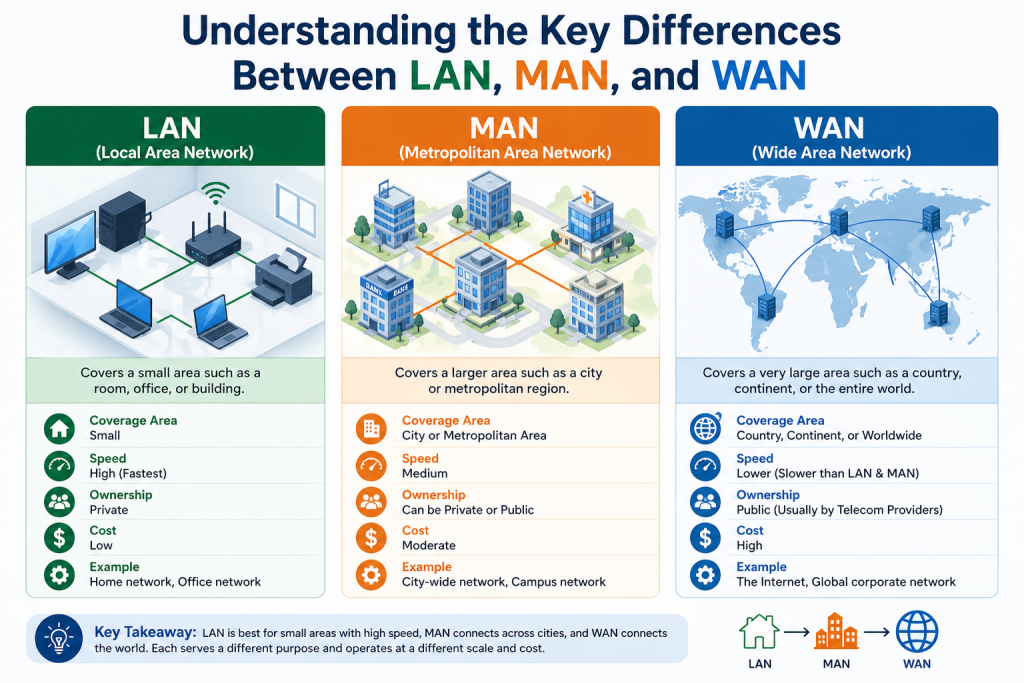
Comparison of LAN, MAN, and WAN
Understanding the differences between LAN, MAN, and WAN is essential for designing and managing networks effectively. Each type serves a specific purpose and operates at a different scale.
LANs are designed for small areas and provide high-speed communication between devices within a limited space. They are typically owned and managed by a single entity and offer excellent performance and control.
MANs cover larger areas, usually a city or metropolitan region. They connect multiple LANs and provide high-speed communication within urban environments. These networks are often managed by service providers.
WANs operate on a much larger scale, connecting networks across regions, countries, and continents. They rely on extensive infrastructure and are essential for global communication.
The choice between these network types depends on the specific needs of an organization. Factors such as geographic coverage, performance requirements, and cost all play a role in determining the most suitable solution.
Evolution of Network Technologies
The evolution of networking technologies has been driven by the need for faster and more reliable communication. Early systems relied on copper-based technologies that had limited capacity and performance.
As demand for data increased, new technologies were developed to improve network performance. Fiber-optic communication became the standard for high-speed data transmission, enabling networks to handle larger volumes of traffic.
LAN technologies evolved to support higher speeds and more devices. Modern LANs can deliver gigabit and even multi-gigabit performance, making them suitable for demanding applications.
WAN technologies also advanced significantly, reducing the gap between local and long-distance communication speeds. This has made it possible to deliver high-quality services across global networks.
MANs, which once played a critical role in bridging the gap between LANs and WANs, have been impacted by these advancements. While their importance has decreased in some areas, they continue to serve specific use cases.
Conclusion
Metropolitan Area Networks represent an important stage in the evolution of networking. They were developed to meet the growing demand for high-speed connectivity within urban environments and played a key role in connecting multiple local networks within cities.
Although advancements in WAN technology have reduced their prominence, MANs remain relevant in certain contexts where dedicated metropolitan connectivity is required. They continue to support applications that demand high performance and low latency within urban areas.
When viewed alongside LANs and WANs, MANs help complete the picture of how networks are structured and how they operate at different scales. Each type of network serves a distinct purpose, and together they form the foundation of modern communication systems.
Understanding these network types is essential for anyone involved in networking or technology. It provides insight into how data moves across different environments and helps in designing systems that are efficient, reliable, and scalable.
A clear understanding of LAN, MAN, and WAN also helps professionals make better decisions when planning infrastructure. Each network type comes with its own advantages, limitations, and cost considerations, so choosing the right one depends on the specific requirements of a project. For example, a small business may only need a well-designed LAN, while a large enterprise operating in multiple regions must rely heavily on WAN connectivity.
In addition, knowledge of these network types is crucial for troubleshooting. When issues arise, being able to identify whether the problem exists within a local network, a metropolitan connection, or a wide area system can significantly reduce downtime and improve efficiency. This understanding allows network administrators to isolate faults quickly and apply the correct solutions.
As technology continues to evolve, the demand for faster and more reliable connectivity will keep increasing. Concepts like cloud computing, remote work, and smart devices all depend on well-structured networks. By mastering these foundational network types, individuals can build a strong base for adapting to future advancements and managing increasingly complex systems with confidence.
Continue exploring the technologies and certification concepts that matter most to you.