In today’s interconnected world, computer networks are expected to handle massive volumes of data while maintaining performance, security, and reliability. As organizations grow, their networking requirements become more complex, making it necessary to adopt smarter ways of managing traffic. One of the most important concepts that enables efficient network management is segmentation, which involves dividing a network into smaller, more manageable parts.
Originally, networks were designed as flat structures where all devices shared the same communication space. This approach worked well for small environments but quickly became inefficient as networks expanded. Broadcast traffic increased, performance dropped, and security risks became harder to control. To address these challenges, network engineers introduced the concept of Virtual Local Area Networks, commonly known as VLANs.
VLANs allow administrators to create logical divisions within a physical network. Devices that belong to the same VLAN can communicate with each other as if they were on the same physical network, even if they are located in different areas or connected to different switches. At the same time, devices in separate VLANs are isolated from one another unless specific routing rules are applied.
This logical separation provides a strong foundation for better traffic control, improved performance, and enhanced security. However, for VLANs to function across multiple devices, there must be a standardized way to identify and manage traffic. This is where 802.1Q port tagging becomes essential. It provides the mechanism that allows network devices to recognize VLAN information within Ethernet frames and handle traffic accordingly.
Understanding how 802.1Q works is a key step for anyone involved in networking. It is widely used in enterprise environments, data centers, and service provider networks, making it one of the most important standards in modern network design.
What Is Port Tagging
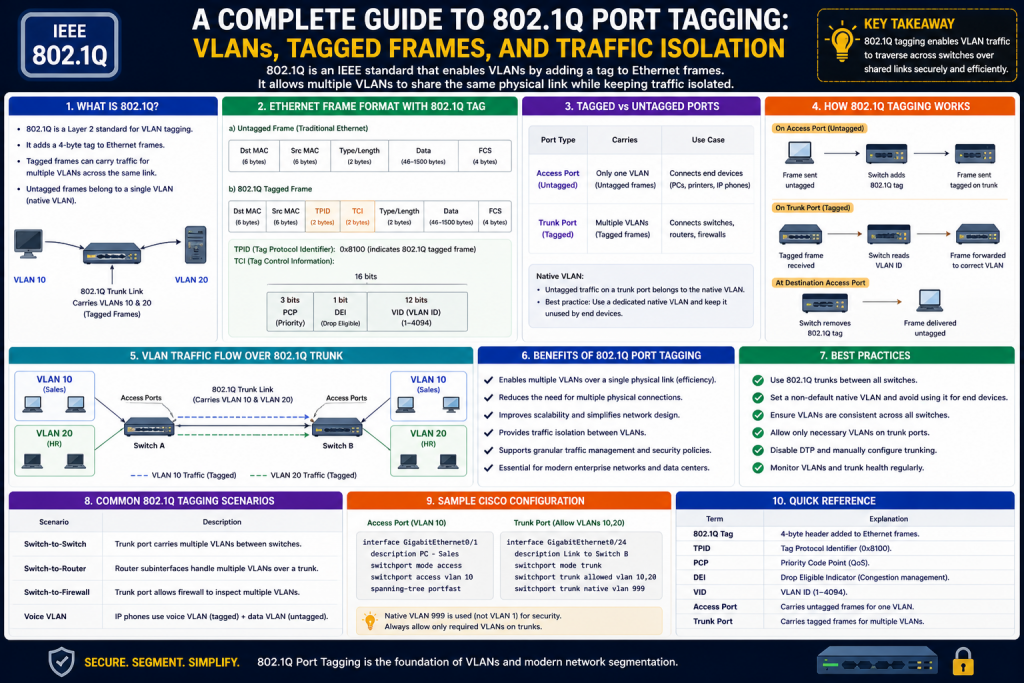
Port tagging is a technique used in networking to label Ethernet frames with information about the VLAN they belong to. This labeling allows switches and other network devices to distinguish between different streams of traffic, even when they share the same physical connection. Without tagging, it would be impossible to maintain separation between VLANs when data travels across shared links.
When a frame is transmitted across a network, it typically contains source and destination MAC addresses, along with payload data. With port tagging, an additional piece of information is inserted into the frame header. This information is known as a VLAN tag, and it includes a VLAN identifier that tells the receiving device which VLAN the frame belongs to.
Port tagging is primarily used on trunk links, which are connections between switches or between a switch and a router. These links are responsible for carrying traffic from multiple VLANs. By tagging each frame, the network ensures that VLAN information is preserved as data moves from one device to another.
In contrast, access ports are used to connect end devices such as computers, printers, and servers. These ports typically handle traffic from a single VLAN and do not require tagging. When a frame enters an access port, the switch associates it with the configured VLAN for that port. When the frame leaves the switch through an access port, any VLAN tag is removed before transmission.
This distinction between tagged and untagged traffic is fundamental to how VLANs operate. It allows network devices to manage traffic efficiently while keeping the complexity hidden from end users and devices that do not support VLAN tagging.
Port tagging also plays a critical role in enabling flexible network designs. It allows multiple VLANs to share the same infrastructure without interfering with each other. This reduces the need for additional hardware and simplifies network expansion, making it easier for organizations to scale their operations.
Why VLAN Tagging Is Necessary
As networks grow in size and complexity, the need for efficient traffic management becomes more important. VLAN tagging provides a solution to several challenges that arise in large network environments. One of the main reasons for using tagging is to maintain clear separation between different types of traffic.
In a typical organization, different departments may have different networking requirements. For example, the finance department may handle sensitive data, while the marketing team may require access to shared resources and internet services. By placing these departments in separate VLANs, administrators can ensure that their traffic remains isolated.
Without VLAN tagging, maintaining this separation would require separate physical networks for each department. This approach would be costly, inefficient, and difficult to manage. Tagging allows multiple VLANs to coexist on the same physical infrastructure, significantly reducing hardware requirements and simplifying network design.
Another important reason for using VLAN tagging is improved performance. In a flat network, broadcast traffic is sent to all devices, regardless of whether they need it. This can lead to congestion and reduced efficiency. By dividing the network into VLANs, broadcast traffic is limited to specific segments, reducing unnecessary load and improving overall performance.
Security is another major factor. VLAN tagging helps prevent unauthorized access by isolating sensitive systems from general network traffic. Even if an attacker gains access to one part of the network, they cannot easily reach other VLANs without proper routing and access controls.
In addition, VLAN tagging supports advanced networking features such as Quality of Service. By assigning priority levels to different types of traffic, administrators can ensure that critical applications receive the bandwidth they need. This is especially important for services like voice and video communication, where delays can significantly impact user experience.
Overall, VLAN tagging is a fundamental technology that enables efficient, secure, and scalable network design. It addresses many of the limitations of traditional networks and provides a flexible framework for managing modern communication systems.
The 802.1Q Standard
The 802.1Q standard is the most widely used method for implementing VLAN tagging. It was developed to provide a consistent and interoperable way for network devices to handle tagged traffic. By following this standard, devices from different manufacturers can work together seamlessly in a VLAN-enabled network.
The core idea behind 802.1Q is to insert a small tag into the Ethernet frame. This tag contains important information that identifies the VLAN and helps determine how the frame should be processed. The tag is added between the source MAC address and the EtherType field in the frame.
One of the key components of the 802.1Q tag is the VLAN identifier. This field uses 12 bits, allowing for up to 4096 unique VLANs. While not all of these IDs are available for use, the range is sufficient for most network environments.
Another important field is the priority code point. This field is used for Quality of Service and allows administrators to assign priority levels to different types of traffic. By using this feature, networks can ensure that time-sensitive data is delivered promptly, even during periods of congestion.
The standard also defines a concept known as the native VLAN. This is a default VLAN that handles untagged frames on trunk links. It is used to maintain compatibility with devices that do not support VLAN tagging. While this feature is useful, it must be configured carefully to avoid potential security risks.
By standardizing the tagging process, 802.1Q makes it possible to build large, complex networks with multiple VLANs. It ensures that all devices interpret VLAN information in the same way, reducing the risk of misconfiguration and improving overall reliability.
Tagged and Untagged Frames
Understanding the difference between tagged and untagged frames is essential for working with VLANs. Tagged frames contain additional information that identifies their VLAN, while untagged frames do not include this information.
When a frame is transmitted over a trunk link, it is typically tagged with an 802.1Q header. This header includes the VLAN identifier and other relevant information. The receiving device reads this tag and uses it to determine how to handle the frame.
On access ports, frames are usually untagged. When a frame arrives at an access port, the switch assigns it to the VLAN configured for that port. When the frame is sent out, any VLAN tag is removed before transmission. This ensures that end devices, which may not support VLAN tagging, can communicate normally.
The concept of a native VLAN is closely related to untagged frames. Frames belonging to the native VLAN are transmitted without a tag on trunk links. This allows devices that do not support tagging to communicate with the network. However, it also introduces potential security concerns if not configured properly.
Managing tagged and untagged traffic correctly is critical for maintaining a stable network. Misconfigurations can lead to communication failures, security vulnerabilities, or unexpected behavior. For this reason, administrators must carefully plan and verify their VLAN settings.
How 802.1Q Operates in a Network
In a VLAN-enabled network, switches use 802.1Q tagging to manage traffic between different segments. When a frame enters a switch, the device determines its VLAN membership based on the port configuration. If the frame arrives on an access port, it is assigned to the VLAN associated with that port.
When the frame needs to be forwarded to another switch over a trunk link, the switch adds an 802.1Q tag. This tag ensures that the VLAN information is preserved during transmission. The receiving switch reads the tag and forwards the frame to the appropriate VLAN.
If the frame is destined for a device connected to an access port, the tag is removed before transmission. This process ensures that end devices receive standard Ethernet frames without any additional complexity.
Trunk links play a vital role in this process. They allow multiple VLANs to share the same physical connection while maintaining separation between them. This reduces the need for additional cabling and simplifies network design.
Switches also maintain a VLAN table that maps ports to VLANs. This table is used to determine how frames should be forwarded. By using this information, switches can efficiently route traffic within and between VLANs.
The combination of tagging, trunking, and VLAN tables allows networks to operate efficiently and securely. It provides a flexible framework for managing traffic and adapting to changing requirements.
Benefits of 802.1Q Port Tagging
The use of 802.1Q port tagging offers several important benefits. One of the most significant advantages is improved network organization. By dividing a network into logical segments, administrators can manage traffic more effectively and apply specific policies to each VLAN.
Another key benefit is enhanced security. VLANs isolate traffic, preventing unauthorized access between different segments. This is particularly important in environments where sensitive data must be protected.
Port tagging also improves performance by reducing unnecessary broadcast traffic. By limiting broadcasts to specific VLANs, networks can operate more efficiently and avoid congestion.
Scalability is another advantage. As organizations grow, new VLANs can be added without requiring additional physical infrastructure. This makes it easier to expand the network and adapt to changing needs.
Finally, 802.1Q tagging simplifies network management. By using standardized tagging methods, administrators can configure and maintain networks more easily. This reduces complexity and minimizes the risk of errors.
Overall, 802.1Q port tagging is a powerful tool that enables modern network design. It provides the flexibility, security, and efficiency needed to support today’s demanding networking environments.
Designing a VLAN Strategy for Effective Network Segmentation
Before configuring 802.1Q port tagging on network devices, it is essential to create a well-structured VLAN design. A thoughtful design ensures that the network remains scalable, secure, and easy to manage over time. Without proper planning, VLAN implementations can quickly become confusing, leading to inefficiencies and potential security gaps.
The first step in designing a VLAN strategy is to understand the organizational structure and how different departments or services interact with the network. Each group within an organization typically has different requirements. For example, administrative teams may need access to internal systems, while guest users may only require internet connectivity. Separating these groups into different VLANs helps ensure that access is controlled appropriately.
Another important consideration is traffic patterns. Network administrators should analyze how data flows within the network and identify which devices frequently communicate with each other. Devices that exchange large volumes of data should ideally be placed within the same VLAN to reduce the need for routing, which can introduce latency.
Security requirements also play a major role in VLAN design. Sensitive systems such as financial databases or human resource platforms should be isolated from general user traffic. This isolation limits the potential impact of security breaches and makes it easier to enforce access control policies.
Scalability should not be overlooked. A well-designed VLAN structure allows for future growth without requiring major reconfiguration. This can be achieved by reserving VLAN IDs for future use and maintaining a consistent naming convention that clearly identifies the purpose of each VLAN.
Documentation is a critical part of the design process. Creating diagrams and written records of VLAN assignments, port configurations, and device roles helps administrators maintain a clear understanding of the network. This documentation becomes invaluable when troubleshooting issues or onboarding new team members.
By investing time in proper VLAN design, organizations can avoid many common pitfalls and ensure that their network infrastructure remains efficient and adaptable.
Configuring VLANs on Network Devices
Once the VLAN design is finalized, the next step is to configure the network devices to support 802.1Q tagging. This process typically involves switches, routers, and sometimes firewalls, depending on the network architecture.
On a switch, VLAN configuration begins with creating the VLAN itself. Each VLAN is assigned a unique identifier and, optionally, a descriptive name. Naming VLANs based on their function, such as finance, engineering, or guest, makes it easier to manage and understand the network.
After creating the VLANs, administrators must assign switch ports to the appropriate VLANs. This is done by configuring each port as either an access port or a trunk port. Access ports are assigned to a single VLAN and are used to connect end devices. Trunk ports are configured to carry traffic for multiple VLANs and use 802.1Q tagging to distinguish between them.
Enabling trunking on a port involves specifying which VLANs are allowed to pass through the link. This helps control traffic flow and prevents unnecessary VLANs from being propagated across the network. In many cases, administrators also configure a native VLAN for the trunk port, which handles untagged traffic.
Routers may also be configured to support VLAN tagging, particularly in scenarios where inter-VLAN routing is required. This allows devices in different VLANs to communicate with each other through a routing process. A common approach is to use subinterfaces on a router, with each subinterface associated with a specific VLAN.
Firewalls can also play a role in VLAN configuration by enforcing security policies between different segments. By integrating VLAN awareness into firewall rules, administrators can control traffic more effectively and protect sensitive areas of the network.
Proper configuration of network devices is essential for ensuring that VLAN tagging works as intended. Even small errors, such as incorrect VLAN IDs or mismatched trunk settings, can lead to connectivity issues. For this reason, it is important to verify configurations carefully and test the network after making changes.
Assigning Ports and Managing VLAN Membership
Assigning ports to VLANs is a fundamental task in network configuration. Each port on a switch must be associated with a specific VLAN, either as an access port or as part of a trunk link. This association determines how traffic entering or leaving the port is handled.
Access ports are typically assigned to a single VLAN and are used for connecting end devices. When a device sends data through an access port, the switch automatically associates that traffic with the configured VLAN. The device itself does not need to be aware of VLAN tagging, making this approach simple and efficient.
Trunk ports, on the other hand, are used to connect switches or other network devices that need to carry traffic from multiple VLANs. These ports use 802.1Q tagging to preserve VLAN information as frames travel across the network. Administrators must carefully configure which VLANs are allowed on each trunk to avoid unnecessary traffic and potential security risks.
Managing VLAN membership also involves keeping track of which devices belong to which VLANs. This can be done manually by assigning ports, or dynamically through protocols that automatically assign VLANs based on device characteristics. Dynamic VLAN assignment can simplify management in large environments, but it requires additional configuration and infrastructure.
Consistency is important when managing VLAN membership. All switches in the network should have a consistent understanding of VLAN IDs and their associated purposes. Inconsistent configurations can lead to communication failures and make troubleshooting more difficult.
Regular audits of VLAN assignments can help ensure that the network remains organized and secure. Over time, changes in the network may lead to unused VLANs or incorrect port assignments. Identifying and correcting these issues helps maintain a clean and efficient configuration.
Verifying and Testing VLAN Configurations
After configuring VLANs and port tagging, it is important to verify that everything is working correctly. Testing ensures that devices can communicate as expected and that VLAN segmentation is functioning properly.
One of the simplest ways to test connectivity is by using basic network tools such as ping. By sending test packets between devices within the same VLAN, administrators can confirm that communication is working. Testing between different VLANs can also verify whether routing is configured correctly.
More advanced tools, such as packet analyzers, can provide deeper insights into network traffic. These tools allow administrators to capture and examine frames, including their VLAN tags. By analyzing this data, it is possible to confirm that tagging is being applied correctly and that frames are being forwarded as expected.
Traceroute is another useful tool for understanding how traffic moves through the network. It shows the path that packets take from source to destination, helping identify any issues along the way.
Switches also provide built-in commands for verifying VLAN configurations. These commands can display information about VLAN assignments, trunk status, and port configurations. Reviewing this information helps ensure that the network is set up correctly.
Testing should not be a one-time activity. Regular verification helps identify issues early and ensures that the network continues to operate smoothly as changes are made. By incorporating testing into routine maintenance, administrators can maintain a high level of reliability.
Best Practices for 802.1Q Implementation
Implementing 802.1Q port tagging successfully requires following a set of best practices. These practices help minimize errors, improve performance, and enhance security.
One of the most important practices is using clear and consistent naming conventions for VLANs. Names should reflect the purpose of the VLAN, making it easier to identify and manage. Avoid using generic names that do not provide meaningful information.
Documentation is equally important. Keeping detailed records of VLAN configurations, port assignments, and network diagrams helps maintain clarity. This documentation should be updated whenever changes are made to ensure accuracy.
Another best practice is limiting the number of VLANs allowed on trunk ports. Allowing only necessary VLANs reduces unnecessary traffic and improves security. It also simplifies troubleshooting by reducing the complexity of the network.
Administrators should also avoid using the default VLAN for regular traffic. The default VLAN is often targeted in attacks, so it is safer to create separate VLANs for specific purposes and leave the default VLAN unused or restricted.
Regular monitoring of network performance is essential. By analyzing traffic patterns and identifying bottlenecks, administrators can optimize VLAN configurations and improve overall efficiency.
Consistency across devices is critical. All switches should have matching VLAN configurations and trunk settings to ensure seamless communication. Any discrepancies can lead to connectivity issues and unexpected behavior.
By following these best practices, organizations can create a stable and efficient network environment that fully leverages the benefits of 802.1Q port tagging.
Troubleshooting Common VLAN and Tagging Issues
Despite careful planning and implementation, issues can still arise in VLAN configurations. Troubleshooting these problems requires a systematic approach and a clear understanding of how VLANs and tagging work.
One common issue is VLAN mismatch, which occurs when two devices have inconsistent VLAN configurations. This can prevent communication between devices and lead to network disruptions. Checking VLAN IDs and ensuring consistency across devices is the first step in resolving this problem.
Incorrect trunk configuration is another frequent issue. If a trunk port is not properly configured, it may fail to carry traffic for certain VLANs. Verifying trunk settings and allowed VLAN lists can help identify and fix this problem.
Tagging errors can also occur if frames are not being tagged or untagged correctly. This can result in traffic being assigned to the wrong VLAN or dropped entirely. Packet analysis tools can be useful for diagnosing these issues.
Native VLAN mismatches can cause unexpected behavior, particularly when untagged traffic is involved. Ensuring that both ends of a trunk link use the same native VLAN is essential for proper operation.
Connectivity issues may also arise from incorrect port assignments. If a device is connected to a port assigned to the wrong VLAN, it may not be able to communicate with other devices. Reviewing port configurations and making necessary adjustments can resolve this issue.
In some cases, hardware or firmware limitations may cause compatibility problems. Ensuring that all devices support 802.1Q and are running compatible software versions can help prevent such issues.
Effective troubleshooting requires patience and attention to detail. By methodically checking configurations and using the right tools, administrators can identify and resolve problems efficiently.
Maintaining and Optimizing VLAN Environments
Once a VLAN environment is up and running, ongoing maintenance is necessary to keep it operating efficiently. Networks are dynamic, and changes in usage patterns, device additions, and organizational growth can all impact performance.
Regular reviews of VLAN configurations help ensure that the network remains aligned with current needs. This includes removing unused VLANs, updating port assignments, and revising security policies as necessary.
Performance monitoring is another important aspect of maintenance. By tracking metrics such as bandwidth usage and latency, administrators can identify areas for improvement. Adjustments to VLAN design or Quality of Service settings may be needed to optimize performance.
Security should also be reviewed periodically. As new threats emerge, it is important to update security measures and ensure that VLAN segmentation continues to provide adequate protection.
Automation tools can help simplify maintenance tasks. These tools can monitor network activity, detect anomalies, and even apply configuration changes automatically. While automation requires initial setup, it can significantly reduce the workload for administrators.
Training and knowledge sharing within the team are also important. Ensuring that all team members understand VLAN concepts and configurations helps maintain consistency and reduces the risk of errors.
By taking a proactive approach to maintenance and optimization, organizations can ensure that their VLAN environments remain efficient, secure, and ready to support future growth.
Understanding Security Risks in VLAN Tagging
While 802.1Q port tagging provides powerful capabilities for network segmentation and management, it is not inherently secure on its own. VLANs are often misunderstood as complete security boundaries, but in reality, they are primarily designed for traffic separation rather than full protection. Without proper safeguards, vulnerabilities can be exploited, potentially allowing unauthorized access to sensitive network segments.
One of the main reasons VLAN tagging can be vulnerable is due to misconfigurations. Even small errors in trunk settings, VLAN assignments, or port configurations can create opportunities for attackers to bypass segmentation controls. For example, if a trunk port is improperly configured to allow unnecessary VLANs, it could expose parts of the network that should remain isolated.
Another concern is the reliance on shared infrastructure. Since multiple VLANs operate over the same physical links, any weakness in the tagging or switching process could impact multiple segments simultaneously. This makes it critical to ensure that all devices involved in VLAN tagging are properly configured and secured.
In addition, older network devices or improperly updated firmware may not fully support modern security practices. This can introduce compatibility issues or leave the network exposed to known vulnerabilities. Keeping devices updated and following vendor recommendations is an important step in maintaining a secure environment.
Understanding these risks is the first step toward building a more secure VLAN infrastructure. By recognizing that VLAN tagging alone is not a complete security solution, administrators can implement additional measures to protect their networks.
VLAN Hopping Attacks
VLAN hopping is one of the most well-known threats associated with VLAN environments. This type of attack allows an unauthorized user to gain access to traffic in a different VLAN, effectively bypassing segmentation controls.
There are two primary methods used in VLAN hopping attacks. The first involves switch spoofing. In this scenario, an attacker configures their device to mimic a switch and attempts to establish a trunk link with a legitimate switch. If successful, the attacker can gain access to traffic from multiple VLANs.
The second method is known as double tagging. This technique involves inserting two VLAN tags into a single Ethernet frame. When the frame passes through a switch, the outer tag is removed, and the inner tag is processed by the next switch. This can trick the network into forwarding the frame to a different VLAN than intended.
Both types of VLAN hopping attacks exploit weaknesses in configuration rather than flaws in the 802.1Q standard itself. Proper configuration and security practices can effectively prevent these attacks.
To reduce the risk of VLAN hopping, administrators should disable trunking on ports that do not require it. Access ports should never be allowed to negotiate trunking automatically. Additionally, using dedicated VLANs for trunk links and avoiding the use of default VLANs for sensitive traffic can help mitigate risks.
Regular monitoring and auditing of network configurations also play a crucial role in detecting and preventing VLAN hopping attempts. By staying vigilant and proactive, administrators can protect their networks from this type of threat.
Double Tagging Exploits
Double tagging is a more specific form of VLAN hopping that takes advantage of how switches process tagged frames. In this attack, the malicious actor crafts a frame with two VLAN tags. The first tag corresponds to the native VLAN of the trunk link, while the second tag targets the VLAN the attacker wants to access.
When the frame is transmitted, the first switch removes the outer tag because it matches the native VLAN. The frame is then forwarded to the next switch, which reads the second tag and processes it as if it were a legitimate VLAN tag. This allows the attacker to inject traffic into a VLAN they should not have access to.
This type of attack relies heavily on the presence of a native VLAN and the use of untagged traffic on trunk links. If the network is configured to tag all VLAN traffic, including the native VLAN, the risk of double tagging attacks can be significantly reduced.
Another effective mitigation strategy is to avoid using the default VLAN as the native VLAN. Instead, administrators can assign an unused VLAN ID as the native VLAN, reducing the likelihood of exploitation.
Ensuring that access ports are not connected to trunk links is also important. Double tagging attacks typically require the attacker to be connected to an access port in the native VLAN. By carefully controlling port assignments and VLAN configurations, administrators can minimize this risk.
While double tagging is less common than other types of attacks, it remains a potential threat in poorly configured networks. Understanding how it works and taking preventive measures is essential for maintaining a secure environment.
Unauthorized VLAN Configuration Changes
Another significant risk in VLAN environments is unauthorized modification of VLAN configurations. If an attacker gains access to network devices, they may attempt to change VLAN assignments, create new VLANs, or alter trunk settings to gain access to restricted areas.
This type of attack can have serious consequences. It may allow unauthorized users to intercept sensitive data, disrupt network operations, or introduce malicious traffic into the network. In some cases, it can lead to a complete breakdown of network segmentation.
Preventing unauthorized changes requires strong access control measures. Network devices should be secured with strong passwords and, where possible, multi-factor authentication. Default credentials should always be changed, as they are widely known and easily exploited.
Role-based access control can also be implemented to limit the actions that different users can perform. For example, only authorized administrators should be able to modify VLAN configurations, while other users may have read-only access.
Logging and monitoring are essential for detecting unauthorized changes. By keeping detailed records of configuration changes, administrators can quickly identify suspicious activity and take corrective action.
Regular backups of device configurations provide an additional layer of protection. In the event of unauthorized changes, configurations can be restored to a known good state, minimizing disruption.
Implementing Port Security Measures
Port security is a key component of protecting VLAN environments. It involves restricting which devices can connect to specific switch ports and controlling how those devices interact with the network.
One common technique is MAC address filtering, which allows only specific devices to connect to a port based on their hardware address. This prevents unauthorized devices from gaining access to the network.
Another important measure is limiting the number of devices that can connect to a single port. This helps prevent attackers from using hubs or other devices to connect multiple unauthorized systems.
Disabling unused ports is also a simple but effective security practice. Unused ports can be exploited by attackers to gain physical access to the network. By shutting them down, administrators reduce the attack surface.
Dynamic Host Configuration Protocol controls can also be implemented to prevent unauthorized IP address assignment. This helps ensure that only trusted devices can obtain network connectivity.
Port security measures should be combined with regular monitoring to detect unusual activity. Alerts can be configured to notify administrators of potential security violations, allowing for quick response.
By implementing strong port security practices, organizations can significantly reduce the risk of unauthorized access and maintain better control over their network environments.
Securing Network Devices and Infrastructure
Network devices themselves must be secured to protect VLAN configurations and overall network integrity. This includes switches, routers, and any other devices involved in traffic management.
One of the most important steps is changing default login credentials. Many devices are shipped with standard usernames and passwords, which are widely known and easily exploited. Updating these credentials is a basic but critical security measure.
Access to device management interfaces should be restricted to trusted networks or specific IP addresses. This prevents unauthorized users from attempting to access configuration settings.
Encryption should be used for management connections whenever possible. Protocols such as secure shell provide a safer alternative to unencrypted methods, reducing the risk of credential theft.
Firmware updates are also essential. Manufacturers regularly release updates to address security vulnerabilities and improve performance. Keeping devices up to date helps protect against known threats.
Physical security should not be overlooked. Network devices should be placed in secure locations with controlled access. Unauthorized physical access can bypass many logical security measures.
By securing both the logical and physical aspects of network devices, administrators can create a strong foundation for protecting VLAN environments.
Advanced VLAN Security Techniques
Beyond basic security measures, there are advanced techniques that can further enhance VLAN protection. These methods provide additional layers of control and help mitigate more sophisticated threats.
Private VLANs are one such technique. They allow administrators to create sub-segments within a VLAN, restricting communication between devices even within the same VLAN. This is useful in environments where devices should be isolated from each other, such as in hosting or multi-tenant networks.
VLAN access control lists provide another level of control. These lists allow administrators to define rules that govern traffic between VLANs. By specifying which types of traffic are allowed or denied, administrators can enforce strict security policies.
Network segmentation can also be combined with firewall rules to create a defense-in-depth strategy. Firewalls can inspect traffic between VLANs and block suspicious or unauthorized communication.
Monitoring tools can be used to analyze traffic patterns and detect anomalies. By identifying unusual behavior, administrators can respond to potential threats before they cause significant damage.
Implementing these advanced techniques requires careful planning and expertise. However, they can significantly improve the security and resilience of VLAN environments.
Monitoring and Auditing VLAN Environments
Continuous monitoring is essential for maintaining a secure and efficient network. By keeping track of network activity, administrators can identify potential issues and respond quickly.
Monitoring tools can provide real-time insights into traffic patterns, bandwidth usage, and device performance. This information helps administrators optimize network configurations and detect anomalies.
Auditing involves reviewing configurations and policies to ensure they remain accurate and effective. Regular audits can identify outdated settings, unused VLANs, or potential security gaps.
Change management processes should be implemented to track modifications to the network. This ensures that all changes are documented and approved, reducing the risk of accidental misconfigurations.
Alerts and notifications can be configured to inform administrators of unusual activity. This allows for rapid response to potential threats or performance issues.
By combining monitoring and auditing practices, organizations can maintain a high level of visibility and control over their VLAN environments.
Performance Optimization in Tagged Networks
In addition to security, performance optimization is an important consideration in VLAN environments. Properly configured VLANs can improve efficiency, but poor design can lead to bottlenecks and reduced performance.
One key factor is managing broadcast traffic. By limiting broadcasts to specific VLANs, networks can reduce unnecessary traffic and improve efficiency. This is especially important in large environments with many devices.
Quality of Service settings can be used to prioritize critical traffic. By assigning higher priority to time-sensitive data, such as voice or video, administrators can ensure a better user experience.
Load balancing can also be implemented to distribute traffic evenly across network links. This helps prevent congestion and improves overall performance.
Regular performance testing can identify areas for improvement. By analyzing metrics such as latency and throughput, administrators can make informed decisions about network optimization.
Proper cable management and hardware selection also play a role in performance. Using high-quality equipment and maintaining a clean infrastructure can help ensure reliable operation.
Future Trends in VLAN and Network Segmentation
As networking technology continues to evolve, new approaches to segmentation are emerging. While VLANs remain a fundamental tool, they are increasingly being complemented by software-defined networking and other advanced technologies.
Software-defined networking allows administrators to manage network configurations through centralized software. This provides greater flexibility and simplifies the management of complex environments.
Network virtualization is another trend that extends the concept of VLANs. It allows multiple virtual networks to coexist on the same physical infrastructure, providing even greater scalability.
Automation is becoming more common in network management. Automated tools can configure VLANs, monitor performance, and respond to issues without manual intervention.
Despite these advancements, the principles of 802.1Q tagging remain relevant. Understanding how VLAN tagging works provides a strong foundation for adapting to new technologies.
Conclusion
802.1Q port tagging is a fundamental technology that enables efficient network segmentation and management. It allows multiple VLANs to share the same physical infrastructure while maintaining logical separation between different types of traffic. This capability is essential for modern networks, where performance, scalability, and security are critical.
However, implementing VLAN tagging is only part of the process. Proper planning, configuration, and maintenance are required to ensure that the network operates effectively. Security considerations must also be addressed, as VLANs alone do not provide complete protection against threats.
By understanding potential risks such as VLAN hopping and double tagging, administrators can take proactive steps to secure their networks. Implementing strong access controls, monitoring activity, and using advanced security techniques further enhances protection.
Ongoing maintenance and optimization are equally important. Regular audits, performance monitoring, and updates help ensure that the network continues to meet organizational needs.
As technology evolves, new tools and approaches will continue to enhance network segmentation. Nevertheless, the core concepts of 802.1Q tagging remain a vital part of networking knowledge.
With a solid understanding of these principles, network professionals can design and manage robust, secure, and efficient network environments that support the demands of modern organizations.
Continue exploring the technologies and certification concepts that matter most to you.