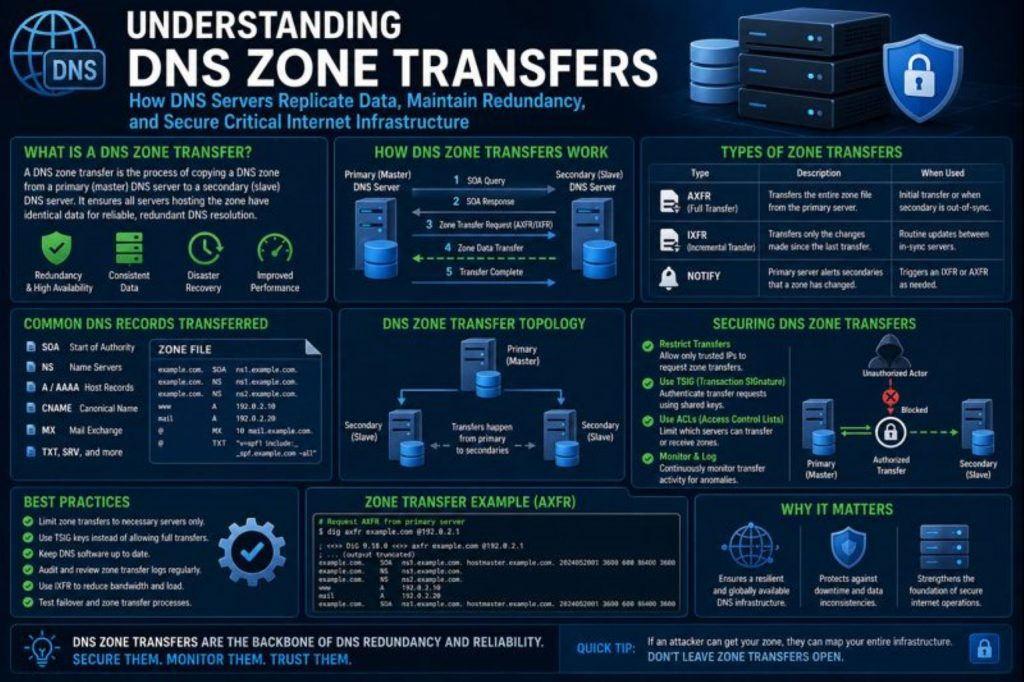
The modern internet is built on systems that most users never see but rely on every single day. One of the most important of these systems is the Domain Name System, or DNS. Every website visit, email delivery, cloud application request, software update, or online authentication process depends on DNS functioning accurately and efficiently. While most people recognize DNS as the service that translates domain names into IP addresses, fewer understand the behind-the-scenes mechanisms that keep DNS information synchronized, redundant, and resilient across multiple servers. One of the most critical of these mechanisms is the DNS zone transfer.
DNS zone transfers are foundational to maintaining reliable internet infrastructure because they allow DNS servers to replicate domain information from one authoritative server to another. This process ensures consistency, availability, and fault tolerance across networks. Without DNS zone transfers, organizations would struggle to maintain backup DNS servers, achieve disaster recovery readiness, or ensure that users worldwide consistently reach the correct online destinations.
To appreciate the role of DNS zone transfers, it is important to first understand the broader purpose of DNS itself. The internet is based on IP addresses, which are numerical labels assigned to devices connected to networks. These addresses allow systems to find one another, but they are difficult for humans to remember. DNS simplifies this by translating human-friendly names into machine-usable IP addresses. For example, instead of remembering a string of numbers, users simply type a recognizable name, and DNS resolves it to the proper server location.
This translation process may appear simple from the user’s perspective, but in reality it involves a distributed ecosystem of DNS servers working together. DNS is not a single database. It is a hierarchical, globally distributed system that includes recursive resolvers, root servers, top-level domain servers, and authoritative name servers. Authoritative servers are especially important because they hold the official DNS records for specific domains. These records are stored in zone files.
A DNS zone is an administrative portion of the DNS namespace managed by a specific organization or administrator. Zone files contain all the DNS records associated with that domain or subdomain. These records define where websites are hosted, which mail servers handle email, what subdomains exist, how services authenticate, and much more.
For example, a zone file may include A records pointing a website name to an IPv4 address, AAAA records for IPv6, MX records for mail routing, CNAME records for aliases, NS records for name servers, TXT records for metadata, and SOA records for zone authority details. Together, these entries create the roadmap that directs internet traffic.
Because DNS is essential for business continuity, organizations cannot rely on a single DNS server. If one authoritative server fails due to power outage, hardware malfunction, software corruption, cyberattack, or connectivity issues, users could lose access to websites and services. To prevent this, organizations deploy multiple authoritative servers.
These servers are typically divided into primary and secondary roles. The primary server hosts the master copy of the zone file. Administrative changes are usually made here first. Secondary servers maintain replicated copies of the primary zone data and can answer DNS requests if the primary becomes unavailable or overloaded.
The process of replicating zone data from primary to secondary servers is known as a DNS zone transfer.
The Core Purpose of DNS Zone Transfers
DNS zone transfers are designed to ensure that multiple DNS servers maintain synchronized copies of the same zone data. This synchronization supports reliability, redundancy, and operational continuity.
Imagine a business with offices around the world. If all DNS queries had to be answered by one server in a single location, performance bottlenecks and outage risks would increase significantly. By replicating DNS zones to multiple servers across regions, organizations improve speed, resilience, and user experience.
Zone transfers help ensure:
- Secondary DNS servers always have updated records
- DNS redundancy protects against server failure
- Load is distributed across multiple servers
- Disaster recovery is possible
- Geographic performance improves
- Administrative consistency is maintained
Without zone transfers, DNS records could become inconsistent across servers. One server might point users to a new website IP while another still references an outdated server. Such discrepancies could cause downtime, failed services, or security risks.
DNS zone transfers are therefore not optional conveniences. They are essential for stable, enterprise-grade DNS operations.
Primary DNS Servers and Secondary DNS Servers
To understand DNS zone transfers deeply, one must distinguish between primary and secondary DNS servers.
A primary DNS server, sometimes called the master server, is the authoritative source of DNS records for a zone. This server contains the editable original zone file. Administrators create, modify, and delete records here.
A secondary DNS server, also known as a slave server in older terminology, stores a read-only copy of the zone obtained from the primary server. Secondary servers do not generally allow direct administrative editing. Instead, they update automatically through zone transfers.
This relationship ensures centralized control with distributed resilience.
For example, if a company updates the IP address of its website due to migration to a new hosting environment, the administrator modifies the A record on the primary server. Secondary servers must then receive that updated information to ensure consistency. DNS zone transfer protocols facilitate this replication.
How DNS Zones Are Structured
DNS zones can contain extensive information about an organization’s digital infrastructure. This is why proper management and security are so important.
A typical zone file contains:
- SOA (Start of Authority) Record
- NS (Name Server) Records
- A Records
- AAAA Records
- MX Records
- CNAME Records
- TXT Records
- SRV Records
- PTR Records
The SOA record is especially important because it governs replication timing and versioning. It contains:
- Primary name server
- Responsible administrator
- Serial number
- Refresh interval
- Retry interval
- Expire interval
- Minimum TTL
The serial number acts as a version identifier. Every time the zone changes, this number should increase. Secondary servers compare their stored serial number with the primary server’s serial number to determine whether updates are needed.
The Two Types of DNS Zone Transfers
DNS zone transfers generally fall into two categories: full zone transfers and incremental zone transfers.
Full Zone Transfer (AXFR)
AXFR stands for Authoritative Full Zone Transfer. In this process, the entire DNS zone file is copied from the primary server to the secondary server.
This means every DNS record is transferred, regardless of how many changes were made.
AXFR is useful when:
- Setting up a new secondary server
- Recovering from data corruption
- Rebuilding DNS infrastructure
- IXFR is unsupported
- Serial inconsistencies exist
The advantage of AXFR is completeness. It ensures the receiving server gets a fresh, exact copy of the entire zone.
The disadvantage is efficiency. Large DNS zones may contain thousands of records, making full transfers bandwidth-intensive and slower.
Incremental Zone Transfer (IXFR)
IXFR stands for Incremental Zone Transfer. Instead of transferring the entire zone, IXFR transfers only changes made since the last known version.
This may include:
- Added records
- Deleted records
- Modified records
IXFR significantly reduces network traffic and speeds synchronization.
Benefits include:
- Lower bandwidth usage
- Faster updates
- More frequent synchronization
- Better scalability
However, IXFR requires proper change tracking and compatibility between DNS servers.
A Practical Analogy for Understanding DNS Zone Transfers
Imagine a company handbook distributed to offices worldwide.
If one phone number changes, there are two ways to update every office:
- Reprint and resend the entire handbook
- Send only the updated page
AXFR is the full handbook replacement. IXFR is the updated page.
Both methods work, but one is usually more efficient.
Why DNS Redundancy Is Essential
DNS downtime can cripple businesses. If DNS fails, websites may appear offline even when servers are operational. Email may stop flowing. Authentication services may fail. Cloud applications may become inaccessible.
Secondary DNS servers mitigate this risk.
Key redundancy benefits include:
- Business continuity
- High availability
- Failover support
- Geographic resilience
- Reduced latency
Zone transfers make this redundancy possible by ensuring all authoritative servers share accurate data.
The Security Risks of DNS Zone Transfers
While DNS zone transfers are operationally necessary, they can also create serious security vulnerabilities if improperly configured.
A DNS zone file may reveal:
- Internal hostnames
- Mail server locations
- VPN gateways
- Administrative portals
- Subdomains
- Infrastructure naming conventions
For attackers, unauthorized zone transfers can serve as reconnaissance tools.
By requesting an AXFR from a poorly configured server, an attacker may gain a full blueprint of a target’s digital environment.
This information can support:
- Phishing campaigns
- Target enumeration
- Lateral movement
- Service exploitation
- Email attacks
Because of this, unrestricted zone transfers are dangerous.
Historical Misconfigurations and Open Zone Transfers
In earlier internet eras, many DNS servers were configured to respond openly to AXFR requests. Security awareness was lower, and convenience often outweighed risk.
Modern DNS security best practices strongly discourage open transfers. Today, zone transfers should be limited to explicitly approved secondary servers.
Despite this, misconfigurations still occur.
Common causes include:
- Default settings left unchanged
- Poor firewall rules
- Overly broad ACLs
- Legacy server deployments
- Inadequate audits
DNS administrators must regularly test and verify transfer restrictions.
DNS Zone Transfers and Internet Stability
DNS zone transfers represent a balancing act between accessibility and protection.
On one side, they support:
- Synchronization
- Reliability
- Backup
- Global availability
On the other side, they introduce:
- Reconnaissance risks
- Data exposure
- Attack surface expansion
This dual nature makes DNS zone transfers both essential and sensitive.
Organizations must implement them thoughtfully, using strict controls, secure authentication, and operational best practices.
When Full Transfers Are Still Necessary
Although IXFR is more efficient, AXFR remains important.
Scenarios include:
- New secondary deployment
- Major zone restructuring
- Corrupted secondary data
- Incompatible software
- Failed incremental history
AXFR should not be considered outdated. It remains a crucial recovery and initialization mechanism.
The Relationship Between DNS and Organizational Scale
Small businesses may use limited DNS infrastructure, while enterprises may operate dozens or hundreds of DNS servers globally.
As infrastructure complexity grows, DNS zone transfer planning becomes increasingly strategic.
Larger organizations must consider:
- WAN bandwidth
- Replication intervals
- Security segmentation
- Hybrid cloud synchronization
- Compliance
- Monitoring
DNS zone transfers evolve from a simple administrative function into a core infrastructure management discipline.
Introduction to the Technical Process Behind DNS Zone Transfers
Understanding what DNS zone transfers are provides an important foundation, but mastering DNS infrastructure requires a deeper exploration into how these transfers actually function at the protocol and operational level. DNS zone transfers are not random copies of information. They are structured synchronization mechanisms governed by standards, timing controls, record versioning, transport protocols, and server authorization policies.
Each transfer is part of a carefully coordinated process designed to maintain consistency between authoritative DNS servers while minimizing bandwidth consumption, reducing replication errors, and preserving service continuity across distributed environments. At the center of this process are Start of Authority records, serial numbers, refresh intervals, retry intervals, and expiration settings, all of which determine when updates are needed, how often secondary servers should check for changes, and what happens if synchronization fails. Full transfers and incremental transfers each serve distinct operational purposes, balancing completeness with efficiency depending on infrastructure needs. Additionally, transport reliability plays a major role, as DNS zone transfers commonly use TCP to ensure ordered, complete delivery of potentially large datasets.
Security policies further shape this process by controlling which servers are authorized to request or receive zone data, often reinforced by IP restrictions, access control lists, and cryptographic authentication methods such as TSIG. Without understanding these deeper mechanics, administrators may overlook critical dependencies, creating inefficiencies, synchronization failures, or security vulnerabilities that can undermine the integrity and resilience of the entire DNS ecosystem.
The true strength of DNS lies not only in translating names to IP addresses but in ensuring that authoritative data remains synchronized across distributed infrastructure. For organizations that rely on multiple DNS servers for resilience, performance, and continuity, understanding how full and incremental transfers technically operate is essential.
This section explores the internal mechanics of DNS zone transfers, including Start of Authority records, serial numbers, TCP communications, refresh intervals, AXFR and IXFR workflows, transfer triggers, failure scenarios, and replication lifecycle management.
The Start of Authority Record: The Foundation of Zone Synchronization
At the center of DNS replication is the Start of Authority record, commonly known as the SOA record. Every DNS zone contains one SOA record, and it serves as the administrative control point for synchronization.
The SOA record contains several key values:
- Primary authoritative server
- Responsible party or administrator email reference
- Zone serial number
- Refresh interval
- Retry interval
- Expire interval
- Minimum TTL
Of these values, the serial number is arguably the most critical for zone transfers. It acts as the version identifier for the zone file. Every time a DNS administrator changes a zone record—whether adding a new subdomain, updating an IP address, or modifying mail settings—the serial number should increase.
Secondary DNS servers compare their locally stored serial number with the primary server’s serial number. If the primary’s number is higher, the secondary knows its copy is outdated and synchronization is required.
Without proper serial number management, secondary servers may fail to update correctly, potentially serving stale DNS data.
Serial Number Formats and Best Practices
Serial numbers can technically be any increasing integer, but many administrators use date-based formatting for clarity.
A common format is:
YYYYMMDDNN
For example:
2026042701
This indicates the first DNS zone update on April 27, 2026.
This format improves administrative visibility and troubleshooting because engineers can quickly identify when changes occurred.
Poor serial number practices may lead to:
- Failed replication
- Inconsistent records
- Synchronization loops
- Administrative confusion
The most important rule is monotonic increase. The serial number must always move forward.
How Secondary DNS Servers Check for Updates
Secondary servers do not constantly request entire zone files. Instead, they follow the refresh interval defined in the SOA record.
For example, if the refresh interval is set to 900 seconds, the secondary server waits 15 minutes before querying the primary server’s SOA record.
This query asks:
Has the serial number changed?
If the answer is no, no transfer occurs.
If the answer is yes, the secondary initiates either an IXFR or AXFR depending on capability and conditions.
This process reduces bandwidth usage while maintaining synchronization.
The Refresh Interval Explained
The refresh interval determines how frequently secondary servers check for updates.
Short intervals provide faster synchronization but increase query traffic.
Long intervals reduce overhead but may delay DNS updates.
Common considerations include:
- Frequency of DNS changes
- Organizational scale
- WAN bandwidth
- Security policies
- Business criticality
For dynamic environments such as cloud services, shorter intervals may be preferred. For static environments, longer intervals may suffice.
Retry Interval and Communication Failures
If a secondary server attempts to check the SOA record and the primary server is unreachable, the retry interval determines how long the server waits before trying again.
This helps prevent overwhelming the primary server or network with repeated requests during outages.
For example:
- Refresh interval: 15 minutes
- Retry interval: 5 minutes
If the refresh attempt fails, the server retries in 5 minutes rather than waiting another full cycle.
Expire Interval and Secondary Server Authority Loss
The expire interval defines how long a secondary server can continue serving its current zone data without successful contact with the primary server.
This protects against serving indefinitely outdated information.
For example, if the expire interval is set to one week and the primary server remains unreachable beyond that period, the secondary server stops serving the zone authoritatively.
This prevents stale DNS information from persisting indefinitely.
TTL and Caching Considerations
Time to Live, or TTL, controls how long DNS responses can be cached by resolvers and clients.
TTL does not directly control zone transfers, but it strongly influences how quickly DNS record changes propagate to users.
Low TTL values:
- Faster updates
- More DNS traffic
High TTL values:
- Better performance
- Slower change propagation
DNS administrators often temporarily lower TTL before major migrations to accelerate transition speed.
Full Zone Transfer Workflow
A full zone transfer replicates the entire zone database from primary to secondary.
Secondary Initiates AXFR Request
The secondary server connects to the primary server over TCP port 53 and requests a full zone transfer.
TCP is used because reliability is essential for large data sets.
Primary Validates Authorization
The primary server checks whether the requesting secondary is permitted to perform zone transfers.
If unauthorized, the request is denied.
If authorized, the transfer proceeds.
Primary Sends Entire Zone File
The primary server transmits all DNS records in the zone, including:
- SOA
- NS
- A
- AAAA
- MX
- CNAME
- TXT
- Others
Secondary Stores Zone Copy
The secondary server saves the full zone and updates its local serial number.
Ongoing SOA Monitoring Begins
The secondary resumes scheduled SOA checks based on refresh intervals.
Advantages of AXFR
- Complete synchronization
- Simplicity
- Recovery-friendly
- New server initialization
- Corruption correction
Disadvantages of AXFR
- High bandwidth consumption
- Longer transfer times
- Greater processing load
- Larger attack exposure if intercepted
Incremental Zone Transfer Workflow
Incremental transfers improve efficiency by sending only changes.
Secondary Detects Serial Difference
The secondary notices the primary’s serial number is newer.
Secondary Requests IXFR
The secondary sends its current serial number to the primary and requests only changes since that version.
Primary Reviews Change History
The primary checks whether it has sufficient delta history.
Delta Transfer
If available, the primary sends only changed records.
This may include:
- New entries
- Removed entries
- Updated records
Secondary Applies Changes
The secondary updates its zone without replacing the entire file.
Advantages of IXFR
- Reduced bandwidth
- Faster synchronization
- Lower resource consumption
- Better for large environments
- Supports frequent updates
Limitations of IXFR
- Requires maintained history
- Software compatibility dependencies
- More complex implementation
- May fail back to AXFR
Fallback from IXFR to AXFR
If incremental history is unavailable, corrupted, or unsupported, the primary may instruct the secondary to perform AXFR instead.
This ensures continuity even when IXFR cannot proceed.
TCP Port 53 and Why UDP Is Insufficient
Standard DNS lookups commonly use UDP because queries are small and speed matters.
Zone transfers require:
- Ordered delivery
- Complete packets
- Error correction
- Session reliability
TCP provides these guarantees.
Network administrators must ensure:
- TCP 53 allowed between authorized servers
- Firewall ACLs configured properly
- IDS tuned for legitimate transfer traffic
Blocking TCP 53 may silently break zone replication.
NOTIFY Messages and Accelerated Synchronization
Some DNS systems use DNS NOTIFY to reduce waiting for refresh intervals.
When a primary server changes, it proactively sends a NOTIFY message to secondary servers, informing them updates are available immediately.
This accelerates propagation.
Benefits include:
- Faster replication
- Reduced stale windows
- Better operational responsiveness
Secondary servers still verify via SOA before transfer.
DNS Zone Transfer Logging and Monitoring
Operational visibility is critical.
Logs can reveal:
- Unauthorized AXFR attempts
- Failed IXFR requests
- Serial mismatches
- TCP failures
- Authentication errors
Monitoring tools may track:
- Transfer frequency
- Replication latency
- SOA consistency
- Transfer success rates
These metrics help identify security threats and operational issues.
Common Causes of Zone Transfer Failure
Zone transfers may fail due to:
- Incorrect serial numbers
- Firewall restrictions
- TCP blocking
- Unauthorized IPs
- ACL errors
- TSIG failures
- Corrupted zone files
- DNS software incompatibility
Troubleshooting requires systematic validation of each layer.
Split-Brain DNS and Transfer Complexity
Organizations sometimes maintain separate internal and external DNS zones for security.
This introduces complexity because:
- Internal records must stay private
- External zones must remain public
- Transfers must remain segmented
Improper configuration can expose internal infrastructure externally.
Scaling DNS Replication Across Enterprises
Large organizations may deploy:
- Hidden primary servers
- Regional secondaries
- Anycast DNS
- Multi-cloud DNS
- Hybrid on-premises replication
In these environments, DNS zone transfer strategy becomes a major architectural consideration.
Introduction to DNS Zone Transfer Security and Operational Defense
DNS zone transfers are indispensable for maintaining redundancy and synchronization between authoritative DNS servers, but they also represent one of the most underestimated security risks in network infrastructure. A properly functioning DNS architecture requires replication, yet replication itself can expose valuable internal intelligence if not carefully controlled. This creates a paradox: DNS zone transfers are operationally necessary but potentially dangerous.
. If organizations fail to secure transfer permissions, attackers may exploit misconfigured servers to obtain detailed DNS zone files containing subdomains, mail servers, VPN gateways, development environments, administrative systems, backup services, and authentication portals. Such exposure provides adversaries with a strategic blueprint of network structure, enabling faster reconnaissance, targeted phishing, brute-force attempts, privilege escalation, and service exploitation. In many cases, a single unauthorized zone transfer can reveal more actionable intelligence than hours of traditional scanning. This makes DNS security a foundational element of cyber defense rather than a background administrative task. As businesses increasingly rely on hybrid cloud platforms, global DNS infrastructures, remote workforces, and interconnected services, the stakes become even higher. Securing DNS zone transfers through strict access controls, IP restrictions, TSIG authentication, DNSSEC validation, hidden primary servers, continuous monitoring, and regular audits is essential for reducing attack surfaces. Ultimately, organizations must recognize that DNS is not merely a naming system—it is a strategic infrastructure layer where operational continuity and cybersecurity intersect.
For organizations managing modern digital infrastructure, the challenge is not whether to use DNS zone transfers, but how to secure them. A misconfigured zone transfer policy can reveal internal hostnames, subdomains, mail servers, VPN gateways, and infrastructure topology to unauthorized parties. For cybercriminals, this information can function like reconnaissance gold, dramatically reducing the time required to map a target’s environment.
As organizations continue expanding into hybrid cloud, distributed networks, multi-region services, and zero trust architectures, DNS security has become a core discipline. DNS zone transfer defense is no longer just a network administration task. It is a cybersecurity imperative.
This section explores how DNS zone transfers are secured, how attackers exploit weak configurations, how TSIG and DNSSEC strengthen trust, how administrators configure secure transfer policies, how to troubleshoot failures, and how enterprise organizations build resilient DNS ecosystems.
Why DNS Zone Transfers Are a Security Target
A DNS zone file is often more revealing than administrators realize. It may contain detailed infrastructure intelligence such as:
- Web server hostnames
- Development subdomains
- Staging systems
- Mail servers
- Authentication portals
- VPN endpoints
- Remote access gateways
- Monitoring systems
- Internal naming conventions
- Geographic infrastructure segmentation
An attacker who successfully performs an unauthorized AXFR can gain a blueprint of an organization’s exposed digital assets.
For example, discovering records such as:
- vpn.company
- mail.company
- dev.company
- admin.company
- backup.company
provides immediate targeting opportunities.
This information can support:
- Credential phishing
- Brute-force attacks
- Social engineering
- Service fingerprinting
- Vulnerability scanning
- Password spraying
- Lateral movement planning
Zone transfer exposure therefore transforms DNS from a utility into an intelligence source.
Unauthorized Zone Transfer Enumeration
Attackers often begin by attempting AXFR requests against public-facing name servers.
A poorly secured server may respond with the full zone file.
This process can reveal:
- Entire subdomain inventories
- Legacy infrastructure
- Misconfigured services
- Third-party integrations
- Cloud migration remnants
Even if direct exploitation is not immediately possible, this information dramatically improves attack precision.
Modern reconnaissance frameworks often automate zone transfer testing as part of standard target profiling.
The Principle of Least Privilege for Zone Transfers
The most fundamental DNS zone transfer defense is limiting who can request them.
Zone transfers should never be open to “any server.”
Instead, organizations should restrict transfers only to explicitly approved secondary DNS servers.
This can be done through:
- IP allowlists
- Access control lists
- Firewall rules
- TSIG authentication
- VPN segmentation
- Private inter-server channels
The principle is simple: if a server does not need zone data, it should not receive zone data.
Configuring Secure Zone Transfer Permissions
Most DNS platforms allow administrators to define transfer authorization settings.
Typical options include:
Allow to Any Server
This is highly insecure and should almost never be used.
Allow to Name Servers Listed in NS Records
More secure, but still risky if NS records are broad or manipulated.
Allow Only Specific IP Addresses
Best practice for most environments.
This ensures that only designated secondary servers can initiate transfers.
Administrators should periodically audit these settings because infrastructure changes, migrations, or acquisitions may create outdated rules.
Firewall Protection for DNS Transfers
Firewalls should enforce DNS replication boundaries.
Recommended controls include:
- Allow TCP port 53 only between authorized DNS servers
- Block AXFR/IXFR from untrusted sources
- Log transfer attempts
- Segment internal and external DNS architectures
- Monitor anomalous TCP DNS traffic
Many organizations focus heavily on UDP 53 because standard DNS queries use UDP, but zone transfers use TCP. Neglecting TCP DNS controls can create hidden vulnerabilities.
TSIG: Transaction Signature for DNS Authentication
One of the most effective protections for DNS zone transfers is TSIG.
TSIG uses shared secret cryptographic keys between DNS servers to authenticate communications.
When a secondary server requests a transfer:
- The request is cryptographically signed
- The primary validates the signature
- If valid, the transfer proceeds
- If invalid, the transfer is rejected
This prevents unauthorized systems from impersonating legitimate secondary servers.
Benefits of TSIG
- Authentication of DNS peers
- Message integrity
- Reduced spoofing risk
- Replay resistance via timestamps
- Stronger trust between DNS servers
TSIG Limitations
- Shared secret management complexity
- Manual key rotation needs
- Does not encrypt data confidentiality
- Scaling challenges in large distributed systems
TSIG primarily protects trust and integrity, not privacy.
DNSSEC and Its Distinct Security Role
DNSSEC, or DNS Security Extensions, is often misunderstood in the context of zone transfers.
DNSSEC does not primarily secure primary-to-secondary transfer authorization like TSIG. Instead, DNSSEC protects DNS responses from forgery and tampering between DNS systems and resolvers.
DNSSEC adds digital signatures to DNS data, allowing recipients to verify authenticity.
DNSSEC Protects Against
- DNS spoofing
- Cache poisoning
- Forged responses
- Man-in-the-middle record manipulation
DNSSEC Does Not Primarily Prevent
- Unauthorized AXFR requests
- Open zone transfer exposure
- Internal ACL misconfiguration
DNSSEC and TSIG are complementary, not interchangeable.
TSIG vs DNSSEC: Strategic Differences
TSIG secures server-to-server trust.
DNSSEC secures DNS data authenticity for broader consumers.
A mature DNS security architecture may deploy both.
Hidden Primary DNS Servers
A highly effective enterprise design pattern is the hidden primary model.
In this model:
- The true primary server is not publicly exposed
- Public-facing authoritative servers are secondary servers
- Only authorized secondaries communicate with the hidden primary
Benefits include:
- Reduced attack surface
- Better administrative control
- Improved segmentation
- Lower reconnaissance risk
This model is especially valuable for enterprises with sensitive infrastructure.
Split-Horizon DNS and Segmented Zones
Many organizations maintain separate DNS views:
External DNS
Public websites and services
Internal DNS
Private systems, VPNs, development resources
This architecture is often called split-horizon or split-brain DNS.
Properly securing transfers here is essential because accidental external replication of internal zones could expose critical systems.
Monitoring and Logging for DNS Security
DNS security is incomplete without visibility.
Key monitoring priorities include:
- Failed AXFR attempts
- Unexpected IXFR requests
- Unauthorized source IPs
- Serial anomalies
- Transfer timing spikes
- TSIG validation failures
Security information and event management platforms often ingest DNS logs for anomaly detection.
Indicators of concern include:
- Repeated transfer denials from external IPs
- Unusual DNS TCP traffic
- Excessive SOA requests
- Geographic anomalies
Common DNS Zone Transfer Misconfigurations
Even experienced administrators can create vulnerabilities.
Frequent issues include:
- Allow any transfer settings
- Forgotten legacy secondaries
- Broad NS trust
- Missing TSIG
- Disabled logging
- Incorrect firewall assumptions
- Exposed hidden primaries
- Internal zone leakage
Routine audits are critical.
Troubleshooting DNS Zone Transfer Failures
Security is important, but operational continuity matters too.
Common legitimate failures include:
Serial Number Problems
If the serial number is not updated correctly, secondaries may not request changes.
Firewall Blocking
TCP 53 may be accidentally blocked.
TSIG Key Mismatch
Shared secrets may differ.
ACL Errors
Secondary IPs may be omitted.
Corrupted Zone Data
Malformed records may stop replication.
Software Incompatibility
Different DNS platforms may support varying IXFR features.
A Structured Troubleshooting Process
- Check SOA serial consistency
- Confirm TCP 53 connectivity
- Verify authorized transfer settings
- Validate TSIG keys
- Review logs
- Force manual AXFR test
- Inspect zone syntax
- Confirm software compatibility
This methodical approach minimizes downtime.
Enterprise DNS Governance
Large organizations often integrate DNS zone transfer management into broader governance programs.
This includes:
- Change control
- Key management
- Compliance validation
- Disaster recovery testing
- Security audits
- Zero trust networking
- Infrastructure as code
DNS is increasingly treated as strategic infrastructure rather than background IT.
Cloud and Hybrid DNS Security
Modern enterprises frequently use:
- On-premises DNS
- Cloud DNS
- SaaS DNS
- Managed DNS providers
Zone transfer security becomes more complex across these boundaries.
Considerations include:
- Secure tunnels
- API alternatives
- Cloud ACLs
- Cross-provider trust
- Data sovereignty
- Compliance frameworks
DNS as a Critical Cybersecurity Layer
Threat actors increasingly target infrastructure services because they provide leverage.
DNS compromise may enable:
- Traffic redirection
- Credential theft
- Service outages
- Malware distribution
- Command and control
Because DNS zone transfers expose infrastructure maps, securing them reduces attacker intelligence.
Best Practices for DNS Zone Transfer Security
Key recommendations include:
- Restrict transfers to approved IPs
- Use TSIG authentication
- Deploy hidden primaries
- Segment internal and external DNS
- Monitor logs continuously
- Audit transfer permissions regularly
- Secure TCP 53
- Maintain DNSSEC where appropriate
- Update serial numbers properly
- Test disaster recovery
The Future of DNS Security
As infrastructure evolves, DNS management is increasingly automated, cloud-integrated, and policy-driven.
Emerging priorities include:
- Zero trust DNS
- Automated policy validation
- Secure DNS over encrypted channels
- Infrastructure as code DNS
- Threat intelligence integration
- DNS anomaly detection using AI
Zone transfer security will remain relevant because replication will always be essential where authoritative redundancy exists.
Conclusion
DNS zone transfers are essential for synchronization, redundancy, and business continuity, but they also present substantial security challenges when mismanaged. A DNS zone file can reveal detailed infrastructure intelligence, making unauthorized transfers highly valuable to attackers.
Protecting DNS zone transfers requires layered defense: strict access controls, firewall segmentation, TSIG authentication, DNSSEC for data integrity, hidden primaries, logging, monitoring, and regular audits.
Organizations that treat DNS merely as a technical necessity often underestimate its strategic importance. In reality, DNS is a cornerstone of both operational resilience and cybersecurity. Zone transfer security, therefore, is not simply about replication—it is about trust, visibility, and control over one of the internet’s most essential systems.
. DNS governs how users, applications, services, and devices locate one another across complex digital ecosystems, making it a foundational layer of connectivity that directly impacts uptime, performance, and security posture. When DNS is mismanaged or inadequately protected, the consequences can extend far beyond simple website outages, potentially affecting email delivery, authentication systems, cloud services, internal communications, and even disaster recovery capabilities. Because DNS touches nearly every digital interaction, attackers often view it as both a reconnaissance resource and a strategic target. Unauthorized zone transfers can reveal infrastructure intelligence that fuels larger campaigns, while compromised DNS trust can redirect traffic, disrupt operations, or undermine user confidence. This is why mature organizations increasingly integrate DNS governance into broader cybersecurity frameworks, incorporating access controls, cryptographic protections, segmentation, monitoring, and policy enforcement. Effective zone transfer security strengthens not only DNS integrity but also organizational awareness of infrastructure dependencies, hidden risks, and resilience strategies. In a digital world shaped by distributed systems, cloud adoption, and evolving cyber threats, DNS security becomes a business-critical function that supports continuity, governance, compliance, and strategic defense.
By mastering DNS zone transfer security, organizations strengthen availability, reduce attack surface, improve governance, and build a more resilient digital foundation.
Continue exploring the technologies and certification concepts that matter most to you.