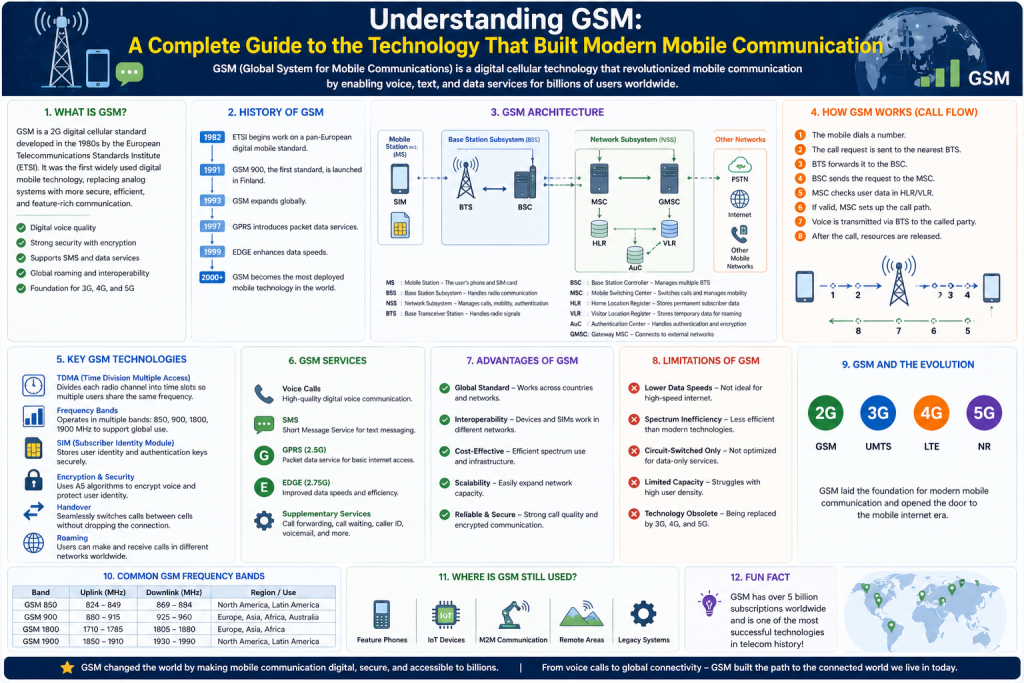
Global System for Mobile Communications, commonly known as GSM, is a widely used standard that enables mobile phones to function across different networks and countries. It was developed to solve one of the earliest challenges in mobile communication: incompatibility between systems. In the early days of mobile technology, different countries and regions built their own independent networks, which meant that mobile devices could not operate outside their original service areas. This lack of standardization created major limitations for users, especially travelers.
GSM addressed this issue by introducing a unified and standardized approach to mobile communication. It allowed devices to communicate seamlessly across borders, making international roaming possible. This innovation transformed mobile communication from a localized service into a global system. As a result, GSM quickly became the dominant standard worldwide and played a crucial role in shaping the modern telecommunications landscape.
Another defining feature of GSM is its approach to security. It introduced authentication processes and encryption techniques to protect communications. While these features were advanced at the time of their introduction, some of them have become outdated as technology has evolved. Nevertheless, GSM laid the groundwork for secure mobile communication and influenced the development of newer technologies.
Historical Background and Development
The development of GSM began in the early 1980s when European countries recognized the growing problem of incompatible mobile networks. At that time, each country had its own system, which created barriers to communication and limited the potential of mobile technology. To address this issue, a coordinated effort was initiated to create a unified standard.
The initial discussions were led by the European Conference of Postal and Telecommunications Administrations. This organization brought together experts and policymakers to develop a solution that could be adopted across multiple countries. Later, the responsibility for standardization and technical development was transferred to the European Telecommunications Standards Institute. This organization played a key role in refining the GSM specifications and ensuring their successful implementation.
By 1991, GSM services were officially launched. What started as a European initiative quickly gained global acceptance. Countries around the world adopted GSM because of its reliability, flexibility, and compatibility. Over time, it became the most widely used mobile communication standard, connecting millions of users across different regions.
The success of GSM can be attributed to its collaborative development process. By involving multiple stakeholders and creating an open standard, GSM encouraged innovation and competition. This approach allowed manufacturers to develop compatible devices and infrastructure, leading to rapid growth and widespread adoption.
Key Features of GSM
GSM introduced several important features that set it apart from earlier mobile communication systems. One of the most significant innovations was the use of SIM cards. A SIM card stores user information and allows individuals to switch devices without changing their phone number or service provider. This flexibility made GSM more user-friendly and convenient.
Another important feature is international roaming. GSM networks are designed to work together, allowing users to access services in different countries. This capability made GSM particularly attractive to travelers and businesses operating across borders.
GSM also introduced digital communication, replacing the analog systems used in earlier networks. Digital technology improved call quality, increased network capacity, and enabled additional services such as text messaging. It also made it possible to implement encryption and authentication mechanisms, enhancing the security of communications.
The open nature of GSM standards encouraged competition among manufacturers. Companies could develop their own devices and equipment as long as they followed the established guidelines. This led to a diverse range of products and helped reduce costs, making mobile communication more accessible to a wider audience.
GSM Network Architecture Overview
The GSM network is designed as a complex system with multiple components working together to provide seamless communication. It is divided into different subsystems, each responsible for specific functions. The two primary subsystems are the Base Station Subsystem and the Network Switching Subsystem.
This division allows GSM networks to manage both the physical transmission of signals and the logical routing of communication. By separating these functions, the system can operate more efficiently and handle large volumes of traffic.
Understanding the architecture of GSM is essential for anyone involved in telecommunications. It provides insight into how mobile networks operate and how different components interact to deliver services.
Base Station Subsystem
The Base Station Subsystem is responsible for handling all radio communication between mobile devices and the network. It acts as the interface between users and the broader telecommunications infrastructure. This subsystem includes several key components that work together to ensure reliable signal transmission.
One of the main components is the Base Transceiver Station. These are the cell towers that communicate directly with mobile devices. They transmit and receive radio signals, enabling phones to connect to the network. The placement of these towers is critical, as it determines the coverage area and signal strength.
Another important component is the Base Station Controller. This element manages multiple transceiver stations and coordinates their activities. It allocates resources, controls handovers between cells, and ensures efficient use of network capacity.
Voice codecs are also part of the Base Station Subsystem. These technologies convert voice signals into digital data that can be transmitted over the network. By compressing and encoding the data, codecs help optimize bandwidth usage and maintain call quality.
The Base Station Subsystem plays a vital role in ensuring that users can connect to the network and communicate effectively. Its performance directly impacts the quality of service experienced by users.
Network Switching Subsystem
The Network Switching Subsystem is responsible for managing the core operations of the GSM network. It handles call routing, data management, and connectivity with other networks. This subsystem ensures that communication reaches its intended destination efficiently.
One of the key components of this subsystem is the switching system. It directs calls and messages to the correct recipients by analyzing routing information. This process happens quickly and seamlessly, allowing users to communicate without noticeable delays.
The subsystem also includes location registers that track the movement of mobile devices. As users move between different areas, the network updates their location information to ensure that calls and messages are delivered correctly. This capability is essential for maintaining connectivity in a mobile environment.
Gateways are another important part of the Network Switching Subsystem. They connect GSM networks to external systems, such as landline networks and other mobile carriers. This allows users to communicate with people on different types of networks.
Overall, the Network Switching Subsystem acts as the brain of the GSM network, coordinating various functions and ensuring smooth operation.
How GSM Enables Communication
GSM enables communication through a series of coordinated steps that occur almost instantly. When a user initiates a call or sends a message, the mobile device first connects to the nearest cell tower. This connection is established through radio signals managed by the Base Station Subsystem.
Once the signal reaches the network, it is processed by the Network Switching Subsystem. The system identifies the destination and determines the best route for the communication. It then directs the signal through the network until it reaches the recipient.
If the recipient is on a different network, the system uses gateways to establish a connection. This ensures that communication can occur across different platforms and technologies. The entire process is designed to be efficient and reliable, providing users with a seamless experience.
Advantages of GSM
GSM offers several advantages that contributed to its widespread adoption. One of the most important benefits is its global compatibility. Users can travel to different countries and still use their mobile devices without any issues.
Another advantage is flexibility. The use of SIM cards allows users to switch devices or service providers. This gives consumers more control over their mobile experience.
GSM also supports a wide range of services, including voice calls, text messaging, and basic data communication. This versatility made it a comprehensive solution for mobile communication needs.
Cost-effectiveness is another key benefit. The open standard encouraged competition among manufacturers, leading to lower prices for devices and services. This made mobile communication accessible to a larger population.
GSM in the Modern World
Although newer technologies such as 4G and 5G have largely replaced GSM in many developed regions, it still plays an important role in the modern world. In many developing areas, GSM remains the primary means of communication due to its affordability and established infrastructure.
GSM is also widely used in machine-to-machine communication and Internet of Things applications. Its reliability and low power requirements make it suitable for devices that need to operate over long periods with minimal maintenance.
In addition, many legacy systems and older devices still rely on GSM networks. These systems may not be compatible with newer technologies, making GSM an essential part of the telecommunications ecosystem.
GSM Equipment Installation and Deployment
Installing a GSM network is a complex process that requires careful planning, precise execution, and continuous evaluation. Unlike simple communication setups, GSM infrastructure must support thousands or even millions of users simultaneously while maintaining reliable connectivity. A poorly designed or incorrectly installed system can lead to weak coverage, dropped calls, and security issues.
The installation process is not just about placing equipment in the field. It involves understanding the environment, predicting user behavior, and ensuring that every component works together efficiently. From selecting the right locations for towers to configuring power systems and testing performance, each step plays a critical role in the overall success of the network.
A well-installed GSM network provides consistent coverage, handles traffic effectively, and adapts to changing demands over time. This requires a combination of technical knowledge, strategic planning, and practical experience.
Planning a GSM Network Deployment
Before any physical installation begins, detailed planning is essential. This stage determines how well the network will perform once it is operational. Engineers must analyze various factors to design a system that meets current needs while allowing room for future growth.
One of the first considerations is population density. Areas with high population concentrations require more base stations to handle increased traffic. In contrast, rural areas may need fewer stations but must cover larger geographic regions. Understanding these differences helps in determining the number and placement of network components.
Usage patterns also play an important role. Business districts typically experience high network activity during working hours, while residential areas see more usage in the evenings. Events such as concerts, sports matches, and festivals can create temporary spikes in demand. Planning for these variations ensures that the network remains stable under different conditions.
Another critical aspect is capacity planning. Engineers often include additional capacity beyond current requirements to accommodate future growth. This extra headroom helps prevent congestion and reduces the need for frequent upgrades.
Environmental factors must also be considered. Terrain, weather conditions, and physical obstacles can affect signal propagation. Mountains, buildings, and dense vegetation can weaken or block signals, requiring adjustments in tower placement and antenna orientation.
Essential Hardware Components
A GSM network relies on a variety of hardware components, each serving a specific function. Selecting high-quality equipment and ensuring proper installation are key to achieving reliable performance.
Base Station Equipment
Base stations form the backbone of the GSM network. They include transceivers, controllers, and supporting systems that enable communication between mobile devices and the network. These stations must be equipped with reliable power sources, as any interruption can disrupt service.
Redundant power systems are often used to ensure continuous operation. Battery backups provide immediate support during power outages, while generators can sustain the system during extended disruptions. This layered approach minimizes downtime and enhances reliability.
Environmental control systems are also necessary. Equipment must be protected from extreme temperatures, humidity, and dust. Air conditioning and ventilation systems help maintain optimal operating conditions, preventing overheating and damage.
Security is another important consideration. Base stations should be housed in secure enclosures to prevent unauthorized access and tampering. Physical security measures such as locks, surveillance systems, and alarms are commonly used.
Antenna Systems
Antennas are responsible for transmitting and receiving radio signals. Their placement and alignment directly impact the quality of coverage. To achieve optimal performance, antennas must have a clear line of sight to the target area.
Mounting hardware must be strong and durable to withstand environmental stress. Materials such as stainless steel or galvanized metal are often used to resist corrosion. Proper alignment tools are required to ensure accurate positioning, as even small deviations can affect signal quality.
Weather protection is essential for antenna systems. Exposure to rain, wind, and temperature fluctuations can degrade performance over time. Protective measures such as waterproofing and sealing help extend the lifespan of the equipment.
Site Selection and Placement
Choosing the right locations for GSM infrastructure is one of the most critical aspects of deployment. The effectiveness of the network depends largely on where base stations and antennas are installed.
Highs such as towers, rooftops, and elevators are ideal for maximizing coverage. These locations allow signals to travel further and reduce interference from obstacles. However, accessibility must also be considered. Technicians need to reach these sites for maintenance and repairs.
Urban areas present unique challenges. Buildings can block or reflect signals, creating weak coverage. In such cases, additional base stations or cells may be required to fill gaps. Careful planning helps ensure consistent service across densely populated areas.
In rural areas, the focus is on covering large distances with fewer stations. This requires strategic placement to maximize reach while maintaining acceptable signal quality. Balancing coverage and cost is a key challenge in these environments.
Power Infrastructure and Reliability
A stable power supply is essential for GSM network operation. Without reliable power, even the most advanced equipment cannot function effectively. Power infrastructure must be designed with redundancy and resilience in mind.
Commercial power is typically the primary source. However, it is often supplemented with backup systems to handle interruptions. Battery backups provide immediate support during short outages, ensuring that continues without interruption.
Generators are used for longer outages. These systems can operate the network for extended periods, depending on fuel availability. Automatic transfer switches are used to seamlessly transition between power sources, minimizing downtime.
Grounding systems are also important. They protect equipment from electrical surges and lightning strikes. Proper grounding reduces the risk of damage and enhances overall safety.
Installation Process
The physical installation of GSM equipment involves several requirements, each requiring careful execution. which includes clearing the area, setting up foundations, and ensuring that all necessary infrastructure is in place.
Mounting the base station equipment is a critical step. The structure must be stable and capable of supporting the weight of the equipment. It should also be designed to withstand environmental stress such as wind and vibration.
Antenna installation requires precision. Technicians must align the antennas correctly to achieve the desired coverage pattern. Specialized tools are used to measure زاوية and orientation, ensuring accurate placement.
Cabling and connections must be handled carefully. Loose or improperly connected cables can lead to signal loss and performance issues. Proper insulation and protection are necessary to prevent damage from environmental factors.
Environmental Considerations
GSM equipment is often exposed to harsh environmental conditions، protective measures are necessary to ensure long-term reliability. Temperature control is essential, as extreme heat or cold can affect
Humidity and moisture can cause corrosion and damage electronic components. Sealed enclosures and waterproofing techniques help prevent these issues. In coastal areas, salt can accelerate corrosion, requiring additional protective measures.
Wind and physical stress must also be considered. Mounting systems should be designed to withstand strong winds and other environmental forces. Regular inspections help identify potential problems before they become serious.
Testing and Verification
Once the installation is complete, thorough testing is required to ensure that the network operates as intended. Each component is tested individually and as part of the overall system.
Drive testing is used to measure coverage across different areas. Technicians travel through the coverage zone while monitoring signal strength and quality. This helps identify gaps and weak signals.
Walk testing is performed indoors to evaluate performance buildings. This is important for ensuring that users receive adequate coverage in offices, homes, and other enclosed spaces.
Load testing evaluates the network’s ability to handle traffic. By simulating high usage conditions, engineers can determine whether the system can support peak demand. This helps prevent congestion and service degradation.
Interference testing is also important. It identifies potential sources of signal disruption, allowing engineers to make necessary adjustments. Reducing interference improves overall network performance.
Security testing verifies that encryption and authentication mechanisms are functioning correctly. This ensures that communications are protected and that unauthorized access is prevented.
Performance Evaluation
After testing, the results are analyzed to network performance. Coverage maps are created to visualize signal strength across th. These maps help identify areas that
Call quality is another important metric. Engineers evaluate clarity under different conditions to ensure a satisfactory user experience. Data performance is also tested, especially in networks that support internet connectivity.
Capacity analysis determines whether the network can handle current and future demand. If issues are identified, adjustments can be made to improve performance.
Challenges in GSM Deployment
Deploying a GSM network comes with several challenges. One of the main difficulties is balancing coverage and cost. Installing more base stations improves coverage but increases expenses. Engineers must find the right balance to achieve efficient operation.
Interference from other networks can also pose problems. Proper frequency planning and coordination are necessary to minimize conflicts. Failure to address interference can lead to degraded performance.
Environmental factors such as terrain and weather can complicate installation. Adapting to these conditions requires careful planning and specialized equipment.
Security is another concern. Protecting the network from unauthorized access and potential threats is essential for maintaining trust and reliability.
Introduction to GSM Configuration
After the physical installation of a GSM network is complete, the next critical phase is configuration. This stage ensures that all network components operate together in a coordinated and efficient manner. Configuration involves setting parameters, defining communication rules, and enabling the systems that control how calls and data are handled.
Unlike installation, which focuses on hardware, configuration is primarily concerned with software and system behavior. Engineers must carefully adjust settings to match the network’s design goals and real-world conditions. Even small misconfigurations can lead to performance issues such as dropped calls, interference, or inefficient use of resources.
Modern GSM systems often use digital tools and interfaces to simplify configuration. However, the underlying principles remain rooted in traditional telecommunications concepts, including circuit switching and signaling protocols. Understanding these principles is essential for building a reliable and efficient network.
Basic Network Setup
The basic setup of a GSM network begins with defining how different components communicate with each other. This includes assigning frequencies, setting power levels, and establishing timing synchronization across the network.
Frequency planning is one of the most important aspects of this process. Each cell in the network must operate on specific frequencies that do not interfere with neighboring cells or other networks. Careful planning ensures that signals remain clear and that users experience consistent service quality.
Power levels must also be configured correctly. If transmission power is too high, it can cause interference with nearby cells. If it is too low, coverage gaps may occur. Engineers must find the right balance to achieve optimal performance.
Timing synchronization ensures that all parts of the network operate in harmony. This is particularly important in GSM systems, where precise timing is required for signal transmission and reception. Proper synchronization reduces errors and improves overall efficiency.
Traffic routing is another key element. The network must determine how calls and data are directed from one point to another. Efficient routing minimizes delays and ensures that resources are used effectively.
Security Configuration
Security is a fundamental aspect of GSM networks. While the original GSM standard introduced important security features, modern networks require additional measures to address evolving threats.In the early days, GSM security was considered advanced because it included mechanisms for user authentication and encryption of voice data over the air. These features were designed to prevent unauthorized access and protect user privacy. However, as technology has progressed, attackers have developed more sophisticated methods to exploit weaknesses in older systems.
One of the primary challenges in GSM security is the reliance on legacy encryption algorithms. Some older encryption methods are no longer considered secure because they can be broken with modern computing power. As a result, network operators must upgrade to stronger encryption techniques and ensure that outdated protocols are no longer in use. This transition is not always simple, especially in regions where older infrastructure is still widely deployed.
Another important consideration is network authentication. GSM originally focused on authenticating the user to the network, but it did not always verify the authenticity of the network itself. This limitation can make it possible for attackers to set up fake base stations that trick devices into connecting. Modern security improvements aim to address this issue by introducing mutual authentication, where both the device and the network verify each other.
In addition to encryption and authentication, monitoring plays a critical role in maintaining security. Network operators must continuously analyze traffic patterns to detect unusual behavior. Suspicious activities such as repeated login failures, abnormal data usage, or unexpected connection requests can indicate potential security threats.
Regular software updates and security patches are also essential. These updates fix known vulnerabilities and improve overall system resilience. Without timely updates, networks remain exposed to risks that could compromise user data and service reliability.
Authentication is the first line of defense. It verifies that a device is authorized to access the network. This process typically involves validating the SIM card, checking device identity, and confirming credentials through network protocols.
Encryption is used to protect communication from unauthorized access. GSM supports several encryption algorithms, each offering different levels of security. Stronger encryption methods provide better protection but may require more processing power.
Fraud detection systems are also an important part of security configuration. These systems monitor network activity for unusual patterns that may indicate unauthorized use or attacks. Early detection helps prevent potential damage and ensures the integrity of the network.
Regular monitoring and updates are necessary to maintain security. As new vulnerabilities are discovered, networks must adapt by implementing improved protection mechanisms.
Performance Optimization
Once the network is configured, continuous optimization is required to maintain high performance. Optimization involves analyzing network behavior and making adjustments to improve efficiency and user experience.
One of the key areas of optimization is power control. Adjusting transmission power helps reduce interference and improve signal quality. Dynamic power control allows the network to adapt to changing conditions in real time.
Handover management is another critical aspect. As users move between cells, the network must transfer their connection seamlessly. Proper handover configuration ensures that calls are not dropped during this process.
Load balancing is used to distribute traffic evenly across the network. By preventing any single cell from becoming overloaded, the network can maintain consistent performance even during peak usage.
Optimization also includes improving voice quality and data performance. Engineers analyze metrics such as call clarity, latency, and throughput to identify areas for improvement.
Monitoring and Maintenance
Ongoing monitoring is essential for maintaining a GSM network. Modern systems generate large amounts of data that provide insights into network performance. By analyzing this data, engineers can identify issues and take corrective action.
Key performance indicators include call completion rates, voice quality, authentication success rates, and network congestion levels. Monitoring these metrics helps ensure that the network operates within acceptable limits.
Maintenance activities include regular inspections, software updates, and hardware checks. Preventive maintenance helps identify potential problems before they affect users.
Software updates are particularly important. They can fix bugs, improve performance, and enhance security. However, updates must be carefully planned and tested to avoid introducing new issues.
Scheduling maintenance during low-traffic periods minimizes disruption to users. This approach ensures that the network remains available when it is needed most.
Troubleshooting GSM Networks
Despite careful planning and optimization, issues can still arise in GSM networks. Troubleshooting is the process of identifying and resolving these problems.
A systematic approach is essential for effective troubleshooting. Engineers typically start at the physical layer and work their way up through the network. This method helps isolate the root cause of the problem.
Common physical issues include loose connections, damaged equipment, and power failures. These problems can often be resolved quickly with proper inspection and repair.
Network-level issues may involve interference, capacity limitations, or routing errors. These problems require more detailed analysis and may involve adjusting configuration settings.
Authentication failures and security issues can also occur. These problems must be addressed promptly to maintain network integrity and protect user data.
Effective troubleshooting requires both technical knowledge and practical experience. By following a structured approach, engineers can resolve issues efficiently and restore normal operation. In GSM networks, where multiple systems interact simultaneously, even a small fault can impact a large number of users. This makes it essential to approach problems methodically rather than relying on guesswork.
The first step in troubleshooting is identifying and clearly defining the problem. Engineers need to gather detailed information, including error reports, user complaints, and system logs. Understanding the scope of the issue—whether it affects a single user, a specific cell, or the entire network—helps narrow down possible causes. Without accurate problem identification, efforts may be wasted on irrelevant areas.
After defining the issue, engineers move on to isolating the source. This is typically done by analyzing the network layer by layer. Starting from the physical layer, they check hardware components such as antennas, cables, and power systems. If no faults are found, they proceed to higher layers, including configuration settings, routing systems, and software processes. This step-by-step approach ensures that no potential cause is overlooked.
Using diagnostic tools is crucial during this phase. GSM networks generate extensive data that can reveal patterns and anomalies. Performance monitoring systems provide insights into signal strength, call drop rates, and network congestion. By carefully examining this data, engineers can identify irregular behavior and trace it back to its source.
Practical experience plays a major role in speeding up the troubleshooting process. Experienced engineers often recognize familiar patterns and can quickly predict likely causes based on previous incidents. This intuition, combined with technical analysis, leads to faster and more accurate solutions.
Once the root cause is identified, corrective actions are implemented. These may include repairing or replacing faulty equipment, updating software, or adjusting network parameters such as frequency allocation or handover thresholds. After applying the fix, thorough testing is necessary to confirm that the issue has been resolved and that no new problems have been introduced.
Finally, documenting the entire troubleshooting process is essential. Keeping records of issues, solutions, and outcomes helps build a valuable knowledge base. This documentation can be used for training, future reference, and improving overall network reliability.
Evolution of GSM Technology
GSM has undergone significant evolution since its introduction. While it was originally designed for voice communication, it has been adapted to support data services and other applications.
Technologies such as General Packet Radio Service and Enhanced Data rates for GSM Evolution extended the capabilities of GSM networks. These enhancements allowed users to access the internet and use data-based services.
Despite these advancements, GSM is gradually being replaced by newer technologies such as 4G and 5G. These systems offer higher speeds, greater capacity, and improved efficiency.
However, GSM continues to play an important role in many parts of the world. Its widespread infrastructure and low تكلفة make it a practical choice for certain applications.
GSM in Modern Applications
Even as newer technologies emerge, GSM remains relevant in several areas. One of the most significant is the Internet of Things. Many IoT devices rely on GSM for connectivity its reliability and low power requirements.
Remote and rural areas also on GSM networks. In these regions, the cost of deploying newer technologies may be too high, making GSM a more viable option.
Legacy systems and devices continue to use GSM as well. These systems may not be compatible with newer networks, requiring ongoing support for GSM infrastructure.
In addition, GSM serves as a backup communication system in some Its simplicity and reliability make it a useful fallback option when other networks are unavailable.
Future Outlook
The future of GSM is shaped by the ongoing evolution of telecommunications technology. While its role is changing, it is unlikely to disappear completely in the near term.
Many operators are gradually phasing out GSM networks to free up spectrum for newer technologies. This process is happening at different speeds in different regions, depending on demand and infrastructure.
At the same time, GSM continues to support critical applications. Its established presence and proven reliability ensure that it remains part of the telecommunications landscape.
The knowledge gained from GSM development continues to influence modern systems. Concepts such as frequency management, network optimization, and security remain relevant in newer technologies.GSM was one of the first large-scale digital mobile communication systems, and the lessons learned from its design and operation have shaped the evolution of wireless networks over the years.
Frequency management remains a critical aspect of all mobile communication systems. GSM introduced organized methods for assigning and reusing frequencies across different cells to reduce interference and improve efficiency. These principles are still applied today, although in more advanced forms. Modern networks use dynamic spectrum allocation and intelligent algorithms, but they are built on the same foundational ideas established during GSM development.
Network optimization is another area where GSM has had a lasting impact. Early GSM networks required careful tuning of parameters such as transmission power, cell coverage, and handover thresholds. These practices helped ensure stable connections and good call quality. In modern systems, optimization has become more automated and data-driven, but it still relies on the same core of maximizing performance while minimizing resource usage.
Security concepts introduced in GSM also continue to play an important role. GSM was among the first technologies to implement user authentication and encrypted communication in mobile networks. Although some of its original encryption methods are now outdated, the basics of protecting user identity and data remain essential. Newer technologies have expanded on these ideas with stronger encryption protocols and more advanced authentication techniques.
Additionally, GSM helped establish the importance of standardization and interoperability. By creating a common framework that different manufacturers could follow, it enabled devices and networks to work together seamlessly. This approach continues to guide the development of modern communication technologies, ensuring compatibility and encouraging innovation across the global telecommunications industry.
Conclusion
GSM has played a transformative role in the history of mobile communication. From its origins as a solution to incompatible networks, it grew into a global standard that connected millions of users worldwide. Its introduction of digital communication, SIM-based identity, and international roaming changed how people interact and communicate.
The configuration, optimization, and maintenance of GSM networks demonstrate the complexity of modern telecommunications systems. Each stage requires careful planning, technical expertise, and continuous improvement to ensure reliable performance.
Although newer technologies have taken the lead in many regions, GSM remains an important part of the global communication ecosystem. It continues to serve developing areas, support IoT applications, and provide connectivity for legacy systems.
Understanding GSM provides valuable insights into the principles that underpin all wireless communication technologies. Its legacy continues to shape telecommunications, making it an essential topic for anyone interested in networking and mobile systems.
Continue exploring the technologies and certification concepts that matter most to you.